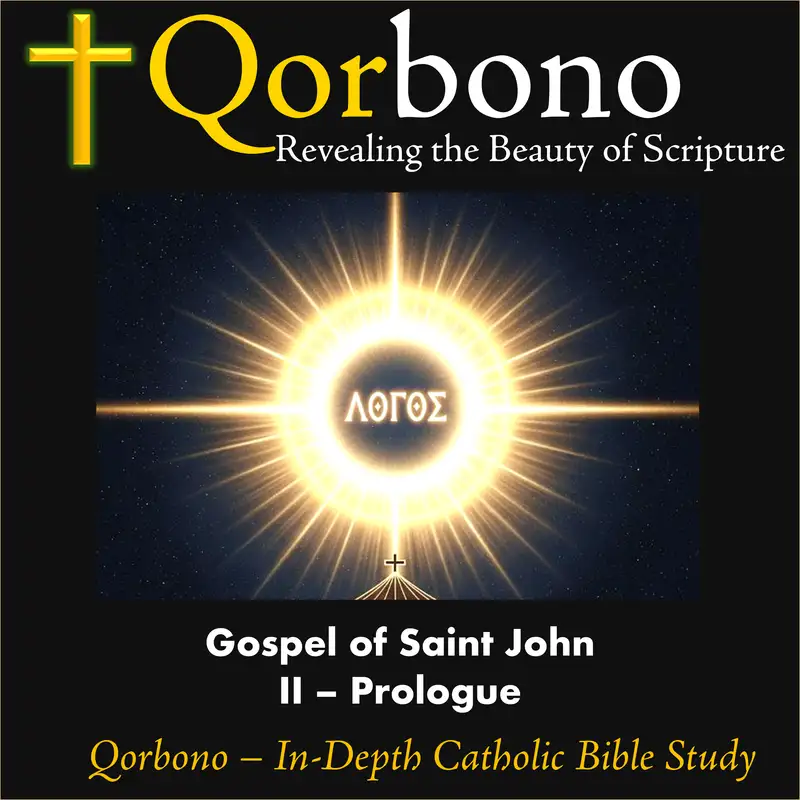
02 - Prologue
00:00
So this is the second lecture on the Gospel of Saint John. And before we begin, I'd like you guys to give Boris a shout. Boris is the gentleman right behind you who is... Thank you.
00:18
So Boris takes care of the live streaming. He does the post editing to make those videos available. He does all that out of his own free time. And I would suggest you go check his, uh this page, newce.org slash Corbono. And then if you're so inclined to help him with the fray, all the costs that he incurs, you can donate at his website. Really appreciate that. Thank you very much.
00:49
We started last time with the foundation. Today we're going to dive into the prologue, which is the first part of the Gospel of St. John. How many of you joining us for the first time tonight? All right. I do suggest that you check out the earlier talk because it lays out some principles we're going to use for the study. It would be helpful. You can do so either by going to Corbono or newce.org where you can find a talk.
01:18
Like I said, it was recorded. um And we're going to dive into the prologue tonight. So far, we've covered content and intent. By content, I mean what is the text all about? What is the Gospel of St. John all about? And what was the intent of the author? We spoke quite a bit about that last time. We talked about some biblical interpretive principles, which you can also find in the catechism.
01:46
And then we introduced the very foundational notion of the covenant. Now, don't worry, I'm going to be repeating those throughout the whole lecture and hopefully this lecture and the study and hopefully they'll become um something you remember and you understand very well. So if you haven't seen those before, don't worry too much. We're going to cover them as we go. Today, we're going to cover five topics.
02:16
We talk about the heart of the matter. I do want you to understand at the outset what I think the Gospel of St. John is all about. I'm to lay it out in that section. Then we're going to dive into the prologue, which is John chapter 1, verse 1 through 18. And there we're going to deal with the Trinitarian theology, the notion of a herald and a king, the tabernacle of flesh, and then do some conclusion. Forget this addendum.
02:46
Leftover from last time, I should have taken out and I forgot. Apologies. Please silence your phones if possible. I appreciate that. Thank you.
02:57
You're always welcome to phone your questions if you are so inclined to do so. You can at this time grab this QR code and that will allow you to submit questions anonymously as well as submit questions throughout the study. If you don't want to do that, that's fine. You can do it also at the end. There's always a Q &A session. This is just in case you feel like doing it as the lecture goes. I'll take questions towards the end. So I'll give you a moment to grab that before we continue.
03:33
And I do encourage you to ask questions. There are no irrelevant questions. If you have a question, you can be assured other people around you have it. So please, I encourage you to share your thoughts and ask questions. Thank you. All right.
03:58
Please stand, we'll start with prayer. In the name of the Father, of the Son, of the Holy Spirit, amen. Together. Come Holy Spirit, fill the hearts of your faithful and kindle in them the fire of your love. Send forth your spirit and they shall be created and you shall renew the face of the earth. Oh God, who by the light of the Holy Spirit did instruct the hearts of the faithful, grant that by the same Holy Spirit,
04:28
We may be truly wise and ever enjoy His consolations. Through Christ our Lord, Amen. Our Lady, Seat of Wisdom. Saint Joseph. Saint Michael. All ye angels and saints. In the of the Father, the Son, of the Holy Spirit, Amen. Please be seated. Thank you.
04:49
So, the heart of the matter. As you can see, it's a covenantal centric study. My contention, my thesis is that the Gospel of St. John is part one of the introduction of Jesus Christ as the strong party, the creator, the ruler of the world.
05:20
In the Gospel, he introduces Jesus Christ and shows us how he establishes his kingdom. And part two is in the book of Revelation, where he shows us how Christ, the King of Kings, rules over the world perennially. And that is the complete picture that St. John wished to draw for us. That is my contention. That's what I want to present to you.
05:50
And I think that the text, the data, bears that contention, that theory. If it doesn't, you'll be the judge.
06:06
So.
06:08
It's a coherent whole. I don't ascribe to the thesis that, by the way, the majority of modern theologians ascribe to, that the Gospel of St. John is written by some community a hundred years after, I mean, a hundred B. A.D. And then there were an initial write-up and some other editors came and added stuff. I don't believe
06:37
that the Gospel was a Frankenstein construction by some community. And I hope to prove to you that there is a coherence to the entire text that shows you it is one author and it is the Apostle John and no one else.
06:54
I want to show you that what St. John wants us to understand is that God establishes the new covenant to replace a broken one. One that didn't work really well and he knew all along that it didn't work really well.
07:14
God wishes to give us a full revelation of who He is, the inner life of the Trinity, and His presence in the Incarnation.
07:26
After the prologue, we're going to go through the second section called the seven signs. In the Gospel of St. John, you'll not see the word miracle. You'll only see the word sign. And there are seven of them. Incidentally,
07:45
What is covenant in Hebrew? How do you say you make a covenant in Hebrew? It's actually an expression. To make a covenant is to seven oneself.
07:59
That's why God created the world in six days and rested on the seventh. He was establishing a covenant. Whenever you see seven, covenant.
08:11
There seven signs. What are those signs? I am going to show you that those seven signs, each one of them is a direct assault on the Old Covenant.
08:24
This is not a peaceful introduction. This is war.
08:32
That is the seven signs that Jesus Christ is going to perform. And after effectively taking over, taking out his enemies, we go into the Book of Glory, which is the institution of the Eucharist, and establishing his kingdom. That's the Gospel of St. John.
08:52
He prepares and institutes a new covenant in the upper room and at the cross and there's a decisive battle where he defeats Satan not with worldly weapons but through the sacrifice of the Lamb on the cross. It's a war. This is battle. This is someone who's coming to conquer. Anyone who lived in ancient times would have understood this text, would have decrypted this text according to the structure of covenant because this is how kings communicated their authority and their power and their glory.
09:25
just as if I say to you today, second amendment.
09:33
That expression brings with it a whole context that you have in mind, that you understand, that you live.
09:45
A thousand years have gone and our understanding of scripture has been modified. Because more often than not, you will not hear about the covenant. You'll hear that Jesus is a nice guy.
10:04
that God the Father is Santa Claus and the Holy Spirit is a pigeon.
10:17
that's not what the scripture says
10:22
And then there is the eternal reign where he rules the world from the throne, leading us to heavenly Jerusalem. And that is the book of Revelation.
10:30
That's my contention. That's my... um
10:36
understanding of the Gospel of Saint John and I'm going to walk you through this. In the Gospel, Jesus is the Lamb of God who is sacrificed, that's in John chapter 1 verse 29. In Revelation, is the Lamb who was slain, who now stands as the King of Kings. Revelation chapter 5 verse 6. Same imagery brought into both books to remind us of Christ. That's the link. The image of the Lamb is the link between the two.
11:06
The seven signs in the Gospel, water to wine, healing the blind, etc. are the medicinal cures for a world under the curse. And then what do you have in the book of Revelation? Seven seals.
11:22
See that? The structure is pretty much the same. But the difference, the seven seals and the seven trumpets, are the final shaking of the earth to remove what is old and establish what is eternal.
11:35
There's a continuity and a coherence in the text that tells you it's a vision of one man who fully understood after a while what was the eternal plan of God beginning to end. You really have two theological geniuses among the apostles. You have Saint Paul and you have Saint John.
12:00
In the tradition of the church, particularly the writings of St. Jerome and St. Augustine, the four evangelists are identified with the four living creatures of Ezekiel in Revelation. And then while the others remain on Earth, the man, the lion, and the ox, which is identified with the three synoptics, St. John is identified with the eagle because he immediately takes flight into the height of the godhead. And that's why you see in the intro this image of the eagle being repeated.
12:29
But the reason why St. John is doing it isn't because he is interested, particularly in himself. He was facing a specific situation and he was addressing it. St. John, when he wrote this Gospel, wasn't thinking, aha, some 2,000 years later, a bunch of people are going to gather in a country I've never seen using a language I've never heard to talk about me. That was not what was on his mind. He had a specific...
12:57
concern at hand that he had to address, which was, who is Christ and why is he important? There was already a conflict during his time over the identity of Jesus versus that of St. John the Baptist. And that's what he set out to address.
13:24
So this is, they call it a spiritual gospel because it focuses on Christ, on the Trinity, if you will. But I personally don't like that. I've covered St. Luke in one of the prior studies, and to say that the gospel of St. John is more spiritual than gospel of St. Luke is nonsensical. I suppose what we should say is that the gospel of St. John,
13:54
is more trinitarian than the other ones. I think that would be appropriate. The three other gospels will hint to the Trinity, but none of them touch upon the substance of the Trinity, what the Trinity is. St. John does. In that sense, yes. But more spiritual? Not sure.
14:14
It's the eagle's gaze, just as an eagle is said to be the only creature that can look directly into the sun without being blinded. I've learned that, I didn't know that. St. John looks directly into the light of light, the divinity of the Word, and he basically is bringing to us the nature of the Trinity. It's also a kingly perspective.
14:37
Because we're not looking at a man performing miracles, we're looking at the strong party establishing his kingdom.
14:49
And it's call to ascension. The goal of Saint John is to pull us up. He wants us to see the world from a Trinitarian perspective, from the way that Trinity sees it.
15:06
My purpose in doing Bible studies isn't to form theologians.
15:12
I'm not a theologian. I'm just a regular guy.
15:17
My purpose in doing Bible studies isn't to make you specialists of the Scripture. Guess who is one of the greatest specialists of the Scriptures?
15:30
Go ahead. I want to hear your guesses. Aquinas. There's someone greater than him.
15:41
Raise your
15:48
St. Augustine, yes, or Augustine as you say. But there is one who is greater than them all. Well, Jesus is the author, you're right, but setting aside our dear Lord, St. Jerome is great, thank you for suggesting that, but is someone greater than them all? Greater than St. Paul, as far as being a specialist of the scripture. His name is Satan.
16:15
No one knows Scripture in and out, back and forth like Satan. In fact, when he tempted our Lord, what did he do? He quoted Scripture. Not trying to make you specialist of Scriptures. No. We're studying Scriptures so we can learn about ourselves.
16:33
so we can become better followers of Christ. That's what we're doing here.
16:40
Alright, let's get into the prologue.
16:45
John chapter 1, verse 1 through 18, split into three parts. 1 through 5 is Trinitarian, 6 through 14 is about the herald and the king, and then 15 through 18 is the tabernacle of flesh. That structure is covenantal. In the old times, when a king is set to conquer a city, before they go to war against the city, they introduce the king. They say, this is who he is, this is his origin, this is his background.
17:15
This is what he did. He's the strong party.
17:19
and you, the city, have a choice to make. You can submit to the king, become basically his servants, because you're the weak party, and if you do so and remain faithful to the king, the king will bless you. But if you betray the king or try to get into some shenanigans against him, he will curse you.
17:45
Blessings and curses are part of the covenant and as part of the structure.
17:52
One person in particular who will go to introduce the king, because the king will not come himself to do this introduction, is the herald. The king will send a herald. The word herald in Assyrian and then in Babylonian is malak. The same word we use for angel. So who is Saint John? He is the herald.
18:16
You can see the whole structure unfolding. And then finally, there is the coming of the king. There is the Trinitarian version where he is up and high and then him becoming man. So that's what the prologue is all about. This is his wrong party. He was with God. He sent his herald and now he's among us. This is it. Anyone living in ancient times would have read this and said, oh yeah, we get it.
18:45
It's like if you receive a letter from the IRS. It follows a specific structure.
18:53
You would get it. That's what this is about.
19:01
So the Logos, the architect of the first covenant, enters into his creation to restore the broken bond and elevate us to divine sonship. To see that Jesus is not just a teacher, but the eternal word who pitched his tent among us to bring us home. This is not just a teacher. This is not just a shepherd. I particularly don't like these romantic images of Jesus walking with a sheep on his foot. There's nothing particularly wrong with it, but it...
19:31
It is blocking you from seeing the King. And you can never lose sight of the fact that he is King.
19:41
You can't never lose sight of the fact that it is Jesus Christ who one day will consign you to hell or receive you in heaven. You can't send yourself to hell. It isn't your actions that get you into hell. No more so than you can get yourself in heaven. It is his judgment.
20:05
He's the king.
20:08
So there's anything you should never lose sight of is Jesus Christ as King.
20:17
Now, here is the Gospel. This is the Revised Standard Version Catholic Edition. You might be using the New American Version, which tends to be friendlier, but this tends to be closer. It's drier, but it's closer to the original. This is why I always refer back to it. So if you don't recognize this translation, this is why. In the beginning was the Word, and the Word was with God, and the Word was God. He was in the beginning with God.
20:44
all the things were made through him and without him, not anything made that was made. In him was life and the life was the light of men. The light shines in the darkness and the darkness has not overcome it." This is the introduction of the King.
21:01
If you read a text like this, when you open a book, you have to ask yourself this question, why is the author intent on starting this way? There is a reason for it.
21:15
I mean, he didn't sit randomly one day and started writing. He had a purpose. What is the purpose? That's what you need to ask yourself. This question.
21:28
Why did he start with this? Why in the beginning? We'll get to that in a minute. I just want you to, I want to alert you to how you basically have to read Scripture. You have to read it thinking about the purpose, the intent that the author, that St. John had in mind when he started writing this. To me, I read this, I've read enough about the covenant, I've read enough covenantal documents, so when I read this it just jumps at me. Yeah, it's a covenantal introduction. By the way, it's the same thing with the Gospel of St. Matthew.
21:57
and the Gospel of St. Luke. Both of them have covenantal introductions. Guess why they start with genealogies? Let me introduce you the Strong Party.
22:11
That's what they're doing. This is how you read ancient covenantal documents that give you genealogies. The king, son of this and son of that, and he did this and that and the other, that is standard fare.
22:25
but we don't have a covenantal understanding anymore so read this text and we're completely befuddled.
22:32
That's why. Saint Mark, not at all. Saint Mark has a completely different purpose. Saint Mark is a disciple of Saint Peter. He's the mouthpiece of Saint Peter. And Saint Peter has a beef for the apostles.
22:48
One of my favorite passages in the entire New Testament is in St. Mark's, when our Lord tells the apostles, beware of the leaven of the Pharisees. And then the apostles assembled and said among themselves, hmm, we have no bread.
23:08
Totally clueless.
23:12
didn't understand a thing. So the Gospel of St. Mark shows us something completely different. How even clueless, confused, men and women can do great things because of Christ.
23:31
That is his purpose. Very different.
23:37
There was a man sent from God whose name was John. There was a man sent from God. Why does he tell you sent from God? Who is God? God is the King. He is the strong party. Sent from God is the expression to say he is the herald. The herald is sent from God.
24:00
He came for testimony to bear witness to the light that all might believe through him. He was not the light, but came to bear witness to the light. A herald bears witness to the king. The true light that enlightens every man was coming into the world. He was in the world and the world was made through him, yet the world knew him not. He came to his own home and his own people received him not. But to all who received him, who believed in his name, he gave power to become children of God.
24:30
who were born not of blood, nor of the will of the flesh, nor of the will of man, but of God." Under this, the undertone here is blessings and the implication is the curses. You see, here are the blessings. Blessing is right here. He gave power to become children of God. That's the blessing.
24:53
And the word became flesh and dwelt among us, full of grace and truth. We have beheld his glory, glory as of the only son from the father. John bore witness to him and cried, this was he of whom I said, he who comes after me ranks before me, for he was before me. And from this his fullness have we all received grace upon grace. For the law was given through Moses, grace and truth came through Jesus Christ. No one has ever seen God, the only son who is in the bosom of the father.
25:22
He has made him known. So this little insertion here, for the law was given through Moses, that is your breakpoint.
25:39
This is what Christ is going to come and topple. Not the law, but the way it was ended up being implemented. All right.
25:50
Let's get into this. In the beginning was the Word, and the Word was with God, and the Word was God. He was in the beginning with God. Why does he start with in the beginning? Everybody will tell you, oh, it's because of Genesis. OK, but what does that mean?
26:06
Why is he quoting something that brings us back to Genesis? Why?
26:15
to establish a new strong party because Genesis is a covenant. It starts with the covenant. God creates the world. He's the strong party. He creates Adam and Eve. Put them in a garden. Right? And by the way, the garden, people think of it as, oh, it was heaven. No, it wasn't. He told Adam, here's the garden, here's the shovel, till and guard. And by the way, it was seven days. There were no Sunday, there were the weekends. There were no vacation.
26:44
That was his duty. And then you can eat from everything, but if you touch this one, you will die. Here's the blessing, here are your curses. Now, we go back to in the beginning. But notice this, in Hebrew, in Hebrew, in the beginning is Bereshit. That's the word, Bereshit. Now, for those of you who understand Aramaic based languages, but even Arabic, you will know right away what Bereshit implies. All you need to do is replace the sh with an s.
27:14
because bir-esh-it in the Lebanese would be bar-ras. Bar-ras means in the head. In English you would say, the one who is at the head of the.
27:30
So Bereshit can mean in the beginning temporarily, that's the second meaning. The first meaning is the one who has power.
27:42
So when he says in the beginning here, he has no intention to go back to a temporal notion of beginning, as it was in Genesis. This is about authority. Who is the first? Who is responsible? Who is in the head? Who is the one who has all authority? In the beginning was, interestingly enough, not God. Notice? Logically, he should have said, in the beginning was God.
28:15
I mean, the sun.
28:19
Right? Proceeds from the father. So the father logically should be in the head. Saint John bypasses the father and goes straight to the son and he says he was in the beginning. Why is he doing that? Because he's showing us who's boss.
28:41
He's showing us who has authority. His intent is not to write a treatise on Trinitarian theology because he... for the sake of it, he's doing it for us. So we know who's boss. It is Jesus Christ. Now let me ask this question. If somebody is boss, what are you supposed to do?
29:05
Raise your voice, I can't hear you. Obey him. So therefore, if he says something, what are you supposed to do? Listen. Who said listen? Huh. You listen. Right? Makes sense? Hmm. Where do we hear that word? Listen. For the first time in the Gospel of St. John.
29:37
No, no, no, before the baptism, no, no, no baptism. Actually, that's not in the Gospel of St. John, I think. That's in the Gospel of St. Luke. But, there is one place where one person says very clearly, listen to him. Who's that? Ah.
29:58
Blessed Virgin Mary. This is coming up, right? First sign at Cana. Listen.
30:10
see that? There is a Marian echo at the very beginning of this book, if you can listen. If you understand the covenant, if you understand this is an introduction of the strong party, here's the person who is the first. Here's the person who is an authority. You take note. You notice this and you straighten up. You think, okay, this is who has full authority over my life. I better listen.
30:38
That's why he begins, in the beginning was the Word. Now, and the Word was with God. Notice how he separates the Word from God, but he then adds, and the Word was God. He wants to make sure that no one will get confused, because there was already confusion at the time about the relationship, the nature of Christ and who He is, and it will take time before it settles.
31:05
And I just want to give you a glimpse into the Strinitarian theology. There's something beautiful going on here. um
31:15
When you, each one of us, because we have an intellect, we're capable of forming an image of ourselves in our heads. We have what we call a self-image. All of us do that, yes? Okay. That is part, that is because you have an intellectual nature. Angels do the same.
31:40
and the Trinity as well. So in particular, God the Father has an image of Himself. In other words, God the Father can think of Himself. But the difference between God the Father and us is that image is perfect, substantial, complete, and contains the fullness of divinity. Whereas with us,
32:08
The image we have ourselves is mostly faulty, partial and incomplete.
32:16
Now, that image of the Trinity, that image of God the Father, is God.
32:24
That image is the Word of God.
32:29
And because God is perfect and beautiful and His image is a perfect representation of who He is, God the Father loves that image. Just as you and I, if we were to see a beautiful painting, we can love the painting. So He loves that image because it is a perfect image of Himself.
32:55
Do understand that? God the Father loves that image because it's a perfect image of Himself, of His goodness, of His glory, of who He is.
33:12
That image is.
33:16
the word, the second person of the Most Holy Trinity. And as such, what is this image doing? What is the purpose of this image? The eternal purpose of this image is to perfectly, perfectly reflect the Father.
33:37
The thing that gives the Lord Jesus Christ most pleasure and joy, which is why we say He gained nothing when He came down here and saved us and went back to heaven. He didn't gain one ounce of glory or happiness that He had before.
33:57
because his perfect happiness is to reflect his father.
34:03
That's all he wants to do. That's all he wants to be. The perfect reflection of the father.
34:12
Now, I'll add one more thing because it can confuse some people.
34:18
You see, there is me, and then...
34:26
There is me and then there is the image of me. Now temporarily the image of me comes after me. Right? So somebody might say, wait a minute, if what you're saying is true, then God the Father is, then God the Father causes the Son to be because he has to think about him. The problem is, the Son is God and therefore cannot be caused. He is the uncaused cause. You're with me? You're following? Right?
34:55
The answer to this is as follows. There is no father without the image of the father. They are from all eternity to all eternity.
35:09
The image is not caused, it is because God the Father is.
35:15
So there's no contradiction. All right. I don't want to delve too deeply into this. What I really want to focus on, this is why reflecting on eternity can be so helpful to all of us. What I really want to focus on is this. The happiness of the son is to reflect the father. Yeah?
35:36
Are you? oh
35:38
I'm asking you a direct question. Are you an imitator of Jesus Christ? Do you wish to be an imitator of Jesus Christ?
35:50
then what ought you to do? What is the mission of your entire life?
35:58
What should you be?
36:02
perfect reflection of the Father. That's it.
36:09
You ought to reflect the father perfectly.
36:14
That is the source of your happiness. uh
36:19
That is the source of your well-being, reflecting the Father.
36:28
Instead, most of us are very busy becoming our very unique self. We're so busy wanting to distinguish ourselves from others.
36:44
and becoming a very distinct and unique person.
36:52
We say we're Christians, but we really are at variance with the will of our Lord.
37:01
Because He doesn't wish for us to be that distinct and different. He wishes for us to be the perfect image of God the Father. And if we could be that perfect image, then...
37:15
We give God the glory.
37:21
That is why it's important to meditate on the Trinity and then think about our lives in the context of the Trinity. Am I doing everything I can to be that perfect image of God the Father? How do we know that? Well, it is one particular virtue that is so important that tells you to what degree you are actually really working on becoming that perfect image. And that virtue is...
37:51
obedience.
37:54
obedience.
38:00
obedience. Now I know from my own life that I struggle with obedience.
38:11
Just have to see me on the highway.
38:15
when God sends a good soul who decides to drive 40 miles slower than me in front of me.
38:24
Obedience isn't the first thing that comes to mind. It's more like a rocket launcher.
38:32
We struggle with these things and yes, we fail short from the glory of God, but we ought to always try to be that perfect image, the perfect reflection of God the Father.
38:49
Now, I think in this particular world that we live in, this has become quite a bit harder also, um unfortunately, for women. Because feminism, which they can hold of society, is teaching them, obviously, to be equal to men and to do everything men can do.
39:13
and to think of themselves and of their well-being and of their value in terms of that ability.
39:21
And while there's absolutely nothing wrong with that, at the theological and psychosomatic level, it is setting them in opposition of God the Father. Because which woman wants to be the image of a father?
39:36
Maybe if it was a mother, she might consider it. But a father, it's a lot harder. It's a very devious trial.
39:49
And the only way to get around this is to really spend time meditating on the Trinity, and particularly in the Gospel of St. John, to see how Jesus acts in full obedience to his Father. And we'll see that as we go through. So the son's entire identity is to reflect the Father. We were created as smaller mirrors to reflect the same divine beauty. The same divine beauty.
40:17
and there is a necessity of love.
40:22
You see, it's interesting because you could have thought, again, I'll bring this up, the image, when the Word of God saw Himself as the image of God, now I am speaking in temporal terms because we're temporal beings, then bear with me, just so I can explain the idea here, when He, as He was aware of who He is, maybe He had a choice, maybe He had to decide whether He wanted to be the image of the Father or not.
40:52
In other words, did the second person of the Most Holy Trinity had the freedom to choose to be that image or not? And the answer to this is emphatically no.
41:04
He did not have that freedom because he is love.
41:13
God does not decide to love. God didn't sit one day and say, oh, I'm going to love. Nothing else to do. I'm going to love. There's no decision. There's decisions for us to love or not to love, but not to God. Because God is love. You understand that?
41:33
God cannot but love.
41:37
The new covenant is not a plan B. It is the strong party, the Father, inviting us into the necessary, eternal, and unbreakable love He has for His Son. The reason why He invites us is precisely because He loves His Son. We are the expression of His love for His Son. That's why He creates. Because He loves His Son.
42:15
I'm gonna kill myself. All right.
42:21
All things were made through him and without him was not anything made that was made.
42:29
The Greek, dia denotes that the sun is the agent of creation. He is the through way by which God's will becomes reality. I can't read, apologies.
42:45
So all things were made through Him. In other words, back to Genesis, when we say in the beginning, God created, what are we talking about when we say God? We're talking about our Lord Jesus Christ. We're talking about the second person of the Most Holy Eternity. That's who was involved in the creation of this world. Just as He was involved in your creation, He created you.
43:17
Just as a house is built through an architect's plan, the universe is built through the logos. The universe reflects, is the image of the sun. So I always say God wrote three Bibles. I mean, he didn't write them directly, but he wrote three Bibles. First one is the universe. The second is the scripture and the third, well actually the second is the family and the third is the scripture. You learn about God and his nature through all three of those.
43:47
Everything that exists from the galaxies to the smallest atom, even AI by the way, carries the DNA of the sun's beauty.
44:00
In fact, would venture to say that AI is presumably the most perfect reflection of angelic power human beings are able to create.
44:14
If you want to know more, you can ask me later. All right. The covenant link. Because we were made through him, we are hardwired for his rules. He built us so we can be happy by being the image of the father. That's how we're happy. This is how we're built. We have no choice in that matter. You cannot choose.
44:38
What makes you happy? Do you understand that? That choice is not yours. It was never yours. It's an illusion.
44:53
We were created for a purpose. That purpose is our happiness. Just as somebody creates a mug for coffee and tea, that mug has no choice in being a mug for coffee. It can't say to itself, you know what, I'm going to be a roller coaster.
45:18
It's a mug!
45:24
You have no choice in what makes you happy. This is one of the first areas where we rebel because we want to choose.
45:36
And that leads to so much misery.
45:42
Living in sin is not just breaking a rule. I wish everybody understood that. The reason why you don't want to sin, because unfortunately, since the Second World War, moral theology has gone negative. By negative, mean it became moral theology is there to tell you what not to do. Don't do this and don't do that. oh Well, that's all well and good, but the reason why you want to live a moral life isn't so you just don't break a bunch of rules. oh
46:11
You want to live a moral life because that's what makes you happy. That's what gives you joy. Joy is the fruit of morality. Without it, there is no happiness. Without morality, you can't be happy. So the reason why you don't want to sin isn't because you're just not breaking a rule. It's just so that you don't want to function against the blueprint of your design. It's like, again, a mug saying, now I'm going to go.
46:40
I'm going to go skate. Where are my skates?
46:50
This is what sin is. A mug saying, I wanna go skate. It's against its nature.
46:56
will make it happy, it will make it very miserable. it thinks, no, no, will make me really happy.
47:07
All right, now why are we saying all this? Why does St. John tell us all this? Why? Because Christ is the mediator of all reality. He's not just the mediator between the Father and us, He's the mediator of all reality. If Christ were to cease to think about this universe for a second, we're gone. Poof.
47:36
This word identifies the Son as the Divine Mediator. From the Father, the source of the decree, through the Son, the agent who executes the decree, in the Holy Spirit, the power that sustains the decree. The decree is creation, the decree is your existence. That's how it goes. The Son is not a junior partner, he is fully God. He isn't just a model the Father looks at, he is the active power of the Father in action.
48:03
Because the world was made through him, the new covenant must also be made through him. He is the only bridge between the strong party and the creation.
48:13
In other words, Christ came to fix what we broke into his own creation.
48:20
and he has full authority to do so.
48:25
In Him was life and life was the light of men. The light shines in the darkness and the darkness has not overcome it.
48:36
The Greek word is zoe, the divine supernatural life of God, not merely bios, biological life. The vitality is zoe, not bios. So, in him is the source of everything that animates us is in Christ. Everything that makes you move, every good thought, every joy, every um remembrance you have of a good moment comes from him. Every one of those.
49:06
um Khalil Gibran in one of his poems said once, don't say you are, don't say God is in your heart, rather say you are in the heart of God. And I really never understood what he meant. It felt very kind of mystical, la la la. But that gives an implication what I'm saying. It gives a hint into this. Everything you do, every thought you have, every...
49:34
good gesture you make comes from the heart of Christ.
49:42
You're in his heart at all times.
49:48
He's not an ours at all times. That's a different story. The light of men, this light becomes light. In the old covenant, the law was a lamp. In the new covenant, the person of the word is the light that reveals the Father's face. In the Temple of Jerusalem, they had a candelabra that was standing next to the altar of bread. And that candelabra was six feet tall.
50:18
the height of Christ, and had, as you know, seven branches, and the six branches were always lit from the center, from the main one. So when Christ said, am the light of the world, he meant that particular candle, the one in the center that lit everything.
50:39
That's why, by the way, we light candles at the beginning of Mass. You understand? That's the purpose. We don't do it because the priests need them to see what's going on on the altar. We do it because this is the light of the world. It's a remnant from the liturgy of the temple.
51:03
The light shines in the darkness and the darkness has not overcome it. Notice, the darkness has not received it, has not overcome it. That was true back then, that is true today. The light shines in the darkness, the darkness has not overcome it. The darkness isn't just the world around you, more importantly, this is the darkness in your own heart. That darkness in your own heart, no matter how deep it is, no matter how strong it is, cannot overcome this light. That is also in your heart by baptism.
51:33
So no matter how hard life is, no matter how difficult it is, no matter how terrible your circumstances are.
51:42
The light shines in the darkness and the darkness has not overcome it. You just need to conform yourself to that thought even if you don't feel it, even if you can't believe it, even if you don't sense it, even if it makes no sense to you. By obedience, conform yourself to this and it'll get you home.
52:08
no matter how hard it is.
52:15
Blessing. To walk in the light is to participate in the life of the architect. Curse. To remain in darkness is to reject the only source of existence leading to the status of death. That's the implication from this text.
52:31
Herald and King. The formal introduction of the Herald, John the Baptist, who identifies the light for the weak party. 9-11, the tragedy of the covenantal rejection. The light enters his own domain, his creation, people, but the world chooses obduracy. They don't want to recognize him. And then 12-13, the covenantal blessing, the legal and spiritual right given to those who receive him to become children of God. That's essentially the Herald going to a city and telling them, this is what's going to happen. uh
53:01
The strong party is coming. You can accept him or you can refuse him.
53:07
There was a man sent from God whose name was John. In covenantal language, John is the ambassador plenipotentiary. He is the official weak party representative sent by the strong party to announce the kings arrival.
53:22
The legal office of witness, he came for testimony, to bear witness to the light. Witness, by the way, testimony, the word testimony in the Greek means martyrdom. It's the same word used for martyrdom. So to bear testimony is to be a martyr.
53:42
So if you go to a restaurant and you're going to eat, and before you eat, you do the sign of the cross and you say prayers, you're bearing testimony.
53:56
In a world that shuns any religious expression in public, it's a small, tiny martyrdom on your part, but you're bearing witness. By doing so, by blessing the food in His name, you're living covenantally. You recognize all blessings come from Him and you give Him glory. Your choices are always the same. Either you glorify men...
54:27
or you glorify God and their consequences to both actions.
54:37
The legal office of witness read that, a covenant is a legal bond. John's role is to provide the sworn testimony that identifies the architects and the people are without excuse. That's why he's there.
54:53
I'm telling you who he is so you don't have any excuse later on to say what we didn't know.
55:00
You've been put on notice.
55:04
the consequences to everything we do.
55:09
The virtue of humility. He was not the light but came to bear witness to the light. True holiness is recognizing our place in the hierarchy. John does not compete with the light. He reflects it.
55:24
So, the bedrock of holiness is humility. Humility is seeing ourselves as we are in God's eyes. That's what humility means. And that is an absolute prerequisite for holiness. And holiness is an absolute prerequisite to enter heaven. I'm not talking about canonized saints. I'm talking about holiness. Habitual, standard, ordinary.
55:54
holiness. I said that many, many times and I'll say to you again, good people go to hell. Holy people go to purgatory. Saints go to heaven.
56:16
Yeah, I know, it's shocking. But to me, is shocking that it's shocking.
56:26
Because we should know that by now. You can't make it to heaven if you're not a saint.
56:33
Good is not good enough.
56:39
The goal of belief that all might believe through him. The witness provides the evidence but the hearer must provide the consent of faith to enter the covenant. St. John came to witness so that people might believe. It's their choice. They have to make that choice to believe so they can enter into this covenant.
57:06
I told you before the role of the herald and Hittite and Assyrian covenantal traditions the herald carried the breath of the king. To hear the herald was legally speaking to hear the king himself. No distinction. The bearer of the treaty, the herald's primary role was to read the terms of the covenant aloud to the weak party. This ensured that no one could later claim covenantal ignorance of the rules.
57:32
A living warning, the herald often performed symbolic acts that illustrated the blessings of obedience and the curses of rebellion. If the people ignored the herald, they were essentially declaring war on the king.
57:45
And then finally establishing the right of way. Before a king entered the city to finalize the covenant, the herald literally prepared the way. So when they came to Saint John the Baptist and asked him, who are you?
57:59
I'm the voice of one crying in the wilderness. Prepare the way. Anybody back then would have understood. Ah, that's the herald.
58:10
We take it mystically because we have no clue. We're like modern Egyptians walking into a pyramid.
58:20
And then when we walk into the pyramid, what do we see? Well, maybe not our generation, but this generation and the one younger. What do think they're going to see when they walk into pyramids? What are going to call these things? Hieroglyphs? No, they're call them emojis.
58:38
It makes no sense. They have no clue what it means. They lost the connection and it makes no sense. And that's what's happening to us. We live our life like the Gospels and emojis. We don't understand anything.
58:51
Back then, they would have understood exactly what that text meant. Make way. I am the one crying in the wilderness. Prepare the way. He's the herald. That's why, by the way, if you notice in the gospels, there is no explanation. St. John doesn't say, John about to said that because he was the herald, king came to bring, he knew everybody would understand. It was given, the context was there. We lost the context. And I'm kind of a little bit.
59:20
peeved about this, which makes my life a lot harder to explain all this. Because I have to go back and reconstruct all of this. And I'm lazy, and I don't like to work.
59:33
Before a king entered the city to finalize the covenant, the herald prepared the way by ensuring the city was ready to receive the sovereign. This is precisely what John the Baptist is called, the voice crying in the wilderness. Why was he sent to prepare the way of Christ? Why? Like he couldn't do anything. He couldn't baptize. He couldn't give the sacraments. Nothing that he did that changed the status of somebody. He couldn't allow someone to go to heaven. You understand that?
01:00:02
So it looks like his purpose from our perspective is useless. He doesn't add anything. Ah, evidently, he adds everything.
01:00:19
Light in a rebellious world. The true light which enlightens everyone was coming into the world. Now, I want you to key off these words. The true light which enlightens everyone. What does enlighten mean?
01:00:40
What does it mean to be enlightened? Does it mean to go sit in the sun and bake?
01:00:47
understand to understand that my friends is the very definition of the meaning of faith to have faith is to understand
01:01:02
Faith is primarily faculty of reason, not of the will. Faith is reason illuminated by grace so we can understand the things of God. Belief, we take faith, we take hope and we act.
01:01:20
So when we say you have to have faith, it means you have to understand.
01:01:26
And the more you understand, the more you have faith. Now by understanding, again, I want to caution you, I don't mean pure intellectual understanding. Satan has that plenty. He has intellectual understanding, a plenty. But he has no faith. So what does it mean to understand then? It means the head and the heart. That understanding must lead you to love. If it doesn't lead you to love, you have no faith.
01:01:54
It is a joyful understanding. It is the encounter of the one you love and you discovering a side of that person you didn't know there, was there before. Or appreciating it more fully or more deeply. It is that kind of understanding we're talking about. It's the understanding of the heart, not just purely the head. You're with me? Okay. That's what this enlightening is all about. It is the true light which gives you that enlightening and you're supposed to reflect it. You're supposed to be the reflection of that light.
01:02:27
This is a universal call. The strong party does not hide. He makes his light available to every soul.
01:02:34
And then, if you often feel that nobody is paying attention to you, that nobody sees you, that nobody knows that you exist, if you feel alone, if you feel rejected, rejoice. You're with Christ.
01:02:55
He was in the world, yet the world did not know Him.
01:03:01
Christ knows loneliness and if He bestows it upon you, if He takes away any particular glorification you might receive in this world which is passing and vain, it is because He loves you. He wants you to be a perfect image of Himself. That's hard.
01:03:23
That is very hard.
01:03:26
But it's the truth.
01:03:30
The creation failed to recognize its own architect, as is always the case. The creation always fails to recognize what is really good.
01:03:41
Because we're busy.
01:03:45
Now, I'm going to give you one advice.
01:03:51
If somebody comes to you and talks to you about something that happened to them, oh, I broke my leg. Oh, I broke my favorite mug. Don't do this. Refrain from doing this, and you will be able to get a heart two sizes bigger.
01:04:12
Do not say, oh, yeah, I also had a mug and I broke it.
01:04:18
or, oh, my cousin broke his leg.
01:04:23
Stay with that person in their pain. Just listen.
01:04:31
Nobody is expecting you to take the pain away. So don't feel embarrassed. Nobody is expecting you to heal the person. Just stay with that person and make sure they are seen. That's all.
01:04:49
That's all you have to do. Pay very close attention to whomever is talking to you as if they're the only person that exists in this world. And in doing so, you're reflecting that light.
01:05:06
He came to His own and His own people did not receive Him. That is shocking in covenantal terms. Because His own are the people who are most ingrained and implanted in the covenant. That is betrayal at the highest level. Jesus wasn't only ignored, He was betrayed by His very own.
01:05:32
Just take time, re-read these passages if you feel sorry for yourself, and try to understand your sorrow in the light of Christ. I'm not taking your sorrow away. It's there, it's genuine, it's real. Just try to understand it in the light of Christ. That's all.
01:05:53
This is breach of terms. Those who are already in the bond with God refuse the very King who came to fulfill that bond. Therefore, what is Jesus to do? He is going to break all the rules that have established and establish a new covenant. And that's what we're going to see later. This is why it's called the prologue. It's announcing to us what is going to happen. The legal right. But to all who did receive Him, He gave the power to become children of God. Power, exusia, which means legal authority or right. It's a legal document. It's like saying...
01:06:23
He gave him authority to become citizens. That's what he's saying basically. It's a legal term to say he's adopting them into his own family. In the New Covenant we aren't just called children, we're given the legal standing of heirs in the Divine Family.
01:06:41
This right is granted to those who believe in His name. In the covenant, the name represents the authority and character of the strong party. To believe in the name is to sign the contract with total trust. ah
01:06:55
You know, in a marriage relationship, the woman takes the name of the man. Why? Why do we do that? Why do we have this habit? Well, because it is... It's not because the man is better than the woman. They're both sinners.
01:07:11
They're both weak. The strong party is God. But it is a reflection. Because we all take the name of God when we enter into this covenant. That's it.
01:07:29
That's what it represents.
01:07:33
A supernatural birth, who were born not of blood but of God. So this is not a biological birth, it is a covenantal rebirth in the life of the Father. And that's the silver lining, the strong party doesn't just want subjects, he wants sons and daughters. So no matter how hard life is, it's temporary my friends. It passes, and it passes quickly.
01:08:01
And the real adventure begins after. So prepare for it well. All you're doing right now is getting ready. The curtains haven't even been pulled out.
01:08:12
You're still backstage. All of this life is backstage. Prepare for it well.
01:08:21
How am I doing on time?
01:08:30
Me me, guys, maybe you should signal. All right, I'm not going to even be able to finish. So let me stop here. We'll take it up next week. No, I mean two weeks. But I do want to leave you with this. So we'll take a break, and we'll come back for questions. But I just want to leave you with this.
01:08:57
When you're about to go to bed tonight and the lights is out.
01:09:04
John, I want you to linger a little bit on this one image. The father gazing lovingly upon his son and the son returning that same loving gaze. I want you to linger on this.
01:09:22
for a little while and then think that this relationship is what created you.
01:09:35
And if... And then God would have done this even if he didn't create the whole universe, even if just created you.
01:09:44
And then I want you to imagine in your eyes both the father and the son turning and now gazing at you.
01:09:55
And I'm to bet for many of you that is going to be hard.
01:10:00
You have a hard time believing in that gaze.
01:10:07
That's okay.
01:10:10
Think about that.
01:10:14
and then try to the best of your abilities to surrender to God.
01:10:21
try.
01:10:26
That is meditation. It's simple.
01:10:32
but it is profound and if you keep doing it
01:10:38
You allow that light to shine upon your heart and you allow it to transform you.
01:10:48
Very good. Please stand. We'll end with a word of prayer. We'll take a break and come back for questions. In name of the Father, of the Son, and the Holy Spirit, Dear Lord Jesus, we want to thank you and praise you and glorify you for your glory, for your goodness, for your love for us.
01:11:10
Lord, we don't necessarily always feel that love. And oftentimes we think that you don't care about us. And so tonight we ask you to send your Holy Spirit upon all of us into our hearts, to illuminate us and give us the strength and courage to turn to you and pray the prayer that you have taught us. Our Father, who art in heaven, hallowed be thy name. Thy kingdom come.
01:11:39
thy will be done on earth as it is in heaven. Give us this day our daily bread and forgive us our trespasses as we forgive those who trespass against us and lead us not into temptation but deliver us from evil. Our lady, see the wisdom. In the name of the Father, the Son, and the Holy Spirit, amen. If you need to be on your way, God be with you, otherwise.
01:12:07
We'll resume in a few minutes and take questions. Thank you.