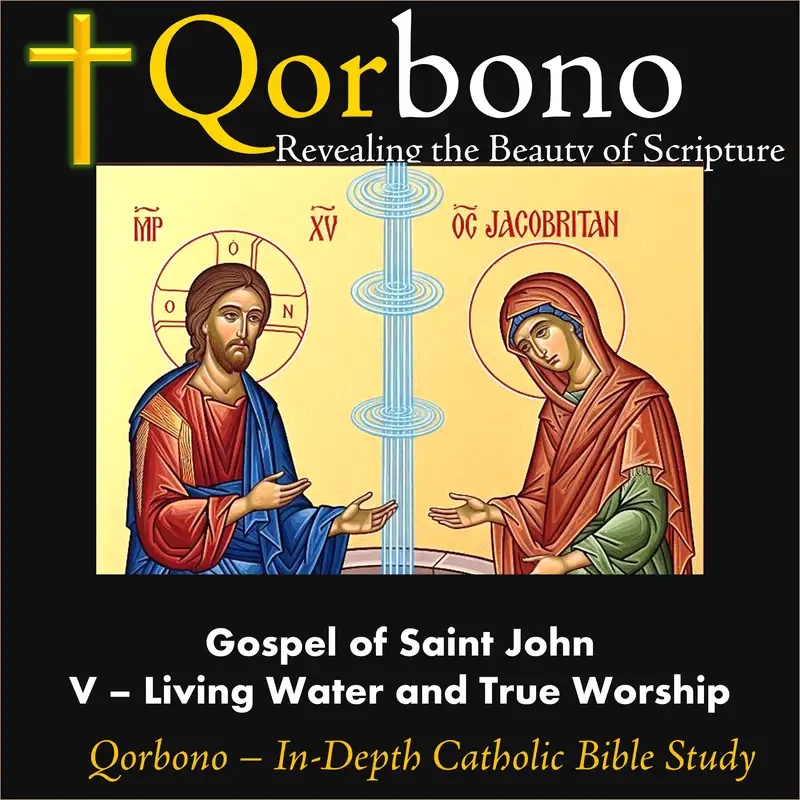
05 - Living Water and True Worship
[01:00:00:00 - 01:00:05:11]
Welcome to this continuation of Bible study on the Gospel of St. John.
[01:00:06:15 - 01:00:09:20]
We are now in lecture five, so one third of the way through.
[01:00:10:24 - 01:00:44:23]
And tonight we're going to be talking about living water and true worship. It is the encounter of Jesus with the Samaritan woman. I don't know if you guys are all subscribing to the newsletter. Again, I encourage you to do so because I do send reminders. And then the last reminder that I sent, I'm sure probably you're just looking at the heading and opening the newsletter, which I understand. But from now on, I will ask you to read the passage of the Gospel for next time, because this is going to be packed. I don't know we're going to have time for Q&A.
[01:00:46:00 - 01:02:06:23]
There is so much to cover in this particular chapter, so get ready. It's going to be a little longer than an hour. I can't promise I can pack it into an hour. It's really difficult. So we are now dealing with the Samaritan woman. Next time it's going to be healing and authority. And that is chapter five. Basically for the next study, please read chapter five of the Gospel of St. John. You don't have to dig too deep into it. Just familiarize yourself with the text. That's what I'm asking for. The journey thus far. Before we dive into the mystery of the well, we must look back at some of the stones that were already laid in theological foundation. I want to show you that, contrary to some of the modern theologians, the Gospel of St. John is an extremely tight, coherent text written by a single author with a single purpose. And I think you can start to see this now as you look at this slide. St. John has showed us that the logos who was with God from the beginning is reclaiming the world he created. I don't think this is coming as a surprise to anyone. This is what Jesus come to do. And from the get-go, we find that his body has become the living temple because this is where the Spirit comes and rests over Jesus, not in the temple in Jerusalem.
[01:02:07:27 - 01:02:15:00]
And now he's systematically overtaking the old order. He's renewing it and he's giving it its true vitality.
[01:02:16:12 - 01:03:38:08]
He did it geographically because he's now declared that Jerusalem is no longer the obligatory place of worship. The location is God who is a person. And we're going to hear that today again, repeated at the well. Liturgically, the rites and traditions established by the Pharisees are being dismantled and replaced with a new wine of the Spirit. We're going to see that again next week. It's going to come back to the four. Financially, he cleanses the temple signaling that his church will not be tied to dubious commercial links or the business of sacrifice. And catechically, he overtakes the office of teaching from the Pharisees speaking with an authority they cannot match. So it's a consistent, coherent approach where he's basically going to them and all to the Jews and telling them this is the new covenant. And there are two polls of opposition. There are those who just cannot fathom that a Galilean will be the Messiah. And then there are the disciples who have a very specific idea about how the kingdom is going to come about. So it's not just one, it's two. And today, the mission. In Judaism, the missionary office was extremely limited, reduced primarily to the legalistic process of making proselytes. And Samaria Jesus is about to explode this limited office into universal harvest.
[01:03:39:19 - 01:03:48:29]
Now, a proselyte from the Greek proselytos, meaning one who has arrived, is a Gentile who has fully converted to Judaism.
[01:03:50:04 - 01:04:23:12]
In Hebrew, they're called Gerd Tzedek, a righteous stranger. To become a full member of the covenant, a proselyte had to fulfill three requirements. Acceptance of the law, a public commitment to follow all 613 commandments of the Torah. Synchomzation for males, the physical sign of the Abrahamic covenant, and ritual immersion, the mikvah, which we already talked about in the wedding feast of Cana. It's a symbolic rebirth through water washing away their Gentile past.
[01:04:25:07 - 01:04:39:26]
And those types of conversion were very limited. Nothing compared to what the missionary impulse of the church. And today, Christ is taking that away and replacing it with something far more powerful.
[01:04:40:28 - 01:07:30:25]
We're going to explore how the new covenant heals ancient wounds. To be able to do that, I need again to show you how incongruous this text that you're familiar with is. If you read it surface level, it is absurd. The reason I'm pointing that out to you is because if you're talking to a non-christian, an atheist, they can use this text against you because it sounds completely absurd. It just doesn't make any sense. And I want to show that to you by shifting away from the scenario 2000 years ago and bringing it to something we're far more familiar with. It's not a transposition, so don't think of it as I'm replacing Jesus and this American woman with modern characters. It's more of a, think of it as a modern encounter that is happening according to the pattern that we find in this chapter. And you will find it, I hope, as absurd as it sounds. And then we'll see and understand why. Then we'll deal with the baptismal prelude, which is the beginning of the chapter where Jesus is baptizing, which is what? Didn't know that, right? And then we'll deal with the Samaritans. Who are they? Most people don't even know who the Samaritans are, what the implication of that story. Then we will get to the encounter at the well and then hit the conclude. As I've told you before, oftentimes scripture sounds like, I mean, we read scripture the way Egyptians, modern Egyptians, walk into a pyramid and look at all the hieroglyphs. Because we're lacking the content, the context, we're lacking the intent. We don't have the tools that were at their fingertips when the text was written. And we have to bring all that back. That's what makes it really difficult. Right? Just we have to put all that construction back in place before we can even talk about this. So it sounds like hieroglyphs. And sometimes it sounds like a hieroglyphs more than before. I'll show you that in a minute. But before I want to leave you, but with this reflection. Am I like the woman at the well returning day after day to the same sunken wells of temporary satisfaction, only to find my thirst remaining unquestioned? Or have I truly encountered the seventh man, the true bridegroom, and allowed his living water to become more than just a shield against suffering, but an internal spring that turns my Lenten desert into a source of Easter, of Easter life for a thirsty world? Am I just a guy who keeps repeating the same old things, never being satisfied, or will I dare go to the bridegroom so he can give me the living water? I think that's the question that Jesus asked us, the same Meritan woman. He's asking that question of all of us, particularly during Easter, during Lent. As usual, you can phone your questions if you don't want to ask them at the end.
[01:07:33:10 - 01:09:12:23]
And we'll see if we're gonna have a Q&A if we have time today. But if you don't, then I mean if you don't, I'll deal with them separately. I'm not gonna drop your questions. I'll guarantee you that, but we'll see what we can deal with them. And I am actually picking this up as you are, because I forgot to do it. So here we go. So please stand as usual for our intro prayer, in the name of the Father, of the Son, of the Holy Spirit, Amen. Come Holy Spirit, fill the hearts of your faithful, and kindle in them the fire of your love. Send forth your Spirit, and they shall be created, and you shall renew the face of the earth. O God, who by the light of the Holy Spirit, did instruct the hearts of the faithful, grant by the same Holy Spirit, we may truly wise and ever enjoy his consolations, through Christ our Lord, Amen. May we see the wisdom, Saint Joseph, all the angels and saints, in the name of the Father, the Son, and the Holy Spirit, Amen. Please be seated. So here we are, Merkley-Well 66, somewhere along Interstate 8, in the California dead. And the first thing I want to do, before I get into this, is give you a summary of this gospel. And like I told you, oftentimes it sounds like hieroglyphs, because oftentimes it is precisely that. So let's go through it. So Jesus and his disciples were baptizing. The Pharisees picked up on that, found out that they're baptizing. So Jesus decided to go north through some, through some area. He got to the well of Jacob, where a woman
[01:09:13:27 - 01:09:51:03]
was getting water at the sixth hour. Jesus said, "Hey, give me something to drink, give me water." Notice he didn't say hello, greetings, no greeting whatsoever. He doesn't know her, she doesn't know him, and he goes, "Give me water to drink." Now if that's not weird, I don't know what is, okay? If that's not gonna creep you out, the stranger you don't know, who sits there, and then suddenly he goes, "Give me water to drink." All right? You go to 7-11, you buy yourself a drink, you're walking out, somebody says, "Hey, am I gonna sit?" This is how weird this is. You get it? You understand? Okay. That gets weirder, because what, do you think she says, "Oh, you're a creep?" No, she says, "Huh.
[01:09:53:20 - 01:10:54:01]
I want to know how come you, a Jew, is talking to a Samaritan?" And then he answers, "If you know who's asking you, you'll ask him for water, and I'll give you water that, when you would never thirst again." And then she says, "Please give me that water." What does Jesus say? "Go get your husband." And she says, "I have no husband." And he says, "You're right. The man you're with now right now is not your husband, and you had five before." She's sort of astonished. And then she goes, "Whoa, I think you're a prophet. Since you're a prophet, I wanted to know, do we worship on Mount Gerizim or in Jerusalem?" And Jesus says, "Uh-uh. From now on, you're going to worship in spirit and the truth." Then she says, "Oh, but the Messiah comes, He's going to tell us all this." And Jesus says, "I am Him." At this point, the disciples show back up. They just came back, and they're completely blown away because He's talking to a woman. Then they offer Him some food. He says, "No, because the only food I have is the food of my father." And they go, "Do you eat? Why is he not eating?"
[01:10:55:06 - 01:11:07:10]
But meanwhile, the woman, skedaddle, goes back to town and tells them about what happened. That gives Jesus the time to talk to them about the harvest. And they have to pray for harvesters because the harvest is plentiful.
[01:11:08:15 - 01:12:15:17]
At which point, the Samaritans came back and they converted. That's the Gospel today. Now I want to show you how strange this whole thing is. So here we are. Murky Well 66 gas station, somewhere along interstate, eight in California desert. Sweltering Tuesday at noon, the heat wave shimmer off the asphalt. A black suit stands next to a pump number one. When a woman in her late 30s pulls in a beat-up sedan to fill up, she steps out wearing sunglasses trying to look invisible. Now there's a guy standing there. You're a woman going to get gas. I want you to put yourself in that situation. Here's what the guy said. So what would you do as a woman? You think he's got a gun, hand the keys, and hope he won't shoot you? Pepper spray him, then taser him? Or you stop dead and stare at him baffled and then say, "I'm a local nobody from the wrong side of the tracks. Why should a suit ask me for my keys?" Does this conversation sounds normal to you? Would any one of you say that? What would the man say? Maybe snatch the keys and drive away or tell her that his wife is about to deliver their baby and he's stuck.
[01:12:16:18 - 01:12:37:24]
And he also needs to go to the hospital. Or if you knew who I was, you'd ask me for keys and I'll let you fly a solar-powered private jet. You'll never have to wait for a bus or worry about an empty tank again. If you're feeling this is as weird, the gospel is just as weird as this. None of it plays the right way. It just doesn't make any sense.
[01:12:40:02 - 01:13:30:29]
So what should the woman say? I think he's loopy, he's a scammer, or a solar-powered plane? Not even Tesla has that. Are you better than that "what's his face, the Tesla guy?" And then what does the guy say? What does the man say? "Yeah, I'm way better than him. Don't judge a book by its cover." Or "Everyone who drives cars will have to refill gas, but those who fly my solar-powered plane will fly around the globe without ever having to worry about refilling their tanks." What should she say? Again. Or "I'm all in. Teach me to fly." Who started with the mere keys. Now she's willing to go with this guy. She doesn't know from Adam or Eve to learn how to fly a plane. It's all normal. What would the man say? "Great way in business, let's drive to the airport." Or "look at your husband." What would she say then? "Mind your own business? Did you fall out and hit your head?" Or "I'm not married."
[01:13:32:03 - 01:13:59:16]
She's very... what would you call? Naive? Talking to a stranger? She doesn't know. What would the man say? "You're not? Well then, shall we sign the contract?" Really? How come? Or "You're right, you've been through five divorces, and the guy you're with now isn't your husband either?" And then the woman, "Are you stalking me? There's something seriously wrong with you? Or you're way better than Musk. You're a prophet." Okay. That is the incongruity of the text.
[01:14:00:16 - 01:14:44:05]
Why does it feel incongruous? Because the context is right. Saint John is counting on a very powerful context to make sense of all of it. Because we don't have it. It sounds like so we have to bring it back. So let's start with the baptismal prelude. "Now when the Lord knew that the Pharisees had heard that Jesus was making and baptizing more disciples than John, although Jesus himself did not baptize by only his disciples." Okay. Now I want you to watch carefully when you read the sentence. There's something grammatically. Does this sound right? Is that how you would say it? "When the Lord knew that the Pharisees had heard that Jesus..." Is that how you would say it? Wouldn't you say instead, "When the Lord knew that the Pharisees had heard that he was making..."
[01:14:45:11 - 01:16:18:16]
So Lord and Jesus seems to be awkward. He won't say it that way. "Was making baptizing more disciples than John and then in between parentheses, although Jesus himself did not baptize by only his disciples." Why write it this way? It sounds so awkward. It's odd. In English it should read, "Now when the Lord knew that the Pharisees had heard that he..." Right? Not Jesus and the Lord. That doesn't make sense. "Jesus was making and baptizing. None of the synoptics mentioned that Jesus baptized." What is the significance of this baptism in the Gospel of St. John? "Although Jesus himself did not baptize by only his disciples." Why the insertion? Why not just say, "Now that the Pharisees had heard that Jesus's disciples were baptizing." Why say, "Jesus was baptizing and then corrected and say, "Well he wasn't really, he was his disciple." So modern theologians will tell you that's an editor who came back and inserted that later. That's how they interpret. And then at this juncture, why does Jesus care about what the Pharisees are thinking? So let's go back to the text. "When the Lord knew that the Pharisees had heard that Jesus was making and baptizing more disciples than John, although Jesus himself did not baptize by only his disciples." It is just awkward in the Greek as it is in English. It doesn't read right. Okay, let's go to the questions. "In the Hebrew and Semitic thought it is common to repeat the proper name rather than use a pronoun to emphasize the official capacity of a person. But by calling him the Lord and Jesus in the same breath, Saint John is distinguishing between Jesus's divine title, Lord of the covenant,
[01:16:19:23 - 01:17:07:17]
and his human name." All right, so how do the Pharisees seize a mass? Just a guide. So he's showing you immediately the disjunction between who he is and how they perceive. So typically it would have been, "Now when the Lord knew that the Pharisees had heard that the Lord," that is a typical Hebraic way of stating it. The people around Saint John would have known that, but he switched it by putting Jesus and they would have immediately picked up on it. There is irony in the writing of Saint John all over the place. It's a very powerful mechanism he uses to bring about meaning. Okay, now why is he baptizing? Is this the right of baptism as we know it in the church? Anybody cares to answer? A lot of people nodding there, but somebody wants to verbalize.
[01:17:08:23 - 01:17:59:03]
Why is it not the right of baptism? Mary. But why is it not the baptism as we know it? They won't have the Trinitarian formula, but more importantly, what has not yet happened? Right. Crucifixion, resurrection hasn't had happened, the church hasn't been founded, the priestly order doesn't exist. It cannot be the baptism as we know it. So it is the baptism of John. Okay, now who is John? He is his herald. He is the one who he sent. The herald is the mouthpiece of the king. What the king says, the herald says, they're they're in harmony. It's one voice. So what is happening here? Jesus is taking over the function of John. That's what's happening. It is no longer John who's baptizing. It is his disciples continuing the same process of preparing the hearts of people to receive
[01:18:00:04 - 01:18:43:10]
the word of Christ. Why does he say then again, Jesus was making and baptizing. Why does he say that? And then he adds, but it's the disciples. It's the exact same formula as you use in the first sentence. The first one establishes the authority, the accountability. It is in the hands of the Lord. The second one tells you who is actually doing it, the doer. That's why. There's no editorial insertion here. There's a clarification of roles and power. Okay, so that's why there's a insertion. And then lastly, why does Jesus care about what the Pharisees are thinking? Because Jesus does not let anyone take his life from him. He gives it up and the time has not yet come. That's why.
[01:18:44:15 - 01:19:49:13]
So knowing their thoughts, he takes action to distance himself from them because his time has not yet come. What does that overall show you? It shows you someone who is in full and complete control of his destiny and he has full authority to do what needs to be done. Hang on to this because there is not a point in the entire gospel of Saint John where that perspective is gone. Never. So now the Samaritans. Before we get into Samaria, we need to know who the Samaritans are. The geography. First, Judea to Galilee. So you have five areas that you need to familiarize yourself with. Judea down south, Samaria in the middle, Galilee up top, along the coast. Okay, Judea down south, Samaria in the middle, Galilee up top, along the coast. East of the Jordan River, you have two more areas. Perea and the Decapolis. Perea south, Decapolis north. It hugs Gallop. So as I said, you have Judea down here,
[01:19:50:19 - 01:24:25:13]
Samaria in the middle, Galilee up top, you have Perea and the Decapolis. Judea and Samaria are governed by Pontius Pilate. The Decapolis is a confederation of Greek cities under Roman authority. And then Perea and Galilee are governed by Herod Antipas, who is the son of Herod. And all these areas used to be governed by Herod after he died, broken up. All right, here's Samaria. This is where Jesus is going. I want you to focus your attention on three Sicar. That's the town where the well is. And these two mounts, Mount Ebo and Mount Gerizin. These three are going to play a very important role. They're part of the context. The listeners to St. John or the readers would have known what they are and they would have understood the implications of that well. We don't, so we have to rebuild all. Okay, so St. John is anchoring us in a very specific location. This is not anywhere. This is the heart of the ancient covenant land. This is the heart of Israel, the kingdom, the northern kingdom of Israel. After the kingdom broke with Solomon's passing, it broke into the southern kingdom of Judea, northern kingdom of Israel. Samaria was part of the northern kingdom of Israel. So Jesus is traveling Jerusalem in the south to his home base in Galilee. The distance is about from Jerusalem northward to Sicar is roughly 30 to 40 miles. About two days of walking. Through each Galilee he has another 20 to 30 miles to go. So about three days of walking is what he has to do. Now there are two roads that get you from Judea to Galilee. One through Samaria, the other one through Perea and the Decapital. This is important because Judea has basically Jews living in it. Perea has also Jews. The Decapolis is Gentile. Samaria has Samaritans but the Jews will call them Kothim and we'll get to it in a minute. And then in Galilee you have Galilean. Okay. Devout Jews will do everything they can to avoid Samaria. They would not go from Judea to Galilee through Samaria. They'll go through Perea and are willing to go even in the Decapolis. The Decapolis is basically Las Vegas. Okay. Same lifestyle. They're willing to chance through all of this instead of going through Samaria. So normally Jesus should have gone through Perea and the Decapolis into Galilee. That is the normal route for a Jew to go. Not through Samaria. So like I said, who lived in Perea and the Decapolis? I told you the Perea was the Jews and the Decapolis was the Gentiles. Did the Jews prefer to deal with Gentiles rather than when Samaria did? As I said the pious Jew would indeed prefer to walk through a pagan Greek city than a heretical Samaritan village. To the Jewish mind, the Gentile was simply someone outside the covenant. Whereas the Samaritan was seen as a covenant breaker over half breed. In the ancient world there was often no one more hated than the person who had the corrupted version of your own truth. I would say not just the ancient world. So is it a strong statement to say that they prefer Gentiles over Samaritans? Absolutely. The Jews viewed Samaritans as kuthim, people from Kutha in Persia who were brought in by the Assyrian. They believe the Samaritans had mixed the worship of Yahweh with five different idols, hence the five husbands symbolism in St. John that St. John uses later. A Jew could buy a pre-packaged sealed product from a Gentile and remain ritually clean. But Samaritan food, water and even their daughters were declared by some rabbiting decrees of the time to be as unclean as swine's flesh. Or a woman in her menstrual state. By asking for a drink Jesus isn't just being friendly, He is crossing a biohazard line that most Jews wouldn't touch. See when you read the text it sounds so nigh. Give me water to drink. No. You have someone who has the flu and filling a water bottle and you ask him for a drink. That's the sentiment you should get when you hear Jesus say give me water. Does leaving Judea make a Jew unclean? Not automatically. So that would be the third question I was going to ask you. Not automatically but but there were high level purely concerns. The dust of the Gentiles. There was a pharisaic tradition that the very dust of Gentile lands was unclean. If a Jew traveled abroad they would often perform ritual washing upon returning to the Holy Land.
[01:24:26:13 - 01:26:30:25]
The land of Israel Judea, Samaria and Galilee were all technically part of the land of promise but Judea containing the temple was the holiest tier. Samaria was a dead zone because the Samaritans were seen as perpetually unclean. If you're a Samaritan you cannot be clean. Ever. The territory of Samaria was treated like a graveyard. If you walk through it you were stepping on bones. That meant you're unclean. So the fact that Jesus goes to Samaria is not just like a little detail. It's a bombshell. Who are the Samaritans? A distinct religious community living mainly in a region of Samaria between Judea and Galilee. They claim to be the true heirs of the ancient Israelites especially the tribes of Ephraim and Manasseh. They practiced a form of the Torah-centered religion of Israel but distinct from mainstream Judea. Their name comes from Samaria the capital city founded by Omri the first king. You can you find him in the book of Kings. First book chapter 16 verse 24. Originally the term simply meant people of Samaria by the time of Jesus referred to distinct ethnic and religious groups. Okay now I want to give you a sense of what Jewish Samaritan tension felt like. Like if a Jewish and Samaritan met what would it be like? Well it didn't mean violence on sight. It's not going to start killing each other. That's not how it felt. But if a Jewish woman dated a Samaritan man that would be like an earlier version of Romeo and Julia. That'll be people dying. I added the bagel as I thought that was missing in Romeo and Julia. They needed a bagel or two. That's what it would be like. Huge, huge tension. If a Jew decides to buy a bagel from a Samaritan shop what would that be like? That would be like Darth Vader selling a bagel to Obi-Wan Kenobi. And again if a Samaritan tries to be friend of a Jew to be friends what would that be like? Klingon taking a selfie with Mr. Spock. If you know anything about Star Trek that's never going to happen. And if you're wondering whether both smiling because that just ate the bagel they had before. So
[01:26:32:05 - 01:27:56:05]
it's tense. Very tense. Not an easy thing. So you understand you'll get a better understanding why she asked him this question. Because it's a big deal that he is talking to. Now with that all out of the way let's get to an encounter of the well. He left Judea and departed again for Galilee. He had to pass through Samaria. Now I hope you see the oddity in that statement. He had to pass through Samaria. No he didn't. You don't usually pass through Samaria. You avoid it. You go through Pareah and the Decapolis to Galilee. That's the normal route. So what is St. John's telling us? So he came to a city of Samaria called Sicar near the field that Jacob gave to his son Joseph. See we are all of us like detectives who brought on a crime scene. And there are clues all over the place. Now we have to reconstruct what happened from looking at the clues. And in case of St. John there are clues all over the place. But he does it in a very understated way because he assumes people know what he's talking about. Like he's not playing a game with us. He's not thinking how can I make a puzzle so they can actually go figure it out. That's not at all what is in his mind. He is writing assuming people had the context and understood what he was saying. Jacob's well was there and so Jesus wearied as he was with his journey, sat down beside the well. It was about the sixth hour. Man let's unpack all this. Why Jesus had to pass through.
[01:27:57:06 - 01:28:50:23]
Now in the Greek when St. John writes that Jesus had to use the verb a day, passed through Samaria. He is using a word that almost always refers to divine necessity. So just as Jesus was led into the desert by the spirit, Jesus is led into Samaria by divine necessity. Not by geographic concerns or not because he wanted to take a shortcut. Like I said Jesus isn't taking the shortcut because he's in a hurry or because he is less pious than other Jews. He is intentionally walking into the unclean heart of the land to show that the new covenant isn't about avoiding dirty people. It's about the living water flowing out to cleanse the very people the old system had written on. Now that echoes what we see in the gospel of St. Matthew.
[01:28:51:25 - 01:29:58:18]
Specifically in the gospel of St. Matthew it's also in the gospel of St. Luke and St. Mark to a certain degree. But whenever Jesus sees a leper of someone who's unclean, he makes a point of touching it. In principle that would make Jesus unclean. But the new covenant the flow is reversed. It's not the unclean who makes the clean unclean, it's the clean who makes the unclean clean. Memorize that and repeat it 10 times. So that's why he had to. Now the field of Jacob. What is that? Why does St. John mention the field that Jacob gave to his son Joseph? Jacob originally bought the land from the sons of Hamor in Genesis chapter 33 verse 19. The gift on his deathbed Jacob gave this specific portion, Shechem in Hebrew, portion is Shechem, to Joseph as an extra inheritance. So Joseph didn't get only two portions. He basically got the double blessings because what Jacob did is that he ignored in his blessing at the end of his life. He ignored Joseph. He didn't bless Joseph but he's blessed his two sons. Effectively giving Joseph the double blessing which normally would go to the oldest son.
[01:30:00:02 - 01:30:39:02]
And then he added on top of that. So it's all a symbol of the overflowing grace of God. Jacob's well was there. Jesus by sitting at this well, well number one, he is basically standing on the grave of the patriarchs because you know what? Jacob is literally buried there. And he's still there. And he's reclaiming the lost portion of the family estate. Whereas the Pharisees are content to make proselytes and will never go into Samaria to preach anything. These people are lost cause, the dead bones. Jesus goes and calls them back. Now Jesus, wearied as he was. Nothing is
[01:30:40:21 - 01:30:47:10]
incidental. Nothing is superfluous. Wearied as he was. Why does St. John tells us that? Now we know it's a two-days journey
[01:30:48:15 - 01:33:46:13]
to get all the way through Samaria. So he's been walking for a while. But what does he mention? Wearied as he was. And it's not mentioned anywhere else. Wearied as he was. It's sort of an inversion. It's St. John's way of showing us how the Lord is about to establish his kingdom and how counterintuitive it is. You would assume that the one who's going to establish the kingdom, the King of Kings, the Lord of Lords, will do it with power, majesty, and strength. And Jesus does the exact opposite. He does it with weakness and failure and the cross. So the one who measured the waters of the whole earth and the whole of his hand is now thirsty and tired. It's the mystery of the Incarnation. It proves Jesus is in a ghost or a vision. He truly entered the covenant of flesh and felt the weight of our limitation. And then we're going to get to one more point that I'll talk to you about it in a second, which is absolutely, but let's leave it for now. And let's look at this business of the sixth hour, the mystery of the sixth hour. Time in the Gospel of St. John is counted this way. It's Jewish timekeeping. The day begins at sunrise, approximately 6 a.m. The first hour is 7 a.m. Okay? And that's how you count. So the third hour is 9 a.m. And the sixth hour is noon. So it was noon when the sun is at its hottest. So it's the hottest part of the day. No one goes to the well at noon. You don't. You go very early in the morning because you want, you don't want to deal with the sun. So the only reason when you go to the well at noon is when nobody else is there because of your social outcast. That's why you're there at noon. So for all the times that Jesus could have chosen to go to the well, you'd think he would go early in the morning because that's when he meets most of the Samaritans. No. He goes at noon to meet one and a woman with a dubious social status. This woman is Zaperia. That's why she's there at noon. Theologically in the Garden of Eden, the breeze of the day afternoon was when God came to look for Adam. So in the garden, God would come in the afternoon to look for Adam. Here Jesus comes at noon, the worst possible hour. It's the redemptive mission of our Lord. And then there is an echo. In the Gospel of St. John, there is echo all over the place. And this particular one is poignant. St. John is the only Gospel to emphasize that Jesus was sent into death at the sixth hour. The hour of his marriage at the well is the hour of his sacrifice on the cross. Because what we're dealing with here is a wedding. And we'll see that in a minute. So the hour of his marriage at the well is the hour of his sacrifice. So what is the cross? The consummation of the marriage. I'm going to mention this. I'll mention that again. In the ancient Near East, a man meeting a woman at a well is the biblical equivalent of a proposal. So it's not just we meet at a well. No, it's a proposal. Isaac and Rebecca found,
[01:33:47:13 - 01:34:38:20]
Rebecca was found at a well in Genesis 24. Jacob and Rachel. She was found at the well in Genesis 29. Moses and Zipporah. She was found at the well in Exodus 2. So as soon as they see the well, as soon as you see Jacob, people of the time of St. John would immediately recall these images and the understanding of the well as the place of a proposal. And they would understand we're dealing here with a wedding and then they would have a short circuit because he's dealing with this woman. You understand? Their reading in the text would have been so much more powerful than ours. Ours is so subdued. Jesus is the true bridegroom who has come to reclaim his bride, Israel. Israel is often called the bride and he has come to reclaim the bride. Jesus is the new Jacob. He doesn't want a drink of water. He wants the heart of the people who abandoned the cup. Okay. That's where he was there for. Now,
[01:34:39:22 - 01:35:47:24]
let's look at Sikar then and now. At the time of Jesus, Sikar was a small village near the ancient city of Shechem. It sat in the valley between Mount Ibo, the mountain of the curse, and Mount Gerizim, the mountain of the blessing. We'll get to that in a minute. Today, the site generally identified with Askar near the modern city of Nablus in the West Bank. Jacob's well is still there, housed within a Greek Orthodox monastery. So if you go to the Holy Land and if you did, you may already visited Jacob's well. Now Mount Ibo and Mount Gerizim, again, as soon as you say Sikar, people will know what the context is. Moses enjoined Joshua that when you enter the Holy Land, you will set six tribes on Mount Ibo and six other tribes on Mount Gerizim and they will recite the curses and the blessings of the covenant. As a reminder of what God will do to them, should they be unfaithful or should they be fae... So there is no doubt this is a covenantal context. And he is the one who is going to take all these blessings and curses of the Old Testament upon himself.
[01:35:48:25 - 01:37:08:22]
So as I said, the history of Mount Ibo and Gerizim is foundational to understand why this American woman points towards them in her conversation with Jesus in a minute. These two mountains form a natural amphitheater near Shechem, Sikar, and they were the site of a dramatic covenant ceremony commanded by Moses and executed by Joshua. The command came in the Deuteronomy chapter 11 and 27. Before the Israelites entered the promised land, Moses instructed them to perform a ritual of blessing and curse once they crossed the Jordan. Mount Gerizim, for the blessing, six tribes, where to stand on Mount Gerizim to announce blessings upon those who kept the law. And Mount Ibal, the curse. The other six tribes were to stand among Ibal to pronounce curses upon those who broke the law. Curses are taken from Deuteronomy 27, 15 and the blessings from Deuteronomy 28, 1 through 14. The execution is found in the book of Joshua chapter 8. After the fall of Ai, Joshua fulfilled this command. He built an altar of uncut stones at Mount Ibal and offered burnt offerings. He then read the entire law, every word of the blessing and the curse to the assembled nation, including women, children and soldiers. That was the way in which Joshua reminded everyone of the fact that they were governed by the covenant with its blessings and its curses.
[01:37:10:28 - 01:37:40:21]
Now, by the time of Jesus, the Samaritans had built their own temple on Mount Gerizim, the Mount of Blessing. The true mountain of blessing where Abraham and Jacob worshipped. So they would not go down to Jerusalem and they did that as soon as they separated from Jerusalem. So the kingdom of Israel, as soon as they separated, they stopped worshiping in Israel in Jerusalem. That's why God sent them waves of prophets. Not because they separated politically, but because they stopped worshiping. And the destruction
[01:37:41:25 - 01:38:48:01]
came about because they continue to refuse to go back to the tour. Now, like I told you before in the Old Testament, three major marriages begin at the well. Isaac and Rebecca, Genesis 24, Jacob and Rachel, Genesis 29, Moses and Zipporah, Exodus 2. And the encounter happens at the well in each of the kids. And that creates a pattern, which I'm going to show you, and you can see how it maps to what we're dealing with here. In the Old Testament, a man journeys into foreign territory. Jesus had to travel to Samaria. The man arrives at the well. Jesus arrives at Jacob's well. He encounters a woman. Jesus encounters this American woman. Water is drawn. Give me a drink. You understand when he asked for a drink, he wasn't asking for a drink. It was a proposal. The woman returns to her people and reports the encounter. She runs back to the village. A marriage results. The town converts. The town is the bride, not the woman, okay? Because the town symbolizes the church. All this imagery would have been evident for us. We have to kind of reconstruct all that and line it up so we can understand. So now here we go. Now that we've covered all that.
[01:38:49:02 - 01:42:20:01]
There came a woman of Samaria to draw water. Jesus said to her, "Give me a drink." Now suddenly it's no longer in Congress and absurd. We understand what Saint John is trying to say. It's the marriage proposal at the well. It's not about water. For his disciples had gone away into the city to buy food. The Samaritan woman said to him, "How is it that you a Jew ask a drink of me, a woman of Samaria? How is it that you a Jew even talk to Samaritan woman? I am completely unclean. I can never be made clean. How could you be talking to me?" Now the question makes complete sense. Why she would ask that question? It's reasonable because it just doesn't compute. You're a Jew. Even standing next to me makes you unclean. What's wrong with you? And now Jesus starts to correct. He's doing with her what he did with Nicodemus. Now I want to repeat that to you because what I said doesn't strike you as strongly as it should. He's doing with her what he did with Nicodemus. What does that mean? What am I implying? I'm sorry? No, not even baptism. This is a good point but that's not what I'm going with. He's treating a Samaritan woman the same as a teacher of the law. That is mind-blowing. For Jews had no dealings with Samaritans. Jesus answered her, "If you knew the gift of God, observe how he refuses to enter into her mindset and he brings his own." Just as he did it with Nicodemus. He says something to confuse her but he's drawing her from her own mindset into his own. "If you knew the gift of God and who is it that is saying to you, give me a drink, you would have asked him and he would have given you living water." Now, sir, you have nothing to draw with and noel is deep. Where do you get that living water? Are you greater than our father Jacob? Observe how he went from... Observe her progression in her thinking. We went from "Sir" to "Are you greater than our father Jacob?" "Who gave us the well and drank from it himself and his sons and his cattle?" Jesus said to her. He's answering obliquely but he is. "Everyone who drinks of this water will thirst again." That's what Jacob gave you. He gave you water that when you drink you will thirst again. "But whoever drinks of the water that I shall give him will never thirst. The water that I shall give him will become in him a spring of water welling up to eternal life." The woman said to him, "Sir, give me this water that may not thirst nor come here to draw." Now, here we have another Nathaniel moment. Just as with the case of Nathaniel, when he told him before Philip called you I saw under the victory and then Nathaniel went, "Rabbi, you are the savior of the world. You are the son of God." You see a leap that is happening here that is not evident from the text. It's not that she believes him. She is now convinced he can do what he said. So first the taboo. Jesus breaks three major social rules here. He speaks to a woman in public. A man is not supposed to speak to a woman, Jewish or otherwise, in public unless she is family member. So he breaks that first taboo. He speaks to a Samaritan. That's the second one. And he asks her to share a drinking vessel with someone who's ritually unclean. So like I said, it's like somebody has the flu and I go and I drink from his cup. What do I make myself when I do that? I make myself vulnerable. That's what Jesus is doing. He's making himself vulnerable. That's the counterintuitive thing about the way he reigns. He makes himself vulnerable. That's the thing we're most afraid of.
[01:42:23:07 - 01:43:38:21]
Most of us are very afraid of making ourselves vulnerable. The woman is so shocked that she doesn't even answer the request at first. She focuses on the social incongruity. By asking for water, Jesus is intentionally making himself vulnerable to her, setting the stage for her to become vulnerable to him. The creator waits for a human being to draw water for him. Isn't that interesting? God, Jesus could have pulled water out of the well with a flick of his finger. He could have done that. He could have made water out of nothing, like he made the wine. Instead, he waits, wearied and tired, for a human and a sinner to draw water for him. God sits down, tired and asks a sinner for a drink. That's the biggest incongruity that the disciples are going to have to deal with and that we have to deal with. We deal with the same exact thing in our personal lives and in the lives of the nation and the world. We think that if Jesus is in control, then the pro-life movement will win, abortion will stop, this will happen, that will happen, and since none of those things are happening, he's not in control. We reduce Jesus to a God who scratches where we itch. We don't want to worship God. We want to be comforted. There's nothing wrong being comforted. Don't get me wrong.
[01:43:39:22 - 01:45:22:23]
100% for it, but not against the truth. So, oftentimes, I think people get very confused about the meaning of mercy. They equate mercy with comfort, mercy with good things where good is defined by what I want good to be. So, and you see it, for instance, in the way people pray. They pray for their kids, they pray for their people, they pray for this one person to be healed, this one too, and not once do they stop and think, well, if this person was sick is healed, will that help that person go to heaven or go to hell? That doesn't even enter their mind because what they're focused on is comfort, not God's will. God works completely differently. Perfect example. Exhibit A, in the Old Testament, Juleb is probably one of the guys to whom God showed the greatest mercy. God spoke with Job about the same as he spoke with Moses. No, there are very few people in the Old Testament who've had this audience with God that lasted so long. God showered Job with mercy. Do you like that mercy? That's the challenge for the disciples as it is. That's the real challenge. And so, there is this wonderful Catholic notion, if you're not familiar with, called, "Holy indifference." If you're not familiar with "holy indifference," I suggest you look it up. So God sits down tired and asks a sinner for a drink. It reverses expectations. Instead of power, we see humility. Instead of commanding, God asks. This reveals something essential about the mission of Christ. He does not conquer hearts by force. He invites them.
[01:45:24:07 - 01:45:26:20]
That's a terrifying thing because if it was by force,
[01:45:28:10 - 01:45:31:05]
you would know you broke a law if it was by force.
[01:45:32:16 - 01:45:43:02]
But if you refuse an invitation, boy, does it push the entire accountability on us. Force, God's take accountability.
[01:45:44:14 - 01:49:44:28]
Invitation, it's all on us. Like many of us think we want free will, we want to be free. We would rather have God come and tell us, "Do A, B, C, D, and E." I think a lot of us would sign up. This freedom business, you know, gets us in a lot of trouble. If you knew the gift of God, the gift, Dorea in the Old Testament, the gift of God was often identified with the Torah, the law. Jesus is subtly claiming to be the new source of revelation. That's the gift of God. Living water. In the literal sense, this meant running water like a spring or river, as opposed to stagnant cistern water. But the spiritual layer, the spring of living water mentioned in Jeremiah 2 13, to thirst for this water is to desire the Holy Spirit. So the spring of living water is the desire, the thirst for the Holy Spirit. The irony, the woman is thinking locally, Jesus is thinking globally. She boasts of Jacob's well, a hole in the ground, and is offering the source of the rivers of paradise. That's why he draws her to him. Doesn't answer her question. There's an inversion going on here. She asks if it's greater than Jacob. Saint John's readers know the answer. He is the God of Jacob, who gave the well in the first place. So the living water becomes a permanent interior state. What he's talking about now is the life of grace. When you have the life of grace with you, you have God in you, and therefore you don't thirst anymore. And then eternal life. This is the first time in a dialogue Jesus explicitly links water to the life of the world to come. It is the fuel for the new covenant journey. Here's what's really also very interesting in this. Just as the academia's thought rebirth was physical, the woman thinks living water is a magical labor saving device. Right? I'm giving some of that water so I don't have to come back and she's thinking plumbing. Right? Give me a faucet so I can just get the water. We may be laughing, but how many of us would have thought exactly? She wants the water so she doesn't have to walk to the well anymore. She wants the blessing without the relationship. We want to treat God like Santa. We have our list of prayers. We just want God to answer our prayers. To sit with him and talk without asking him for something. Eh, we'll think about it. Now let's look at it from a sacramental standpoint. And then in an academia's dialogue, the focus was on the cleansing and birth of baptism, like you said earlier. Samaritan woman focuses on... So now this is the third sacramental. First one was marriage, baptism with the kedemas and now comes. You can see how Jesus replaces the old order with the new sacramental life. The interior spring, St. John describes the water becoming a spring within the person. This is the fullness of the spirit, a permanent active state of grace. Confirmation is a sacrament of strengthening and witness. Note that once the woman receives this revelation, she immediately becomes a missionary to her own town. The spring doesn't stay in her. It wells up and flows out. She goes and witness to her town. That's the sacrament of God. And like I said, this is the first time we hear about eternal life explicitly. Five husbands. Jesus said to her, "Go call your husband and come here." The woman answered him, "I have no husband." Jesus said to her, "You're right in saying I have no husband, for you have had five husbands." And he whom you now have is not your husband. This you said truly. So observe, Jesus is not condemning her. He's just stating the truth. So literally she had sought satisfaction of five men and is now shacking up with the sixth. Okay, what does she represent? It's easy for us, maybe for some, to sort of look down on her or condemn her. But honestly, she's each one of us. Each one of us has something we're hooked on that we want, secretly or otherwise. And we keep going to it and it just doesn't give us anything. None of it at the end satisfies.
[01:49:46:01 - 01:50:22:11]
That's why she stands for all of us in that situation. Now, there is a second layer because Samaria was populated by five pagan tribes. Two kings, seventeen. They worshiped five bales. Bale, the word bale itself, is not a bad word. It's actually used in Song of Songs. It just means "my lord." It's a Phoenician word that means "my lord." But then it was associated with one specific demon god and then took on that very negative connotation. But fundamentally it is "lord." That's what it means. But they worshiped five
[01:50:23:22 - 01:51:03:25]
gods. So that you see the connection with this five, recurring connection. He's not only talking about her, talking about all of Israel. The current Samaritan religion was a hybrid, not a true husband. Now, she had five. She's with a sixth. But there is a very important play on word here. I think some of you may already picked up on it. Right here. "He whom you now have." Another way to say it is that "he whom you are with now." And that would be who? Who is she with now? Jesus. There you go. So the seventh man.
[01:51:04:25 - 01:51:15:04]
What does seven represent? The covenant. Seven is the number of the covenant. Because to make a covenant in Hebrew is to seven oneself.
[01:51:17:28 - 01:51:21:23]
So there's the seventh man. Hold it for after a while. Thanks.
[01:51:24:22 - 01:51:52:00]
"He whom you now have is not your husband." That you said truly. So there is a subtle double meaning here. Jesus is "he." She now has. She's currently in his presence. And he is not her husband. Yet he's the seventh man, the true bridegroom. But the marriage is only just beginning. Now I already told you this about the arithmetics between six and seven. She has now how many men? Six.
[01:51:53:02 - 01:52:03:19]
He's the seventh. What is the importance of six versus seven? Six is the day on which man and beast were created. Man and beast were created on the sixth day.
[01:52:04:20 - 01:52:16:01]
Seventh is the day of rest. So man was created with the beasts, but for the seventh day. He was created on the sixth day, invited to move to the seventh day.
[01:52:19:04 - 01:52:34:14]
Which explains these numbers. Like people ascribe almost magical powers to the number 666. As if there's something special about it. But like I told you before in Hebrew, there is no superlative. You can't say good, better, best.
[01:52:35:25 - 01:52:40:04]
Right? If you want to say, you can't say holy, holier, holiest.
[01:52:41:27 - 01:52:47:26]
The grammar doesn't exist this way. The way you do it, you would say holy. Then if you want to say holier, you say holy, holy.
[01:52:49:00 - 01:52:52:10]
You repeat twice. And if you want to say holiest, you say.
[01:52:54:14 - 01:53:01:18]
Now you understand what you said in the script where you say, okay, that's what you're saying. It's the holiest. So now six is the number of the beast.
[01:53:03:01 - 01:54:06:28]
It's that number because why? Because the beast, the beast were created on the sixth day. Yeah. So six, six is even more bestial and 666 is the ultimate is the bestiality completely away from God. That's why. Simple as that. So what is the number of God in that sense? 777. That's the fulfillment completion of the of the covenant. 777. So she has six men, none of whom release her husband the seventh is and Jesus is inviting her. It's a restoration. You see, it's a restoration of Israel. It's the restoration of this woman to bring her into the covenant. The woman then does what? The woman said to him, sir, I perceive that you are a prophet. So now we moved up. He's now a prophet. Our fathers worshiped on this mountain. Gerizim, I explained to you the temple, the rest of it. And you say that Jerusalem is the place where men ought to worship. Jesus said to her, woman.
[01:54:09:00 - 01:54:31:00]
Whoa. Yeah, you picked up on it now. Yeah, you picked up on it. Woman. Mm. Shades of Mary. See the elevation. Yeah. Woman. That's lady. Hmm. A sinner.
[01:54:33:23 - 01:55:07:10]
That's the power of the grace of Jesus. Right. To elevate. Believe me, the hour is coming when neither on this mountain nor in Jerusalem will you worship the father. Why? Because he is the new temple. You worship in Jesus, right? You worship in front of him before the tabernacle. And now he adds, you worship what you do not know. We worship what we know. So idolatry is worshiping a false God, but idolatry is worshiping the true God falsely,
[01:55:08:21 - 01:56:18:13]
which is why faith is the illumination of your conscience. Faith is understanding. So you can worship God in truth and in spirit for salvation is from the Jews, but the hour is coming and now is when the two worshipers will worship the father in spirit and truth for such the father seeks the worship to worship him. God is spirit and those who worship him must worship in spirit and truth. The woman said to him, I know that Messiah is coming. He was called Christ. Now we move from prophet to Messiah. When he comes, he will show us all things. Jesus said to her, the great I am right here. I who speaks to am he, the great I am that goes all the way back to Moses before the burning bush. I am that I am. It's a divine title. He reveals his divinity to her and observe the slow progress that he walked her through patiently, gently, and then she ends up encountering the true God. Just then his disciples came.
[01:56:20:21 - 01:56:35:28]
They marveled that he was talking with a woman, not a Samaritan woman, a woman. It has nothing with Samaritan. It's just you're not supposed to talk to a woman, not part of your family. Marveled here isn't positive. It's not a good translation. They were shocked.
[01:56:37:17 - 01:57:03:24]
I know it was scandalized, but none said, what do you wish? Why are you talking with her? Nobody asked. So the woman left her water jar and went away into the city and said to the people, come see a man who told me all that I ever did. Can this be the Christ? They went out of the city and were coming to him. Meanwhile, the disciples besought him saying, Rabbi, eat. But he said to them, I have food to eat of which you do not know. So the disciples said to one another,
[01:57:06:29 - 01:57:23:07]
didn't we just say a minute ago, worship in spirit and truth. See the irony here. Do you have a sense they worshiping in truth? No, right. Yeah. They're not there yet.
[01:57:24:11 - 01:58:37:08]
Has anyone brought him food? What do they mean by has anyone brought him food? Really? Did he eat from a Samaritan? That's what they mean. Because you know what? He's not in the middle of a plaza where you have Walmart. It's wilderness. There's a well and there was only one woman there. So has anyone? It was her and he ate from a Samaritan. Like I said earlier, this is the hardest thing. The turning point for the disciples is going to be much harder than the Pharisees and the Sadducees and the Scribes. And Jesus said to them, my food is to do the will of him who sent me and to accomplish his work. Do you not say there are yet four months, then comes the harvest? I tell you, lift up your eyes and see how the fields are already white for harvest. He who reaps receives wages and gathers foods for eternal life so that sower and reaper may rejoice together. For here the saying holds true. One sows and another reaps. I sent you to reap that for which you did not labor. Others have labored and you have entered into that labor. I'm hoping you're starting to pick up on the fact that every single time Jesus doesn't answer the question directly because people don't even understand what they're asking. He basically turns it around to give them what they need. The harvest. Let's start right there.
[01:58:39:10 - 01:59:10:04]
The transition from the woman to the disciple shift the imagery from water to food and harvest. Here's the thing that is very important. And again, you need the context. In Leviticus chapter 26, verse 19 through 20 and the Deuteronomy chapter 28 verse 23 through 24. God warns that if Israel is unfaithful to the covenant, the land will become like iron and heavens like brass. The infidelity,
[01:59:11:14 - 01:59:38:17]
spiritual adultery of the people results in the literal and spiritual famine. So what is Jesus doing here? When he talks about the harvest, he's lifting the curse. The curse that was established because they broke the covenant with Moses when they departed from the covenant and became the kingdom of Israel and started worshiping among Gerizim. That curse is now being lifted because they're in Samaria and the harvest is plentiful.
[01:59:40:11 - 01:59:51:04]
Now what's really interesting is this white fields. Notice he says white fields. Why is he saying white? Wheat is not white. It's golden. What is white?
[01:59:53:16 - 02:00:01:00]
Flowers. Not really. It's actually the Samaritans who will be dressed in white and coming to him.
[02:00:02:12 - 02:00:25:12]
He's not talking about a physical field. He's talking about spiritual and it's plentiful and we need harvesters. Now back to what I said a minute ago in in Hosea chapter two verse 14 through 23. The prophet describes Israel as an unfaithful wife who has gone after many husbands, many bales.
[02:00:26:27 - 02:00:41:15]
God promises to allure her into the wilderness Samaria and speak tenderly to her. He says in that day you will call me my husband and I will serve for myself in the land.
[02:00:42:29 - 02:00:49:02]
The disciples, I mean the readers of St. John, knew scriptures forward and backward.
[02:00:50:17 - 02:02:27:15]
All this resonated for them. The resonance was very clear. With all the technology that we have and we all the richness that is around us collectively we're very poor when it comes to scripture. Poorer than them. So the moment Jesus, the true husband, is recognized by the unfaithful Samaritans as spiritual famine and the white fields are the immediate proof that the curse of the law has been superseded by the blessing of the gospel. Now let's talk about the wages and the fruit. In the covenantal economy wages are the result of labor. Jesus says the reaper receives wages for eternal life. The reward of the missionary is not money or fame but a rejoicing of seeing souls gathered into the covenant. One sows and another reaps. This is a standard agricultural proverb but Jesus gives it a deep historical meaning. The sowers are the patriarchs and the prophets. They labored for centuries in Samaria and Israel planting the seeds of the covenant often without seeing the fruit. The reapers, there are the apostles and Jesus himself. They're stepping into the field that had been cultivated by the tears and blood of the Old Testament saints. Samaria was known for its grain but white for harvest likely refers to the white robes of the Samaritans like I told you. So now seven questions. They marveled that he was talking with a woman. Which word in the original was used that translated as marveled? Was the feeling positive? The answer is no. The word was astonished, shocked or stuck with wonder. The feeling wasn't positive. To a woman like I told you in the rabbinic culture of the time,
[02:02:29:21 - 02:04:02:05]
the fathers, the rabbis warned do not talk much with a woman. Whoever talks much with a woman brings evil upon himself. Saint John emits the word Samaritan here to emphasize that Jesus is breaking a universal gender taboo not just a national one. He was treating her as a person capable of theological discourse which was a radical departure from the norm. Jesus elevates the Samaritan woman to the rank of Nicodemus like I told you. Now the silence of the disciples, why were they silent? Because it's reverent restraint. Why? Because they know who they're dealing with. Even though the action is strange, they don't dare cross-examine him because he is the master. He is the Lord. And then their confusion over food because like I told you, they considered the woman unclean. There was no way he could eat that. And then Jesus' answer, the will as food, my food is to do the will of him who sent me. There are scriptural precedent to that. In the Deuteronomy 8.3, man does not live by bread alone but man lives by everything that proceeds out of the month of the Lord which he quotes to Satan in the desert. And spiritual vitality just as biological food provides calories for the body, doing the will provides the literal vitalizing energy for the soul. The harvest in Samaria was so invigorating to Jesus that it physically superseded his hunger. So then they essentially believed in him and
[02:04:03:22 - 02:04:17:10]
that first missionary appeal was successful. But notice it happens outside of Israel through a woman, through a sinner, and it's not accidental. That's John showing the future church. Okay.
[02:04:18:12 - 02:05:32:22]
And what I mean by that, it is going to be counterintuitive. It is not how we expect it to be. It's going to be uncomfortable. God works in ways that don't necessarily match our thinking or our planning. If you want to be Catholic, prepare to be uncomfortable. Her shame has been transformed into credential. The very thing that made her hide her past is now the proof of Jesus's divinity. It's not about her, it's about him. Same with us. It's not about us, it's about him. And then the two days, he stays with them for two days, which is really interesting. Jews usually are voted stay in Samaritan homes to avoid impurity. Jesus by staying two days in dwelling among them is essentially overturning all of this. And the third day, offered the first of the day of completion or revelation, Exodus 19, Hosea 6.2, by the end of his stay, the revelation is complete. And they give him the title of savior of the world. That's a unique title. This is one of only two times in the New Testament, this specific title is used. The other one is in one John 14, the first letter of John chapter four verse 14.
[02:05:35:01 - 02:05:51:17]
They realize he's beyond the tribes, he's beyond their own scope. He is the savior of the whole world. So they understand the nature of the church, which is so profoundly moving that they're able to understand what the nature of the church is going to be, the nature of the kingdom. They get it.
[02:05:52:19 - 02:06:02:07]
We knew that conversion does not take place without grace and grace is not received without baptism. How were these folks converted on baptism as a sacrament wasn't yet instituted.
[02:06:03:08 - 02:08:12:13]
They converted, but there's no flow of grace. It would seem. Well, they were converted by the actual grace flowing directly from the physical presence of the word, which moved their hearts to a faith that anticipated the sacramental life to come. You have the author of grace standing right there. But it's also, it gives you a sense of this notion, this theology of the baptism by desire, because it's sort of lurking here. So in conclusion, there is divine necessity over geography. Jesus must pass through Samaria, turning a ritual dead zone into a site of divine appointment. The taboo breaking God, grace is aggressive, shattering social gender and national barriers to seek the isolated in the outcast. He doesn't, none of that stops him. None of that stops Jesus from saying what he has to say. And sometimes you need to examine yourself and wonder if you're not too hemmed by social conventions that provide the prevention from taking the grace that you received and passing them on something that you need to look into yourself and determine whether this is happening or not. Living water, transitioning from the cleansing of baptism to the missionary interior of spring of confirmation and a seventh man, like we said, and finally spirit and truth. Worship is no longer localized by geography, but is centered on the person of Christ and the indwelling of the spirit. The more we know Christ, the more we love him and worship him, the more we worship him and love him, the more we know him. And finally, universal harvest, the apostolic mission weeps, what the patriarchs and prophets sowed, moving the covenant from a tribal inheritance to the savior of the world. Now, there's one last thing I want to share with you, which is absolutely amazing. Just give me a second because I need to go back to the first page. Here's a question for all of you. Raise your hand. How many of you knew that the Samaritan woman is a canonized saint? How many of you knew that the Samaritan woman is a canonized saint?
[02:08:18:01 - 02:08:40:27]
In our Maronite calendar, her feast day is March 20th. Let me tell you about her. She's amazing. She's known as Saint Fotena, the enlightened one, because she was enlightened by Christ, and has a title that no other saint has. Her title is "Equal to the Apostles." A woman,
[02:08:42:11 - 02:08:59:13]
equal to the apostles. For her missionary work in Roman Catholic churches, including in the Roman materialogy on March 20th, which is also in the case of the, for the Maronite. So I think it's probably universal. Though her feast is much more prominent in Eastern Catholic and Orthodox traditions.
[02:09:02:10 - 02:09:18:03]
Now, in the Catechism, chapter 1215, this bath, baptism, connected to the well, is called enlightenment because those who receive this instruction are enlightened in their understanding. This is beautifully connected with the Eastern tradition of Saint Fotena, the enlightened one.
[02:09:19:04 - 02:10:05:09]
While the Gospel of Saint John leaves the Samaritan woman at the moment of her religious conversion, ancient Christian tradition, particularly in the East, provides a rich account of her life as one of the first and most effective missionaries of the early church. After her encounter with Christ at the well, she was baptized by the apostles during the first Pentecost. She was given the name Fotena, Fotene in Greek, which means the "enlighted one" or "shining one," representing the living water that illuminated her soul. She had a family of missionaries. Traditions hold that Fotena did not labor alone. She converted her five sisters, Anatolia, Fota, Fotis, Paraskevi, and Kiriaki, and her two sons, Victor and Josiah. Together, they left Samaria to preach the Gospel across the Roman Empire.
[02:10:06:29 - 02:11:02:21]
Fotena is said to have traveled to Carthage, modern Indonesia, to evangelize North Africa. However, she eventually felt called to return to the heart of the Empire, Rome, to confront the persecutions of the Emperor Nero. According to her hygography, Fotena and her family were brought before Nero during his brutal persecution of Christians. Nero attempted to seduce Fotena's sisters and daughters with golden luxury to make them renounce Christ. Instead, Fotena used the opportunity to preach the Gospel to Nero's own daughter, Domnina, and one hundred of her servants, all of whom were converted and baptized. After enduring various tortures, Fotena was finally martyred around the year 66 AD. In a striking and poetic parallel to her life's beginning, the tradition states that she was thrown in a dry well and left to die.
[02:11:05:16 - 02:11:10:07]
The woman who began her journey at Jacob's well, asking for physical water, ended her journey
[02:11:11:14 - 02:11:32:18]
at the bottom of a Roman well, having given her life for the living water that springs up to eternal life. Because she was the first person in the Gospel of John, to whom Jesus explicitly revealed his messianic identity, and because she converted the entire city before the Apostles had even begun their missions, the Church grants her the title "Megalomarter" it's like an ark martyr
[02:11:33:19 - 02:12:06:14]
and "Isa Postolos" equal to the Apostles. Saint Fotena proves that the seventh man, Jesus, doesn't fix just our past. He gives us a future. He took a woman with five husbands, six, and turned her into a woman with five sisters in the faith, moving her from a life of hidden shame to a life of public, world-changing witness. God bless you. Thank you for being so patient with me. We don't have time for questions. Read chapter five and I'll see you in two weeks.