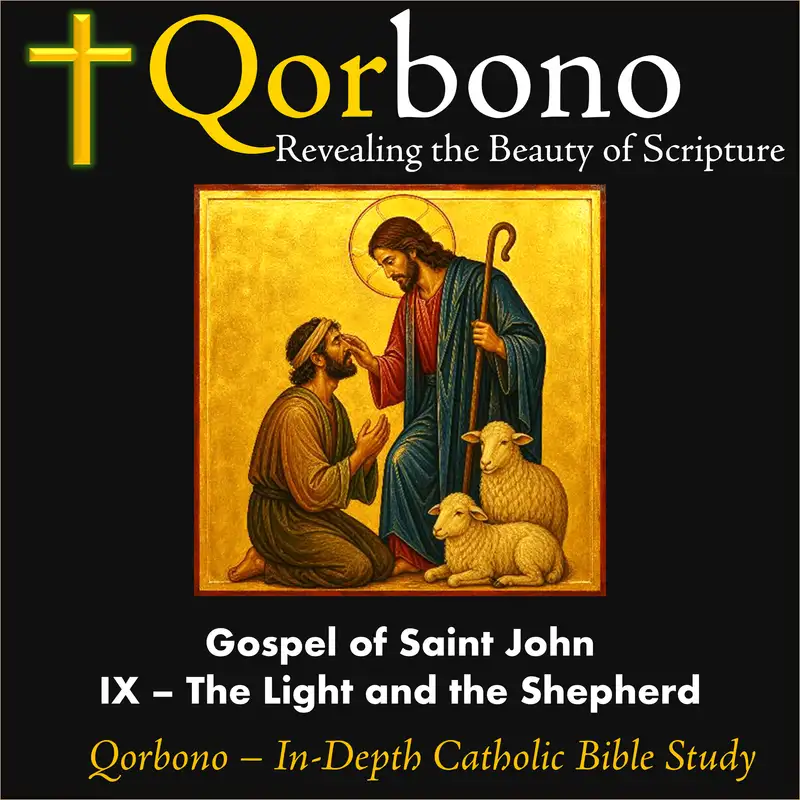
09 - The Light and the Shepherd
[00:00:08:05 - 00:00:09:04]
All right, good evening.
[00:00:10:12 - 00:00:33:24]
Welcome to this continuation of Bible study in the book of St. John. Before we begin, I just wanted to point out a few things. This is, in case you haven't been there, this is the website where all the talks are present. And if you do go to this website, the name is right here, Q-R-B-O-N-O, on top. You can see right here, that's what it will take for you to subscribe to the newsletter, which gives you all the information.
[00:00:35:00 - 00:01:09:16]
But the reason, particularly, why I wanted to show you this today is because of this particular series here, the Q&A series, where people ask me questions that I can't take in particular Bible study and answer them here. And I wanted to point out two talks I just did very recently. The first one was, "Can I Defend the Truth Without Losing My Peace?" Which is, I think, something that is significant to all of us. I did it as the behest of Paul Jonah invited me to their office. And it's sort of an impromptu talk. And they found it useful enough, so I recorded it. And out of this came another question, which is,
[00:01:11:07 - 00:01:16:02]
the first one is about an hour, this one is much shorter, "Is my salvation guaranteed if I raise the dead?"
[00:01:17:13 - 00:01:31:24]
And it has to do with the type of graces that are important for all of us, and particularly sanctifying grace. If you don't really understand the different types of graces, this is an 11-minute talk, I really suggest you listen to it. It's very short.
[00:01:32:26 - 00:02:13:06]
And most of them, not all of them, you can also watch it. So this one, you can watch it on YouTube if you don't want to just listen to it. Either way, today we are going to address chapter 9 and 10 of the Gospel of St. John. And I do hope that you had taken a minute to read those two chapters. Because I think I'm now starting to find my tempo with something like this, it's very, very difficult. There's always this very great desire to get into each of the verses, because St. John, particularly St. John, every verse is like a mini-cathedral. You can spend three days on it. But I think I'm finding my tempo in addressing the Gospel in such short format.
[00:02:14:07 - 00:03:02:28]
And what we're going to see today is really an interesting development in the structure of this study. I am preparing it as I go. And what I showed you here, this book of signs and book of glory, is the standard way in which the book of St. John is divided. You go to any commentary, you'll find this division. It's sort of an accepted division. This is why I've adopted it. This is not mine. It is essentially the one that almost everyone uses. And in one sense, it's a good division, because it sort of shows you the content. The struggle I had with it is that it's not showing you the intent.
[00:03:04:03 - 00:03:30:27]
When you look at this book of signs, book of glory, you don't really see the intent of the Gospel. What is St. John trying to do? And today, as I was preparing this Bible study, the sort of other structure came up to light. I want to share that with you today. And I think you will find it very useful. As you can see, I am mostly focused on the literal meaning and the intent of St. John and writing this Gospel,
[00:03:32:02 - 00:04:34:08]
rather than on the meaning of every specific verse. I do go into the details on difficult passages, but really that's not the focus of this Bible study. Unlike the ones I've done, for instance, on the book of Revelation, it's like a 52 lecture. I went verse by verse to the entire book. So that's a different approach. I think 52 or some number, I don't remember, it's been a while since I did this. So don't hold me to this specific number. But it's on Corbono. All right, so far, again, we've seen that there is a takeover by the Lord when he came to this world. He was the logos. He came and geographically, he did not come into Jerusalem, which you would have expected him to. He came in Galilee. Liturgically, he is starting to take on the new rites by changing them with the new one of the spirit and the living temple of his body. Financially, he's reminding people that you have to separate
[00:04:35:21 - 00:04:44:10]
what you owe God from what you owe the world. And you can't tie them so closely that you would be unwilling to serve God unless your purse is full.
[00:04:46:03 - 00:04:49:06]
And this is a temptation that we all have to contend with.
[00:04:50:21 - 00:05:22:05]
And catacatically, he begins to overtake their teaching office, which for the Pharisees was really limited to the observance of the law of Moses to the best of their abilities. And again, I hope you have a little bit of a shift in your way of thinking about it. You don't think of them as a bunch of, you know, Darth Vader evil guys. Rather, a bunch of guys who are trying to do the best they can to preserve the law and the tradition and their people in an environment in which the Roman Empire is predominant.
[00:05:23:16 - 00:05:27:07]
Once you start to see them under this light, you can start to see yourself in their shoes.
[00:05:28:09 - 00:05:38:02]
And once you start to see yourself in your shoes, now you really have a vigorous conversation with this gospel. Because oftentimes, we are really closer to them than we think we are.
[00:05:39:03 - 00:05:52:06]
And then we can look at Jesus and see what he's really asking of us. But if you go into this gospel thinking, oh, no, no, I am on Jesus' side. I mean, there's nothing for you to do. There's no tension. And if there's no tension, there's no conversion.
[00:05:53:18 - 00:06:08:11]
And so in a sense, we miss the boat. That's why it's so important not to look at them as the bad guys. Rather, look at them as people are really struggling with something that is very, very hard.
[00:06:10:11 - 00:06:15:07]
And that require God's grace to accept, which is what happens to a lot of us.
[00:06:16:12 - 00:06:24:13]
Many of us struggle with situations which are very, very hard. And we really need God's grace to help us move through them.
[00:06:26:04 - 00:06:34:14]
So I hope you take this point to heart and then shift your view of them. Try to be a little bit more sympathetic towards them instead of just looking at them as the bad guys.
[00:06:36:05 - 00:06:56:01]
Then missionally, from a mission standpoint, he moves into Samaria, which they would have never done. And we've talked about that. Judicially, he heals on the Sabbath, which is supposed to be a day of rest. But their own understanding of the day of rest is illogical. It doesn't make sense because they themselves will circumcise someone on the Sabbath.
[00:06:57:14 - 00:07:05:17]
So you can see that their understanding theologically is shallow. It is formal. They preserve the form.
[00:07:07:05 - 00:07:19:04]
It reminds me of a story I think my wife told me, which is a little funny. It's about this family, this tradition, that whenever they prepared the turkey for Turkey Day, they broke the tail of the turkey.
[00:07:20:21 - 00:07:26:02]
And the kids asked the mom, "Why do you do this?" And her answer is, "Well, because Grandma did it."
[00:07:27:06 - 00:07:31:22]
So they went and asked Grandma, "What did you do it?" And said, "Because great Grandma did it."
[00:07:32:25 - 00:07:43:10]
And I think at the time, her mom was dead, but her aunt was still alive. So they went to her and asked, "Why did mom did this?" She says, "Oh, well, because when we had the turkey, the pot was too small. We couldn't put it in."
[00:07:44:21 - 00:07:51:05]
So what happened? The meaning, the real intent was lost, and all that was left was the form that was now
[00:07:52:06 - 00:08:00:03]
preserved with some mystical intent that the great grandmother never had to begin with. And that's what these guys are doing.
[00:08:02:05 - 00:08:06:18]
And we kind of tend to do the same in many areas of our lives.
[00:08:07:19 - 00:08:16:01]
So we love the form, and then we love Jesus. I heard once a man say that unless there is an organ playing in the church, he will not go to this mass.
[00:08:18:00 - 00:08:19:11]
Well, that's the love of the form.
[00:08:20:23 - 00:08:25:09]
Now, the form is important. There are aspects of the form that makes the mass valid, and we have to preserve those.
[00:08:26:12 - 00:08:33:06]
But we don't love the form for the form's sake. We love it for Jesus' sake, right? Yeah.
[00:08:34:27 - 00:08:50:14]
Diabolically, by exposing Judas, Jesus reveals that the coming conflict rests on a demonic bedrock, meaning that he is not coming here to chase the demon away, right? Lock them in a cage and give us a safe house.
[00:08:53:01 - 00:08:58:19]
The demons will be locked in hell at the end of time. Not before. He could do that, but he's not.
[00:09:01:04 - 00:09:20:02]
So that should make us understand that any sense of perfect safety that we're desiring in this world is always be fleeting. Why? Because back to what I said a minute ago, he doesn't want us to love the house. He doesn't want us to love this world. He wants us to love him.
[00:09:21:07 - 00:09:26:04]
And he makes it perfect for us, being lazy, because we have original sin in us.
[00:09:27:13 - 00:09:36:07]
We stop loving him. It's that simple, right? If you make something very comfortable for a bunch of kids, they will stop looking at you.
[00:09:37:18 - 00:09:57:21]
Festally, at Tabernacles, Jesus fulfilled the feast's water and light rituals, revealing himself as the source of living water. So the feast was meant to point to him. It was a sign, like a sign saying, "San Diego, 20 miles." That's what the feast was supposed to be. And he came fulfilling the feast, but they just could not take their eyes away from the sign.
[00:09:59:18 - 00:10:20:26]
And filialy, he reveals the true sonship between him and God, and finally reveals himself as God, before Abraham, I am. We didn't cover that. We didn't get to it last time, but it's in the scripture. So that's what happened so far. You can see at every angle, every aspect, he comes and overtakes this entire order to establish a new one.
[00:10:22:24 - 00:10:39:28]
In this lecture, we're going to look at a new division of the Gospel of St. John. And then we're going to look at two aspects that are prevalent in the two chapters, the light, Jesus as the light and Jesus as the shepherd, and try to understand what he's doing. You can see now that his approach is going to be pastoral.
[00:10:41:02 - 00:11:12:02]
By healing the man born blind and revealing himself as the good shepherd, Jesus begins to show how he governs his kingdom. He gives sight, gather the outcasts, guards the sheep and leads them by his voice. That's in a nutshell what we're going to start to see today. So as usual, if you're keen on sending questions during the talk, you can grab this QR code and then you'll be able to send your question anonymously.
[00:11:13:08 - 00:11:17:02]
Very good. Now please stand and let's begin with the word of prayer.
[00:11:18:04 - 00:12:00:00]
In the name of the Father, of the Son, of the Holy Spirit, Amen. Together come Holy Spirit, fill the hearts of your faithful and kindle in them the fire of your love. Send forth your spirit and they shall be created and you shall renew the face of the earth. O God, who by the light of the Holy Spirit didn't struck the hearts of the faithful, grant that by the same Holy Spirit we may be truly wise and ever enjoy his consolations through Christ our Lord. Amen. Mary, seat of wisdom, Saint John, most glorious Saint Joseph, all the angels and saints.
[00:12:01:00 - 00:12:04:04]
In the name of the Father, of the Son, of the Holy Spirit, Amen. Please be seated.
[00:12:06:02 - 00:12:28:24]
So this is the why of the gospel. When we read a gospel, we read any actually any book, but particularly the gospel, you have to read it three distances. The close reading, which is verse by verse. What does this word sentence, image or action mean? And there's the narrative reading. Why did Saint John place this episode here in the sequence after what came before and before what comes next?
[00:12:30:05 - 00:12:42:13]
And finally, the covenantal reading. What is Christ doing in the economy of salvation? Establishing, governing or saving his kingdom. The danger is not close reading. The danger is close reading that forgets to step back.
[00:12:43:17 - 00:13:12:00]
And a lot of commentaries that I read tend to do that. They get into the nitty gritty of the verses and the meaning and the passages, but they can't connect them together. So you're lost. You're kind of a little bit confused. Why are they telling you all this without telling you the full intent, which really doesn't help. I'm telling you personally, I'm constantly finding the temptation to give up on the sonics in John's intent and get into the ways of each paragraph, because it's fun.
[00:13:13:01 - 00:13:16:05]
It's so fun to get into every paragraph and then interpret it.
[00:13:17:15 - 00:13:20:12]
There's so much that you can interpret that it's easy.
[00:13:21:16 - 00:13:24:23]
The weeds are holy and beneficial. Absolutely.
[00:13:25:29 - 00:13:29:17]
But losing sight of the intent isn't blindness, it's nearsightedness.
[00:13:31:15 - 00:13:36:02]
Seeing the sacred details so closely while allowing the larger form of St. John's witness to become blurred.
[00:13:38:10 - 00:13:48:18]
Means at the end, I really don't know why he wrote what he wrote. And he wrote the whole gospel as he tells us in the end, so that we may believe. And if I don't understand his intent, how am I supposed to believe?
[00:13:50:19 - 00:14:05:09]
St. John's gospel is especially dangerous in that regard, because every sentence is a little theological cathedral. So I could walk into one verse and come out three weeks later with a beer, the stack of artistic references, and no idea where the lecture went. It's really easy for me to do that.
[00:14:07:10 - 00:14:11:00]
So I say that again on the next side, bigger. Here we go.
[00:14:12:01 - 00:14:26:01]
Is it worthwhile? Yes, I can absolutely. It's absolutely worthwhile. I love to lose myself into the text and look at the concordance and the Greek meaning and the Hebrew meaning and go back to the tradition and an Old Testament. I was just, it's beautiful.
[00:14:28:05 - 00:14:36:08]
Okay. Is it survival for ordinary Catholics on Wednesday night? Barely. Unless you're willing to spend five years with me doing this.
[00:14:38:26 - 00:14:47:07]
Which is why I obsessively keep asking, what is St. John teaching us? What is his intent? If I can communicate that to you, I'll give you the map.
[00:14:48:14 - 00:14:52:11]
Once you have the map of the gospel of St. John, you need me a lot less.
[00:14:54:18 - 00:14:59:07]
And the map is not obvious now because, not because he's trying to hide it,
[00:15:00:15 - 00:15:03:03]
but because we lost the context.
[00:15:05:23 - 00:15:06:16]
So here it is.
[00:15:07:26 - 00:15:33:27]
As I was reading this chapter, asking this question again, these two chapters, what is St. John doing? It occurred to me that there is a fundamental shift that is happening between these two chapters and the prior ones. So I sort of scanned ahead to see if that intuition holds and it does. And now the gospel comes in three parts. First one is establishing the kingdom, which is what we covered from chapter one through eight.
[00:15:36:07 - 00:15:38:15]
The second part is how he governs the kingdom.
[00:15:39:29 - 00:15:46:00]
So now we move into the pastoral side of things. And it starts with this chapter and runs all the way through chapter 17.
[00:15:48:02 - 00:15:50:02]
And the third part is how he saves the kingdom.
[00:15:53:03 - 00:15:55:06]
And that is chapter 18 through 21.
[00:15:57:06 - 00:16:03:13]
When you put those three bits together, you sort of understand why St. John says, this has been written so you may believe.
[00:16:04:14 - 00:16:13:06]
It is no longer about discerning some secrets or mystery in the book, but it's giving you safety.
[00:16:15:16 - 00:16:24:08]
Jesus comes, he establishes the kingdom. He governs the kingdom. He saves the kingdom and he keeps doing this. He keeps doing this.
[00:16:26:08 - 00:16:34:20]
And he will continue doing it until the end of time. Now, the interesting thing about that structure is that that exact same structure is found in the book of Revelation.
[00:16:36:01 - 00:16:49:15]
The book of Revelation is not about the end of times. It's about how the title, the subtitle would be the perennial reign of Jesus Christ. How Christ reigns to all times and how he governs all times.
[00:16:52:05 - 00:17:03:15]
So you can, there's this sort of correspondence between this book, the book of the gospel, and then book of Revelation. They complement each other. They have the same structure, the same thought pattern.
[00:17:07:13 - 00:17:12:04]
Now, if I tell you this, you can go back and see now that the gospel really is a catechism.
[00:17:13:26 - 00:17:20:07]
St. John wasn't writing. We didn't sit down to think to himself, I'm writing something that later on, people will call it gospel.
[00:17:21:22 - 00:17:26:10]
He was writing a catechism, the first catechism to teach people why they should believe in Christ.
[00:17:29:19 - 00:17:52:26]
And the first part shows you that he establishes the kingdom, he fulfills the old covenant, and it's a new covenant. The second part now shows you, which is really the challenge for a lot of the faithful, how he governs, which is very counterintuitive. Because everybody expected him to cover the way classically a king would govern. Come in, destroy your enemies, establish your kingdom, and govern. But Christ does none of that. So it's really hard.
[00:17:54:11 - 00:18:07:17]
So St. John spends time explaining how he governs. And then finally, he gives you the key to why this sort of governance will work, which is the sacrifice and his resurrection.
[00:18:09:21 - 00:18:19:03]
Now, you put those three together, you sort of begin to understand that's the journey. This is who he is, he established it. This is the way he governs. I don't like it. None of us like it.
[00:18:22:23 - 00:18:32:21]
But here's the proof in the pudding right here. He died, and he rose. So the book of signs, the book of glory division is largely about John's literary and dramatic architecture.
[00:18:34:19 - 00:18:39:29]
This division is about the covenantal action. So it's not about the how, it's about the what.
[00:18:42:15 - 00:19:09:24]
They overlap, but they do not map perfectly onto each other. The standard division says, here are the signs that reveal him. Here is the hour that glorifies him. This division says, here's what the son is doing as king, establishing, governing, and saving the covenant people. That's not a replacement. It's a theological lens. So if I were to redo this Bible study, that's what I would start with. This division.
[00:19:11:13 - 00:19:16:09]
Because to me, it is far more practical and meaningful than the other one.
[00:19:17:10 - 00:19:20:25]
John, the gospel of St. John chapter 1 through 8, broadly speaking,
[00:19:22:08 - 00:19:31:11]
they felt like a series of overtakings where he talked about this. The Logos reclaims creation. The temple is fulfilled in his body. The old rites yield a new wine.
[00:19:32:12 - 00:21:23:06]
Jerusalem is relativized because worship is now centered in the son, not in a place. The Sabbath is revealed as the field of the father's ongoing work. It is no longer a place where you just rest. It is a place where the father is working. The manna is fulfilled in the Eucharistic bread. Tabernacles is fulfilled in living water and light. Abrahamic identity is fulfilled in communion with the son. Everything is elevated. Everything is transformed. So Jesus reveals that the kingdom has arrived in himself. He's not merely announcing a kingdom external to himself. He is the place where God reigns, the temple where God dwells, the bridegroom who brings the new wine, the teacher who speaks with divine authority, the bread from heaven, the light of the world, and the son who makes slaves free. The shift is stop looking at places, start looking at him. In him the old is fulfilled. The new is established. The king establishes his kingdom by revealing that every covenantal institution finds its fulfillment in him. So all eyes on him. Now Jesus governs the kingdom beginning clearly in John 9 and 10 and intensifying through John 17. These two chapters are the hinge. The man born blind is not merely healed. He becomes a prototype of the disciple. You want to know what discipleship is? You look at the man born blind. He receives sight, bears witness, suffers expulsion, excommunication, is found by Christ, believes and worships. That's our journey. That's a recapitulation. All of us are born blind, mired in original sin. We receive sight when we're baptized. And then we are called to bear witness through our confirmation. We're going to suffer because the world doesn't like us. But each one of us, if I were to ask you, I am willing to bet each one of you
[00:21:24:12 - 00:21:37:21]
has a moment in your life where you felt Christ's presence. And he came to you unbidden. You didn't expect it. So this Christ that comes to you, he's the one who finds you.
[00:21:39:19 - 00:21:41:06]
And then you believe and you worship.
[00:21:42:06 - 00:21:45:18]
You see now the pastoral life of the church begins in these two chapters.
[00:21:47:16 - 00:22:58:21]
In chapter 11, he calls Lazarus from the tomb. The shepherd's voice reaches even unto death. In chapter 12, he draws all men to himself by being lifted up. In chapter 13, he washes the apostles feet. The king governs through humble service, completely counterintuitive. He's reversing, he's inversing the whole structure of power. In chapter 14, he promises the paraclete. His care will continue through the spirit. 15, he reveals the vine and the branches. The kingdom is governed from within by abiding communion. In 16, he prepares the disciples for persecution, expulsion, sorrow, and witness. And in 17, he prays as a high priest for the protection, unity, sanctification, and mission of his own. So it's the deployment of the church, the deployment of the kingdom, and Christ being constantly present, always governing it. Never leaving it away. Never leaving it aside, ever. The king governs his kingdom by shepherding, cleansing, teaching, protecting, sanctifying, and uniting his own. And then lastly, Jesus saves the kingdom. That's in John 18-21. That's the third movement, which is the Passion, Resurrection,
[00:23:00:04 - 00:23:48:29]
and Restoration of Peter. And that is so critical. That is not some sort of an aside, the last chapter. It isn't some aside. It is integral to the passion and resurrection. The calling of Peter, feed my sheep, feed my lamb, feed my sheep three times. That is integral to the whole thing. Jesus does not save the kingdom by escaping suffering, crushing Rome, or overthrowing the Sanhedrin, which is what normally everybody would expect. Which is what now we keep on expecting. Can't tell you how many, so many people are involved in the struggle of the day, whether in the pro-life movement, or in legislation, or in politics. What is, if you were to sit them down and ask them, what is it that they desire? You will see that it's the same thing. They want abortion completely gone.
[00:23:50:10 - 00:24:03:29]
They want all these bad politics to go away, etc., etc., etc., which is exactly what the disciples wanted. They wanted Rome gone. They wanted a Jewish kingdom, a Jewish king, and everything in place.
[00:24:05:00 - 00:24:16:29]
So that is a natural desire of the heart. In principle, there is nothing wrong with it. If you desire that, it means you are fighting the good fight.
[00:24:19:01 - 00:24:23:29]
The trick, the subtle trick, the difficult one.
[00:24:25:13 - 00:24:38:00]
Is that, back to what I was saying earlier, you're loving the result, instead of the giver of the result. If I'm going to love Jesus, because Jesus is giving me what I want, do I really love him?
[00:24:39:16 - 00:24:41:06]
Or is he Santa Claus?
[00:24:43:00 - 00:24:49:22]
So many of us have in our hearts that Jesus, that's Christ, where we itch.
[00:24:52:08 - 00:24:57:10]
And by the way, this is a fruit of concupiscence. This is a problem with original sin.
[00:24:58:16 - 00:25:21:03]
So I don't want you to be, I'm not trying to guilt trip you here. It is part of the problem that we inherit because of original sin. But if you start to be aware of it, then you start to ask these questions, the important ones. Am I really loving Jesus or not? And what am I supposed to do to love him? Really authentically love him.
[00:25:23:23 - 00:25:29:06]
And that question, if you can ask yourself that question, that's the buried treasure. You just found it.
[00:25:30:09 - 00:26:12:21]
The king saves his kingdom by laying down his life, rising again, breathing the spirit, and entrusting his flock to a postolic shepherding. Not safety, no guarantee, no control, love. So threefold movements, established in the kingdom, one through eight, governing the kingdom, nine through 17, saving the kingdom, 18 through 21. And we're going to continue seeing this as we go. I'm now replacing the classic book of signs and book of glory division. It asks a different question. This is about literary division. It asks how St. John arranged the gospel. This is a governmental division asking what Jesus is doing as a king.
[00:26:13:23 - 00:26:14:29]
And I will leave it at that.
[00:26:16:06 - 00:26:29:03]
Now, why is John nine through 10 the pivot? In these two chapters, there is this second movement that becomes visible. Before this chapter, Jesus has certainly cared about four individuals.
[00:26:30:09 - 00:26:55:21]
He cared, for instance, for the couple getting married at Cana, for Nicodemus, the Samaritan woman, the official son, the paralytic, the hungry crowd. He cared for people. So it's not like suddenly that Jesus doesn't care about anybody before. Now he's starting to care about someone. That isn't the distinction. The distinction is that the caring becomes more ecclesial.
[00:26:56:24 - 00:27:00:27]
The structure of the church begins to appear and governmental.
[00:27:02:09 - 00:27:51:09]
The man born blind is not merely an individual recipient of mercy. He becomes a sheep mistreated by false shepherds and gathered by the true shepherd. Now we see movement. We see full movement of continue talking where this thing is thinking about what it needs to do. And whereas before with the Samaritan woman, there was a conversation, there's a conversion and then Jesus leaves with the wedding feast at Cana. He turns water into wine and then he leaves. Here we see the full movement from being blind to becoming a follower and being excommunicated by the Pharisees. The question now is no longer who is Jesus. It becomes how does Jesus gather and rule those who belong to him?
[00:27:52:23 - 00:28:15:25]
And the answer in these two chapters is by his voice, by his truth, by his self-gift, by his protection, by his prayer, by his sacrifice. And notice all those aspects of governing are the aspects of governing we don't like because they're all internal and hidden and we want external, clear-cut, objective.
[00:28:17:00 - 00:28:18:07]
And he's not going to do that.
[00:28:19:19 - 00:28:56:08]
He frustrates us with this notion that we're going to be able to have perfect governments, perfect structure, perfect church, because we are catering to our own selves. We're still trying to save ourselves when we want those things. So always remember in chapter 8, "Walking on the water, as soon as he stepped on the boat, they arrived where they're supposed to be." Guess what? We don't like that. If I told you, if you have Jesus right now, you are where you're supposed to be, you might not politely but deep down you're frustrated because you have a list of needs and wants that is sky-high.
[00:28:58:18 - 00:29:00:18]
And what I just said doesn't give you that.
[00:29:03:29 - 00:29:09:09]
And between the distance, between this list that you have and the person of Jesus is the whole journey of conversion.
[00:29:11:09 - 00:29:14:11]
Saint Therese Little Child Jesus said towards the end of her life,
[00:29:16:09 - 00:29:31:04]
I used to, I wanted to do all these great things like go on mission, convert people and all of that. Now, now the mere desire of those things is sufficient for me
[00:29:33:01 - 00:29:41:25]
because in the mere desire of those things, there is the love of Jesus. So with that in mind, let's move into the light.
[00:29:42:29 - 00:29:45:17]
In the Gospel of St. John chapter 1 through verse 12,
[00:29:46:18 - 00:29:58:15]
Jesus passed by after the temple confrontation. During Sukkot, he's passing by. We don't know where he's passing by. St. John doesn't tell us but that's beautiful.
[00:29:59:21 - 00:30:06:04]
He's passing by. So Jesus may be passing by you. You're not going to notice.
[00:30:08:19 - 00:30:10:25]
You're not going to notice when he passes by you.
[00:30:13:03 - 00:30:37:05]
Now, as he passed by, he saw a man blind from birth. So the movement here is sort of striking because in the end of chapter 8, Jesus made this majestic proclamation before Abraham was I am. And he leaves a scene of rejection where they were about to stone him. He doesn't retreat into self-protection.
[00:30:38:09 - 00:30:40:07]
He passes by and sees a suffering man.
[00:30:41:08 - 00:30:48:09]
The leaders have seen Jesus and reached for stones. Jesus sees the blind man and gives him sight.
[00:30:49:18 - 00:30:57:12]
Watch how he completely ignores this whole aspect and doesn't stray away from the focus of his mission.
[00:31:00:10 - 00:31:10:27]
The fact that these men want to stone him, the fact that he's rejected doesn't seem to create any sort of anxiety in him. Doesn't seem to make him think, "Oh, the end of the world is about to come."
[00:31:14:02 - 00:31:25:25]
He stays focused on what he's supposed to do. Now, the disciples ask because they see a theological problem. "Rabbi, who sinned? This man or his parents that he was born blind?"
[00:31:27:08 - 00:31:35:26]
So they look at the man. Now, the question is not wrong. It's not a bad question.
[00:31:37:10 - 00:31:38:17]
That's not the irony.
[00:31:39:19 - 00:32:02:15]
It's not that they're asking a bad question. They're asking a good question. We've talked about covenant and the curses and the blessings, and some blessings go down the generations and some curses go down the generations. That's in the scripture. That's what they're basically quoting. No, no. That's not what the focus is. The focus is there is a blind man.
[00:32:03:26 - 00:32:24:24]
What they're seeing is a theological puzzle. So let's all of us go outside, see someone who's homeless, and stand around him and then ask God, "Lord, who sinned? This man or his parents? In front of him. How would you like that?"
[00:32:27:04 - 00:32:29:14]
That's what they're doing.
[00:32:30:15 - 00:32:43:07]
So you see these fairs-eig tendencies were also present in the apostles. Now, what is beautiful about our Lord is that he doesn't abrade them. He doesn't tell them, "Why aren't you seeing this poor man?" He answers the question.
[00:32:45:11 - 00:32:49:08]
And the question, again, is a hard one.
[00:32:51:29 - 00:32:59:23]
It is part of the kingdom. It is part of what it means for us to be in the kingdom. Memorize this.
[00:33:00:27 - 00:33:37:13]
Absolutely memorize his answer. "He, this man, is blind for the greater glory of God." This man is blind for the greater glory of God. Now, if you have an ailment, if you have a pain, if you have a tough situation that you're going through, replace this man with that and say, "It is for God's greatest glory."
[00:33:38:22 - 00:33:40:09]
And then see how you feel about that.
[00:33:41:15 - 00:33:54:11]
Original sin doesn't want us to do anything for God's glory. That's part of the rebellion that we inherited when Adam and Eve rebelled. We want to do things for our own glory, not God's glory.
[00:33:56:03 - 00:34:21:00]
Again, yeah, politely we nod and we say, "Yes." But deep down, when we're pressed, that's really what we want. That's what it means to be converted. That's what it means to be discipled, is to let go of those tendencies and then really trust that God is going to take care of everything. That is very hard for us to do. So then comes the strange healing method. "He spat on the ground, made clay of the spittle, and then known in the man's eyes with the clay."
[00:34:23:01 - 00:34:33:10]
Why? Usually, it's like, you know, be healed. We're done. But which most of us like, right? Nothing is messy. This is messy.
[00:34:35:23 - 00:34:43:28]
Can you imagine during COVID, if Jesus came to do this, they'll arrest him? You know, spitting and then putting that on somebody's eyes.
[00:34:45:15 - 00:34:49:03]
Can you imagine somebody, instead of this guy being blind, he had COVID.
[00:34:50:07 - 00:34:54:28]
And Jesus came and spat and tried to heal him. That guy may call the police.
[00:34:56:24 - 00:35:00:26]
It's not a... right? So why did he do that?
[00:35:02:02 - 00:35:33:24]
Well, because it is re-creation. We go back to Genesis, where God took some dirt from the ground, breathed on it to make man. This is the new creation. Already said that the problem that the Jews had with the Eucharist was when he told them, "You have to drink my blood." That meant you must be excommunicated. You must be cast out of the covenant of Adam and Noah in order to join my covenant.
[00:35:35:20 - 00:35:55:11]
That's the casting out. It's a new creation. And that's why he chooses this method. It is a new creation. So this recalls Genesis, man from the dust of the ground. Jesus acts as creator. He's not repairing a defective vision. He is affecting a new creation.
[00:35:56:21 - 00:36:02:13]
Then he sends the man to wash in Siloam, which meant sent. Funny enough.
[00:36:03:16 - 00:36:14:07]
So Paul of Siloam and St. John says, which meant sent. So what is he now? What does he mean to be a disciple? Is to be sent. Your new creation in Christ, you're sent.
[00:36:15:16 - 00:36:20:10]
That's where we see the hinge, the change from chapters 1 through 8 to this one.
[00:36:22:27 - 00:36:41:10]
So the early church's baptismal language also echoes here. Baptism is called enlightenment in the Catechism. This bath is called enlightenment because those who receive this catechetical instruction are enlightened in their understanding. That's the Catechism in the Catholic Church, paragraph 12-16.
[00:36:44:01 - 00:37:00:06]
And so in this action, the light of the word which Christ had said he was in chapter 8, is now given to this man as a new creation and gives him sight. The sight isn't just physical, it's spiritual, as we shall see in the moment.
[00:37:02:10 - 00:37:04:16]
The sign now, this man becomes a trial.
[00:37:05:19 - 00:37:06:10]
He is judged.
[00:37:07:22 - 00:37:10:08]
The authorities cannot rejoice, they interrogate.
[00:37:11:15 - 00:37:14:03]
Their focus is, oh he did this on the Sabbath, this is possible.
[00:37:16:04 - 00:37:31:00]
The healed man's confession grows under pressure. So why is he brought before the authorities to give glory to God? Why are you disciples? Why are you in the Catholic Church to give glory to God? Why do you go to Mass on Sunday to give glory to God?
[00:37:32:02 - 00:37:57:16]
One area I find kind of problematic, I won't say it's imperfect, it's problematic. It's problematic because it really makes you work against that. This is the prayers of petition. The longer you pray a petition, the more people you have on the list, the greater the tendency to treat Jesus as Santa. Because you're obviously praying for Jesus to do things you want him to do. You are in control.
[00:37:58:22 - 00:38:11:25]
Think about that. If you're wondering what I do, I have long ago done the consecration to our lady through Saint Louis de Montfort and when you are consecrated to Mary through Saint Louis de Montfort, you become her slave.
[00:38:12:26 - 00:38:20:28]
And one thing Saint Louis de Montfort asked us to give up is the freedom to pray for what we want.
[00:38:22:23 - 00:38:27:26]
And so the only thing I pray for are the intentions of our lady, nothing else.
[00:38:29:05 - 00:38:31:23]
So now the healed man's confession grows under pressure
[00:38:33:19 - 00:38:35:15]
and then the opposite happens to the authorities.
[00:38:36:28 - 00:38:38:20]
The more he believes, the less they believe.
[00:38:40:10 - 00:39:22:22]
The parents are brought in to testify, was he your son blind? And they're afraid. So why are you asking us asking him? He's of age, nothing to do with it. Now, did Jesus know this is going to happen? Did he know that the authorities are going to act this way? Oh yeah, he did. Was he provoking them on purpose? Not really. He's not trying to upset them, but he knows that as soon as we start to establish the kingdom, it will create division. That is unescapable because when the truth comes, you either accept it or you're rejected and you have a division. The authority cast the blind man out.
[00:39:24:06 - 00:41:09:00]
He's excommunicated. That's what the casting out means. He's thrown out of the synagogue. He's no longer part of the synagogue. So the entire social life of this man collapsed. Jesus wasted this moment when he's cast out to find him. And he asks, do you believe in the son of man? The son of man, like I mentioned before, is one of the highest Trinitarian title that our Lord can take because it hearkens back to Daniel. I saw one like a son of man standing next to the throne of God. So it is a divine title. Do you believe in the son of man? The man says, Lord, I believe. There you go. When he lost everything, when he's excommunicated, when he had nothing, he found everything. That's our journey, all of us. As long as we're clinging to things, they're interfering. They're creating interference between us and Jesus. As long as you're clinging to possessions, spouses, children, thoughts, desires, all of those create interference between you and Jesus. And to let go of all those things doesn't mean you stop loving them. Means they are subordinated in that love to the glory of God. Doing everything for God's glory is the purpose of our life. And doing it without expecting anything in return. And then Jesus declares, "For judgment I came into this world that those who do not see may see and those who see may become blind." This is covenantal. This is the blessings and the curses of the covenant. Jesus by himself brings up the truth and the truth is either accepted and turns into blessing or rejected and turns into curse. Jesus tells them, "If you were blind, you would have no guilt, but now that you say we see your guilt remains."
[00:41:10:01 - 00:41:34:15]
And what a terrible thing to hear. Your guilt remains. There is no way you will make it into heaven as long as this guilt remains. So in this movement in chapter 9, the man is brought in, he's healed, he goes through judgment, he's excommunicated. Jesus finds him, he makes a profession of faith. He went from being a blind man to being a believer and seeing Jesus.
[00:41:35:23 - 00:43:20:05]
That's what the light does. But Jesus doesn't just bring the light and leave us there. Now that you found the light, now that you became a believer, you meet the shepherd. Which is why these two come together. So the blind man is a model disciple. And in chapter 10, Jesus himself is explaining chapter 9. It is his commentary on what happened. So Jesus categorizes people as thieves, robbers and strangers, those are the outsiders, sheep and the sheepfold. And then there is the shepherd who's the gatekeeper, the door and the shepherd's voice. So the shepherd voice is the one who enters by the door. He is the shepherd of the sheep. The sheep hear his voice and he calls his own sheep by name and leads them out. So the more you actually spend time in sort of meditative prayer, not prayers of petition, but you're meditating, you're trying to understand, you're trying to contemplate Jesus' beauty. The more you become attuned to his voice, the moment of your death, the demons will launch a wicked attack. They will try to overwhelm your reason. As your senses are failing, you can't hear, you can't see, you're still alive, you're in darkness. That's when they will launch their worst attack. That's when these words become important. Can you hear his voice? Will you recognize it? If you're not training yourself now in prayer, if you're not sitting quietly and contemplating and listening to his voice, how will you listen or hear this voice?
[00:43:21:16 - 00:43:42:14]
During this moment. So if you're like me, stubborn as a donkey and have a really, really hard time with all of this, you want a contingency plan, right? You think to yourself, I can't do that. I'm not that strong. I'm not that smart. I'm not going to be able to hear it anyway. I don't hear most of the time what people say. So why would I hear?
[00:43:43:18 - 00:44:04:01]
I want a contingency plan. The contingency plan is called the Rosary. Holy Mary, mother of God, pray for us sinners now. Now, if you think that if the mother of God were to stand by your side while you're dying, do you think any demon will even dare come close? So I don't know about you.
[00:44:05:05 - 00:44:56:07]
I like contingency plans. The keyword here is voice. The healed man in John 9 heard the voice first before he saw Christ. He recognized the truth of Christ's work before he understood everything. He responded to the voice. The authorities, despite their office and learning, did not. The image is covenantal. The image of a shepherd in the Old Testament. Shepherds are rulers. Kings, priests and leaders are supposed to care for God's people. They're supposed to be like shepherds. But Ezekiel condemns the false shepherds. The weak, you have not strengthened. The sick, you have not healed. The cripple, you have not bound up. That's in Ezekiel chapter 34 verse 4. Then God promises, I myself will be the shepherd of my sheep. That's Ezekiel 34, 15. And that's what Jesus is completing here.
[00:44:57:09 - 00:45:08:08]
He is the shepherd of the sheep. He is the fulfillment of this promise. Jesus is not merely a kindly rural image. He is the divine shepherd come to rescue the flock from failed shepherding.
[00:45:09:18 - 00:45:25:24]
And then the catechism draws this directly into the mystery of the church. The church, the catechism tells us in 754, is a sheepfold. The sole and necessary gateway to which is Christ. It is also the flock of which God foretold that he himself would be the shepherd.
[00:45:26:24 - 00:46:28:29]
So in the Gospel of St. John, verse 1 through 6, Christ governs his kingdom not by force, but by his voice. He calls the sheep here. They follow. They flee the stranger. That is why the blind man is a model disciple. He hears the voice of Christ and follows it even when following costs him his place among men. And then Jesus makes this image explicit. He makes his intent abundantly clear. I am the door of the sheep. The door is about access and safety. No one enters unless through Christ. No one is truly shepherd unless it is Christ. And you have to get into a relationship with him in order to enter. You see the pastoral side of this whole thing now. You must as a disciple work on creating and fostering and deepening your relationship with Christ. I came that they may have life and have it abundantly. That's what he came. This life is not mere survival. It is a covenantal life. It is communion with Christ. It is a divine life shared with the flock.
[00:46:30:01 - 00:46:54:02]
I am the good shepherd. The good shepherd lays down his life for the sheep. That's the great declaration. This is where the shepherd theme becomes explicitly Pascal. This is the link with what is going to come in part three. Christ governs by his self-giving. His authority is not a higherling authority. He is the good shepherd who protects, who lays down his life for his sheep.
[00:46:55:13 - 00:46:57:04]
This points forward to the passion.
[00:46:58:07 - 00:47:33:06]
He lays down his life freely. So all of us are called to do the exact same thing. We are called to imitate him. We also foster the king. We foster the kingdom. We bring the voice of the king to others. We lay down our lives so others may have life in imitation of him and for his greater glory. That is what we call to do. And we're called to do this joyfully because if we believe in him, we believe in his glory and we hope to one day behold his glory, then the beauty of that glory will be our happiness. That's what we are called to do.
[00:47:34:19 - 00:48:54:03]
Then in this part, not only that Jesus does this great declaration for the Jews, he widens it and says there are other sheeps that he needs to go and bring into the sheepfold. It is a universal declaration of Christ's kingship. He is to govern the world and he is basically establishing universal Catholic Church when he says this, which then leads to a deeper division because some would say he has a demon in him and others among the Pharisees are saying, well, he has a demon, how come he heals the way he did? How come he can produce these signs? So among the faithful, this leads to peace, contentment and joy. Among those who oppose Christ, it leads to division and squabble. And so during the Feast of the Dedication, it happens a few months later. It is the feast during which the Jews basically rededicated the temple after it has been desecrated during the Maccabean era when the temple had been turned into for a brief moment into a Greek temple. And then when the Maccabees came and then kicked all those guys out, they rededicated the temple. It happens around Christmas. It's about three months after Sukkot, which happens about closer to Pentecost. Okay. And during so now we're thinking about dedication.
[00:48:55:08 - 00:52:36:18]
We're bringing back the theme of the temple. And this is not random because in chapter two, Jesus already revealed himself as the true temple, destroy this temple. And in three days, I will rebuild it. St. John explained, but he spoke of the temple of his body. So the true consecrated presence is no longer the temple, but it is the one who is consecrated. The one who is essentially the one who is God present himself, not in stone, but as the son. They tell him, if you are the Christ, tell us plainly. And Jesus answers by appealing to his works and to the sheep. My sheep hear my voice and I know them and they follow me. And as I appealed back then, he appeals today through the life of the church. At one point in Rome, when Napoleon came in, there was a man, a cleric who came to see the Holy Father and told him, your holiness, Napoleon is here. He wants to destroy the church. And the Holy Father looked at him and said, but that's impossible. We tried and we failed. So all the corruption and all the difficulties and all the challenges you see in the church aren't a sign of weakness. It's a sign of strength. The Catholic Church is the only institution who lasted for 2000 years. There is no other one. No other institution lasted for 2000 years in spite of all the corruption, weaknesses and challenges that was always present in the church throughout her entire history. That is the presence of Christ. But like I told you, he's not going to give us safety. He's not going to give us security. He's not going to make it nice. Because as soon as he does that, we create idols. Our eyes shift. We no longer focus on him, focus on everything else. He then reiterates, I and the Father are one. And the logic is profound. The sheep are in Jesus's hand. The sheep are in the Father's hand. Jesus and the Father are one. The unity of the Father and the Son is revealed through the protection of the flock. That is Trinitarian. That is the will of the Father, the Son and the Holy Spirit. That we remain as one in God's presence. And then that results in the stones being brought back. As soon as he says, I and the Father are one, all I can think of is stoning him. They understand the magnitude of the claim because they tell him, "You being a man make yourself God." They reject it, but they do not miss its force. And the chapter ends with Jesus withdrawing before, beyond the Jordan. And there many believed in him. Again, the irony. Outside of Jerusalem, many believed in him. In Jerusalem, there was one guy. In John 9-10, St. John shows how Christ governs the kingdom he has established. The light gives sight. The truth exposes false shepherds. The cast out sheep is gathered. And the good shepherd reveals that his flock is safe in the hand of the Son and the Father. So what we've seen is a novel division of the Gospel of St. John in three parts, establishing the kingdom, governing the kingdom, and redeeming the kingdom. And then we've seen that these two chapters are the pivot. The light of the world gives sight to the man born blind. Turns him from being blind into a disciple. The sign, him, the man becomes a trial. And the judges are judged. Through that trial, the judges are judged. Interesting, huh? So you think that if Catholics are brought before judges, the Catholics are being judged. Actually, it's the judges who are being judged. The cast out man becomes the model disciple. The false shepherds are exposed. The good shepherd gathers, guards, and gives his life. The kingdom Christ established is now shown under his care. And I'll leave you with this. Do you hear the shepherd's voice? Do I let Christ give me sight?
[00:52:37:22 - 00:52:50:14]
Do I cling to the light when witness becomes costly? Do I recognize false shepherding when it flatters, frightens, or controls? Do I trust the good shepherd when I feel cast out?
[00:52:51:20 - 00:54:13:16]
Do I live as one held in the Father's hand? At the end of the day, we're doing all this. We go to church. We live our life as faithful Catholics for only one reason. To bear witness to the truth, to the light, and to the good shepherd for his glory and not for ours. God bless you. We'll take a quick break and we'll come back in five, four questions. Actually, why don't we just end with the word prayer? So in case you need to leave, you can do so. Please stand in the name of the Father, of the Son, of the Holy Spirit. Amen. Lord Jesus, we want to thank you, praise you, glorify you for your word, for Scripture, for Saint John. We want to praise you for every good inspiration you have given us tonight. We ask you to send forth your Holy Spirit upon us to give us the courage and the grace to put them into effect. And we ask this through intercession of Mary, most holy as we pray. Hail Mary, full of grace. The Lord is with thee. Blessed art thou among women. And blessed is the fruit of thy womb, Jesus. Holy Mary, mother of God, pray for us sinners now and at the hour of our death. Amen. In the name of the Father, the Son, and the Holy Spirit. Amen. So we'll take five minutes and come back for questions.