03 - Behold the Lamb of God
We're now beginning our third lecture in the series on the Gospel of St. John.
Welcome.
Happy to see you all here tonight.
We're going to go through a series of episodes in the life of our Lord,
and it's going to be fast-paced.
I'll tell you right now, it's going to feel like a sip from a fire hydrant.
There's a lot of stuff I'm going to throw at you you probably haven't heard before.
My recommendation, go back and watch or listen to this talk twice or maybe three times,
and it'll start to come together.
So far, we've talked about the content and intent, and this is something really important.
What was the intent of St. John when he wrote this Gospel?
I told you that my perspective is that St. John wrote this Gospel before 70 A.D.,
and the dating is going to be very critical.
I'll show you why in a minute.
And he had a very specific intent to show you that the Lord Jesus Christ is a strong party.
He has come to conquer and to establish his kingdom.
And then in the second part, which is the book of Revelation, he shows you how he roots.
We've talked about the heart of the matter, the prologue, the Trinitarian theology,
the herald and king.
We didn't go through the tabernacle of flesh.
We didn't have enough time.
I'm going to try and cover it tonight briefly before we get into the content for this lecture.
So tonight, we'll cover very briefly tabernacle of flesh, and then we'll go through the first three days.
Then the fourth day when he meets Nathaniel, the wedding feast of Cana, the temple, and conclusion.
Obviously, this is not a verse-by-verse study.
If it were, it'll take us three years to go through it.
And I don't know if you'll have the patience to go through a three-year study,
which is why we're going through this format.
Again, as usual, if you want to phone your questions while I'm giving this lecture, grab this QR code.
This will allow you to essentially use your phone to write any question you think you'd want to have addressed
while we're talking.
Otherwise, you'll feel free to obviously ask questions afterwards.
That's done just as a convenience in case you'd like to use it.
Please stand.
In the name of the Father, of the Son, of the Holy Spirit. Amen.
Together.
Come, Holy Spirit, fill the hearts of your faithful, and kindle in them the fire of your love.
Send forth your Spirit, and they shall be created, and you shall renew the face of the earth.
O God, who by the light of the Holy Spirit did instruct the hearts of the faithful,
grant that by the same Holy Spirit we may be truly wise and ever enjoy his consolation.
Through Christ our Lord. Amen.
May I receive the wisdom?
Thank you.
St. Joseph.
Thank you.
All ye angels and saints.
Thank you.
In the name of the Father, of the Son, of the Holy Spirit. Amen.
Please be seated.
I was just chatting with a few of you a little earlier, and then somebody very kindly pointed
out that I'm challenging.
I suppose you've got that by now.
But I'm not challenging because I want to be challenging.
I'm challenging because that's the truth.
That's all there is to it.
So, last time we tried to address the tabernacle of flesh, which is part of the prologue, and
I didn't get to it.
But I'm going to summarize it for you today, and there's one thing I'm going to say that
I want you to remember.
This is absolutely key.
It is key for the entire Gospel of St. John.
We have a little bit of a misconception about the Gospel of St. John because we are really
taken by the poetry and the beauty and the mysticism, which is all good and well.
However, it is not the fundamentals.
The Gospel of St. John is not just that, which I hope to show you today.
The tabernacle of flesh is this,
And the word became flesh and wealth among us, full of grace and truth.
We beheld his glory, glory as of the only Son from the Father.
John 1.14
What I really want you to focus on is this, the tabernacle was the stent that was built
in the wilderness.
The tabernacle was built after the golden calf.
The purpose of the tabernacle was for God to be separate from his people.
There was no, in plan A of Exodus, there was no mention of a tabernacle.
God would dwell in the midst of his people.
The book of Exodus, half of it, half of the book is on the construction of the tabernacle.
Before the golden calf, God knew already what his people were going to do, and he prepared
for it, so he built the tabernacle.
Key element of the whole tabernacle, the fire inside the tabernacle was not lit by human
hand.
It was lit by God directly, representing the presence of the Holy Spirit.
Right?
So, when you read these words, because they're beautiful, you're taken by the poetry, and because
you're disconnected from that content and the context, you don't really understand the thrust
of the matter.
To a Jew, to somebody really seeped into the drama of their time, dwelt among us, resonates.
That's a bomb that is being thrown at them.
God doesn't dwell among his people.
He is separate.
He was in the tabernacle, then he was in the temple, in the Holy of Holies, completely closed.
Nobody can get there, except the high priest, once a year.
Did you know that they used to tie a rope around the high priest in case he walked into the Holy
of Holies and was killed, so he can pull his body out?
Because they can get in.
God is all separate, dwelt among us.
That is huge.
We beheld his glory.
There's no way you're supposed to behold the glory of God.
It is hidden.
Those two elements is what I want you to focus on, because that's going to play a massive
role in what's going to happen right now.
So, the presence of God has shifted from stone to sacred flesh.
That is the summary of the distinction between the Old and the New Testament.
That.
And we are used to this, so we don't feel it.
But I want you to be able to feel it, so you understand the thrust of the text and the
intent that St. John had in mind.
Why is that important?
Because if you don't understand that, you'll misinterpret it.
And if you'll misinterpret it, you'll be worshipping the wrong God.
I told you, I'm not doing this to form theologians.
I'm doing this so you can deepen your faith and come to know Christ as he wants you to know
him.
Because, my friends, let's be honest, brutally honest.
We're all hypocrites.
Yeah, we say they will be done, but there are a few caveats.
So, that's where our struggle is.
It's right there.
And Christ knows that.
He knows that that's where we're struggling.
But the more we know him as he is, the clearer that struggle is.
Okay.
So, I'm going to skip all that, and I suggest you go check it out when you go through this.
Because I don't have time for this today.
You want to hit straight up into the first three days.
So, the first three days, and this is where it starts.
And this is the testimony of John when the Jews sent priests and Levites from Jerusalem
to ask him, who are you?
What do you say about yourself?
He said, I am the voice of one crying in the wilderness.
Make straight the way of the Lord, as the prophet Isaiah said.
That was the first day.
The next day, he saw Jesus coming toward him and said, behold the Lamb of God who takes
away the sin of the world.
And then the third day, the next day, again, John was standing with two of his disciples,
and he looked at Jesus as he walked and said, behold the Lamb of God.
Okay.
In this, this is not the full passage.
In this passage, what they really drill him, are you the prophet?
No.
Are you one of the prophets?
No.
So, he's not a prophet.
He's not the one to come.
He's not the prophet, which is essentially the one who is like Moses.
He says all that.
Why?
Because he's the herald.
He is the king's herald.
Okay.
He's not a prophet.
He's the king's herald.
But he doesn't say more because the king has not yet come.
The king, he doesn't yet recognize the king is coming, and when the king comes, he will
say what needs to be said.
However, he says this, I am the voice of one crying in the wilderness.
Make straight the way of the Lord, as the prophet Isaiah said.
Now, again, you can be taken by the poetry of it and think, oh, that's so cute or beautiful.
But there is something so fundamental and important that is happening here, and we're going to get into this in one minute.
Now, here's the key.
I want you to look at this.
Everybody tells you, John starts his gospel in the beginning because of Genesis, right?
In the beginning, everybody goes Genesis.
Fine.
But why?
What is the intent?
What is he saying?
More importantly, what is he not saying and assuming you know?
To figure that out, you have to look at the differences between what happened in Genesis
and what happens in the Gospel of St. John.
So, in a creation account of Genesis, you have the sun, the moon, and the stars, which are present and prominent.
In the case of the baptism in the Jordan, they are present but subdued.
There is no mention made of them.
So, this tells you immediately that the focus of St. John isn't about the natural order.
He's not after that.
There's something else going on here.
The land.
In the case of Genesis, the land is essentially fertile and bountiful.
It's producing the good things that you need to eat.
It is there for you.
In the case of the Gospel of St. John, we are in the wilderness.
It's a little bit like when you drive away from the ocean in California.
Not very fertile and bountiful.
The land, in a Jewish mind, always represents the people of God.
But, the water, the sea, Tehom and Behom, is the way that we describe it, is chaos.
And it represented the Gentiles.
You see?
So, when Jesus, in the Gospel of St. Matthew, in the Gospel of St. Luke, says,
if you could tell to this mountain, be uprooted and move into the sea, it would do so.
And people think physically.
But what he was saying, the mountain is the Mount Zion.
Be uprooted from the land, meaning from the kingdom of Israel.
And be thrown into the sea, meaning among the Gentiles.
That's the implication.
Right?
Meaning, you could convert the Gentiles if you had a little bit of faith.
Not, sit down and do some physical lifting.
So, that's why, here, the land is fertile and bountiful, but now it's wild and deserted.
It used to be, now it's wild and, it is not serving its purpose anymore.
Why?
Because the tabernacle of stone is no longer servicing its purpose anymore.
Water is teeming with creatures and monsters in the book of Genesis.
And now, in the baptism of the Jordan, what is it teeming with?
Who are in the water?
Who's in the water?
Sinners.
Finally, that's the most important thing.
The Spirit.
In the book of Genesis, the Spirit is present from the beginning of creation.
It's hovering over the earth.
It's the first or second verse in the book of Genesis.
Where's the Spirit here?
Completely absent.
There is no Spirit.
Until Jesus comes.
Hmm.
Why is that important?
So, when Jesus comes, He comes and the Spirit comes upon Him and He's filled with the Holy Spirit.
Did this happen before?
See, when you interpret Scripture, you have to look at Scripture in the context of all of Scripture.
You ask this question, where do we see that before?
To a Jewish mind, by this I mean somebody who is tied to the temple, to the tradition of the Jews.
Because that makes zero sense.
That is sacrilegious.
And I'll show you why in a minute.
But then you start looking and say, where in the Scripture do we see individuals who are filled by the Holy Spirit?
Well, we start with Bezazel.
Bezazel is a guy you don't know much about him, but he's super important.
He's the guy who built the tabernacle during Exodus.
So, filled with the Spirit of God to build the tabernacle.
Exodus chapter 31 verse 3, 35 verse 30.
And then, when the temple was built, there was a divine fire that ignited the altar, consuming the sacrifice.
Leviticus 9.24.
The next guy to be filled with the Spirit is Joshua, or Jesus.
Another way of saying Jesus.
The man who led them into the Holy Land.
So, observe.
Specific guys were filled with the Spirit because they had a mission to accomplish.
One was to build a tabernacle.
One was to lead them in a promised land.
So, the coming of the Spirit, filling somebody, represents a mission.
Something is about to happen.
Alright?
The third guy is David, who consecrated the site for the temple, and blessed the people as the ark entered Jerusalem.
In 2 Samuel 6, 17 and 18.
The Spirit came mightily upon him.
He prepared the house for his son.
And then finally, Solomon, when the glory fills the house in 1 Kings 8.10,
And the temple fire is lit from the original tabernacle, fire, in 2 Chronicles.
So, that heavenly fire that was in the tabernacle when it was built is the same fire that lights up the fire inside the Holy of Holies in the temple.
Representing the presence of the Spirit.
Now, here's the other key element.
The temple was built by Solomon, the Holy of Holies.
Why do we call it Holy of Holies?
Because in Hebrew, there are no superlatives.
You can't say, good, better, best.
You have to say, good.
Then if you say, better, you have to say, good, good.
You double it.
And if you want to say, best.
You say, good, good, good.
Which is the best.
Which is why, right before the consecration, you're all saying what?
Holy, holy, holy.
Why?
The holiest.
Okay?
So, the temple was built, and the Holy of Holies, that is Shekinah.
The Shekinah is the presence.
The Holy Spirit is present in the temple.
Alright?
Right?
That's about 1,000 B.C.
722 B.C.
Well, a bit before that, the kingdom of David is split into two.
The southern kingdom becomes the kingdom of Judah.
The northern kingdom becomes the kingdom of Israel.
Those guys decide, we're not going to go worship in the temple of Jerusalem.
We're going to build our own.
And so they send waves of prophets to tell them, hey, stop doing this or else.
Yes, then get ready, and now it's happening.
Isaiah was part of these prophets.
The book of Isaiah, so by the way, in Corbono, if you go there, I have one, I have an arrow
over one library that I tell you to start there.
It's called the Catholic Foundation Library.
Now, I told you about the four senses of scripture.
I told you about the covenant.
Now, Isaiah, Daniel, and Ezekiel are absolutely key to understand the New Testament.
They're all part of that library.
So, check it out because it will give you a lot of the interpretive keys you need to really understand,
have a Catholic understanding of the faith.
So, the book of Isaiah is split into two books.
The first part is called the book of damnation.
You want to read curses by God, go read the book of Isaiah.
There isn't a nation that is spared.
Every nation is hit by these curses.
It ends where?
At the end of chapter 39.
What is the first verse of chapter 40 of the book of Isaiah?
It ends where?
I am the voice of one crying in the wilderness,
make straight the ways of the Lord.
It's called the book of consolation.
That's precisely what St. John the Baptist quotes.
Okay?
722 BC.
Assyria conquers the Northern Kingdom.
Now, Assyrians were very smart.
They didn't want to have any shenanigans.
So, whenever they conquered a place,
they would take these people
and force them to intermarry with other people.
Losing their identity
and therefore making it impossible for people to revolt.
So, it was like a tutti-frutti.
They really mixed the whole salad.
That's what they did.
That was a huge tragedy
because there's a prophecy that says
God will restore Israel.
How do you restore Israel?
How do you restore Israel
if they were forced to intermarry?
You cannot undo that.
The Galileans are the descendants of these people.
You understand?
So, the Jews,
which in the Gospel of St. John
means something technical.
It means the people from Judea,
the upper level,
who are tied to the temple in the tradition.
That's what that word means.
It doesn't mean
what you think it means today.
Whenever you hear Jews think
upper echelon,
Pharisees, Sadducees,
people connected to the temple.
The Jews look at the Galilean with suspicion.
Yeah, we like your money.
You're paying your tithes to the temple.
We like the fact that you have it,
but never think you're like us.
You're second class.
Because you're not true Israelites.
So, look at them with a lot of suspicion.
But the Galileans
are reflecting on this.
How will God restore Israel?
Well,
there is only one way
for God to restore Israel.
There's only one way
for God to restore Israel.
It's to restore the whole world.
Because the children of Israel
are no longer children of Israel.
They are mixed.
So, that happens in 722.
Where does the invasion,
the Syrian invasion, begins?
Which two tribes are gone first?
Zebulon and Naphtali.
Where is Zebulon and Naphtali?
At the intersection of Zebulon and Naphtali,
what do you basically have?
A little town called Capernaum.
Do you understand why he's up in Galilee,
not in Jerusalem?
Because where the destruction started,
the restoration will begin.
Then,
in the book of Ezekiel,
he witnesses
the Spirit
leaving the temple.
That's in the chapter 11,
the book of Ezekiel.
That is a key moment.
The Spirit of God
leaves the temple
before its destruction
by the Babylonians.
In 580 CBC,
the Chaldeans
come down
and destroy
the temple
that is now
an empty shell.
There is no more spirit.
That was the first temple
built by Solomon.
Then,
there was a second temple
built by
Ezra and Nehemiah.
And it's,
and the third temple
is the one that
Herod is building.
All,
these two temples
are empty shells.
The Spirit
is not present.
Okay?
There's no spirit.
Now,
if you're a Jew
and you expect
the Spirit
to return
permanently,
where do you think
the Spirit
should return?
Where do you expect
the Spirit
to be back at?
In some hick town
up north
among Galileans
or in the
Holy of Holies?
Yeah,
now I think
you're starting
to get the tension.
The real tension.
When John says,
when St. John says,
the Spirit
came upon Jesus,
that is
sacrilegious.
Just give you
a sense of like
I'm telling you
there is a priest
who's standing
on a surfboard
consecrating Eucharist.
How would you
feel about that?
Ah,
now you're getting
the way
the Jews felt
about this whole thing.
And I'm hoping
that you start
to stop seeing them
as a bunch of guys
who are just rigid
with a hard heart
and don't understand.
Because if you don't
understand the sinner,
you're not going
to understand the sin
and you're not going
to see it in yourself.
There is legitimacy
to their
rejection of Jesus.
Absolutely.
The Spirit
should be back
in a temple,
not somewhere
up there
on the Jordan River
or whatever
among a bunch
of Galileans
who are not really
Israelites.
That's what's
going on here.
This is not...
People think
when they read
this Gospel
and they see
the Spirit
come down,
they think of Epiphany.
Wonderful.
Absolutely.
You're right.
So for the Maronites
and the Eastern Rites,
when we think
of Epiphany,
we don't think
of the Magi's
who celebrate
the baptism
in the Jordan
because you have
the Father,
the Son,
and the Holy Spirit.
It's the revelation
of the Trinity.
Wonderful.
Beautiful.
But that's secondary.
That's the second meaning.
The first one
is a direct,
direct challenge
to the authority
of the Jews
and the rejection
of the old order.
It's the King
who's come to take over
because now the Spirit
is in Him.
He's the new tabernacle
made of flesh,
not of stone.
And that's where
the Spirit dwells.
So for centuries
the Spirit was missing.
The second temple
was formless and void.
Day one,
John the Baptist
witnesses
in the wilderness
leaving the land
of the Old Covenant
for the waters
of the new.
So think about it.
If you are a Jew,
if you are a Galilean,
usually you don't know
how to swim.
Most people
didn't know how to swim.
You now have to leave
the safety of the land
to walk into the water.
That's the preparation.
That's the baptism
of St. John.
That's what he's
preparing them for.
You have to leave
the safety of what you knew
for that which you don't.
There is an inversion
of the order.
That which was safe
is actually against you.
And that which wasn't safe
is actually for you.
You have to leave
one family
to get into the other.
That's a very hard thing
to do
for them
and for us.
Day two,
the Spirit returns
but not to the temple.
He descends
and remains
upon a man.
Which leads
St. John to say,
I have seen
and have borne witness
that this is
the Son of God.
Why is then St. John
the greatest of the prophets?
It isn't because
he made more miracles
than the other prophets.
The greatest prophet
in terms of miracle making
is Elisha.
He made more miracles
than all the other prophets
put together.
So why is St. John
the greatest of the prophets?
Because he is
the king's herald.
That's why.
He's the only one
who saw the king
and he's the only one
who speaks
in the name of the king
directly.
So,
the void,
physical darkness
over the deep
in Genesis,
spiritual darkness
of the wilderness.
The Spirit
hovers over the waters,
the Spirit
remains
on the Son of Man.
The deep
is teeming
with the sea monsters.
The deep
now is teeming
with sinners
in the Jordan.
The source,
life,
begins on land.
Now,
life begins
in the water.
The goal,
Sabbath rest.
The goal,
the wedding feast
of Cana
on the seventh day.
That's why
St. John
starts within
the beginning.
It's a
recreation.
No longer
centered on
stone land
but centered
on one
man,
the God-man,
Jesus Christ.
So,
like I told you,
schematically,
you had
Zebulon
and you had
Naphtali
and then
you had
Capernaum
up in Naphtali
so I'm sorry,
it wasn't on the border
but it was up there.
And this is
Jesus' movements.
He goes from
Bethany
beyond the Jordan
so he's really
at the edge
of what was
considered
the kingdom
of Israel.
Really at the edge
and this is
where the Spirit
returns
which is
anathema
to the Jews.
It's not acceptable.
And then from there
he goes up
to Cana
then to Capernaum
and then
goes back
down to Jerusalem.
Why does he
spend time
up there?
Because he's
reconsecrating
the land
and he is
essentially
restoring it
in the order
in which
it was destroyed.
So if you
have this context,
if you have
Ezekiel,
if you have
Isaiah,
if you have
Daniel,
if you understand
the tabernacle,
the purpose of the temple,
if you have all that
in mind,
you read the gospel
and all those
key words
will jump at you.
If you don't
have any of this,
you're looking
at hieroglyphs.
You're in a pyramid
looking at pretty
pictures
and trying to
make sense of them.
Now,
we get into
another riddle
when he meets
Nathaniel.
Philip found
Nathaniel
and said to him,
We have found him
whom Moses
in the law
and also the prophets
wrote,
Jesus of Nather,
the son of Joseph.
Nathaniel said to him,
Can anything good
come out of Nazareth?
Philip said to him,
Come and see.
Jesus saw Nathaniel
coming to him
and said to him
of him,
Behold,
an Israelite indeed
in whom is no guile.
Nathaniel said to him,
How do you know me?
Jesus answered,
Before Philip called you,
you were under
the fig tree.
I saw you.
Nathaniel answered him,
Rabbi,
you are the son of God.
You are the king of Israel.
Jesus answered him,
Because I said to you,
I saw you under the fig tree.
Do you believe?
You shall see greater things
than these.
And he said to him,
Truly,
truly,
I say to you,
you will see heaven opened
and the angels of God
descending and descending
upon the son of man.
If there is one thing,
one thing about
St. John's style
is irony.
Irony is all over the place.
If you don't see it here,
I'm going to show it to you.
Okay.
Say I meet somebody
who's never met before.
What's your name?
Peter,
I met you before.
Yeah.
Yeah.
No,
I know who you are now.
No,
he doesn't count.
You.
What's your name?
Jameson.
Oh,
I know you too.
That doesn't work.
I need somebody I don't know.
You,
sir.
James.
James.
Suppose I see you for the first time
and I say to you
before,
let's say,
Andrew called you,
I saw you
in your living room.
What would you say back to me?
Is that what you would say?
Would you say,
are you stalking me?
Do you understand?
It's creepy.
This text makes no sense.
Nobody would say that.
But because it's Jesus who speaks,
we have this sort of very,
you know,
it's our Lord talking.
It's always true.
We have engaged with the text.
Before Philip called you,
when you were under the victory,
I saw you.
At least he would have said,
oh,
where were you hiding?
Would you have looked at me
and said,
if I told you I saw in the living room,
would you have said this?
Rabbi,
you are the son of God.
You are the king of Israel.
Do you understand
the force of the irony here?
This makes no sense.
Okay.
So you really have to,
again,
you're inside a pyramid.
You're looking at hieroglyphs.
That text makes no sense.
This is not a normal conversation.
Let's break it down.
First of all,
Jacob.
Jacob had his name
turned into Israel.
What does Jacob mean?
Those of you who speak Arabic,
Ya'aqob,
you know what that means.
The one who makes somebody else trip.
It's a negative name.
It's not positive.
Get it?
Jacob is someone
who has guile in him.
Because that's how
he gained
the double blessing.
He used guile
to trick his brother
and his father.
Okay?
So,
behold an Israelite,
yeah,
behold an Israelite,
indeed,
in whom
is no Jacob.
Jacob
is the natural order.
Israel
is the supernatural order.
No Jacob.
Now,
watch the echo
because he says,
truly,
I say to you,
you will see heaven opened
and the angels of God
ascending and descending
upon the Son of Man.
Where did Jacob
experience this?
In the wilderness,
after he
contended with an angel,
he saw heaven open
and the latter
with angels descending
and ascending.
That's the echo.
Again,
for somebody who see
through the knowledge
of the Old Testament,
they hear all this
and they,
like this.
We're the ones
who are ignorant.
Now,
where was
Nathaniel standing?
It's mentioned
right here.
Philip found
Nathaniel
and said to him,
and then
Jesus points out
before Philip
called you
when you were
under the fig tree.
Huh.
Why is he specifying
under the fig tree?
Again,
for us,
the hieroglyphs
because we just
don't understand.
There's no purpose
to it.
Like if I take out
under the fig tree,
what meaning
do we lose?
Before I saw you,
it doesn't seem
that we lost
anything.
Fig tree.
In Zechariah,
chapter 3,
verse 8 and 10,
the arrival
of God's servant,
the branch.
So Zechariah prophesied
that the shoot of David,
out of the shoot of David,
there would be a branch.
The branch became
a title for the Messiah.
Netzer.
is linked to men
sitting under
the fig tree.
Nazareth,
Netzereth,
by coming from
branch town.
It's the town
of the branch.
So where is
Nathanael
standing
under the fig tree?
Why is he standing
under the fig tree?
Because he's reading
the scriptures.
The Jews
had
the same thing
as we do,
the liturgy of the hour.
They had specific prayers
they would pray
and specific parts
of the scripture
they would read
at specific times
of the years.
They had seasons.
This is happening
close to Passover.
And the reading
for them
close to Passover
involves Isaiah.
So here's Nathanael
under the
reading scriptures.
And he's reading
about Isaiah
and about Zechariah
and they're talking
about the branch.
Again,
irony.
Can anything come,
can anything good
come out of the
branch town?
By coming from
branch town
referencing the fig tree,
Jesus identifies himself
as the long-awaited king
who restores the tribes.
Nathanael,
then,
inspired by the
Holy Spirit,
recognizes
in Jesus
not just a teacher,
he is the strong party
who has seen
into his soul
and fulfilled
the specific prophetic
hope of Israel
restoration.
restoration.
Why?
Remember,
Nathanael is a Galilean.
Remember what I told you
earlier?
Galileans are not
true Israelites.
They're mutts.
They're a mix.
And he's reading
about,
and the hope
of all of them
is the restoration
of Israel.
That's what they're
waiting for.
So as a Galilean,
he knows that God
cannot just restore
Israel.
He has to restore
more
if he
wished to be restored.
That's what his
reflection is.
That's what he's
thinking about.
And Jesus then says,
before Philip called you,
when you were under
the fig tree,
I saw you.
Now that I saw you
right here,
that's where you go
mystical.
Because the
true hidden meaning
is that I knew you
way before
you stood under
that fig tree.
What we're missing
in this
is the gaze
of Jesus
and Nathanael.
That's what you can
recover by
meditating on this.
How did Jesus
gaze on him?
What was that
gaze like?
That's the moment
where you recover
that loving
gaze of Christ
on him
and on you.
And when he's
telling Nathanael,
he's telling all of you.
Before Philip
called you,
when you were
under the fig tree,
doing what?
Reflecting on the
scripture.
I saw you.
And in that
moment,
he was given
that inspiration
by the Holy Spirit
to recognize
in Jesus
what?
What does he say?
He says to him,
you are the
Son of God,
the King of Israel.
Watch how he
linked the Son of God
to the King of Israel.
What is the purpose
of the King?
The King is to come
to free them,
to conquer,
to take over,
and to reign.
So he understands
it covenantally.
And Jesus does not
contradict him.
He confirms it,
but he says,
you will see
still greater things.
Why does he say
this to him?
Not to tell him,
not to boast,
but to start
to correct
that fundamental error.
See,
Jesus is going to have
two sets of enemies.
He has the enemies
that are easy to deal with,
which are the Sadducees,
the Pharisees,
and all those guys.
And the enemies
that are really hard
to deal with,
which are his own
disciples and apostles.
Because those guys
have the mistaken idea,
mistaken understanding
of what Jesus
has come to do.
They think he's going
to be Arnold Schwarzenegger,
you know,
come in,
beat everybody up,
sit on a king,
and then start
giving orders.
He has to completely
correct that vision,
and he starts right here.
Because he tells him,
you will see
heaven opened,
watch,
heaven opened,
so it is not about
an earthly kingdom,
and the angels of God
ascending and descending
upon the Son of Man.
That expression,
Son of Man,
by the way,
is the most
divine expression
Jesus could use.
Son of Man
does not mean,
oh,
I'm son of a man.
Son of Man
comes again
from a vision of Isaiah.
When he looks up
and he sees the throne
of God,
and next to
God the Father,
there is one
like a son of man.
That is the
highest,
greatest title
Jesus could
describe to himself.
So he's now
starting to redirect
the perspective
and the vision
that Nathanael has
from an earthly kingdom
to a heavenly one.
So again,
right here,
the focus is
on helping his apostles
understand who he truly is,
what he come to do,
and
just as he called
Nathanael,
he calls all of us.
When we are
under the fig tree,
when we're reflecting
on the scriptures,
it is Jesus
who comes to us
and tells us
that he saw us
even before
we sat there.
Okay.
Now we move
to the marriage
at Cana.
Another one of these
very misunderstood
texts.
And the reason
why it bugs me,
it really bugs me,
it really,
really bugs me,
is because,
again,
it leads to
a false theology.
And if you have
a false theology,
you end up
worshiping God
the wrong way.
On a third day,
now,
the third day
from which day?
The third day
from the previous day,
which was,
the last day we saw,
which was the fourth day.
So,
four plus three
is
seven.
What is the number seven?
The son of the covenant.
Right?
On the third day,
there was a marriage
at Cana,
in Galilee,
and the mother of Jesus
was there.
When the wine failed,
the mother of Jesus
said to him,
they have no wine.
And Jesus said to her,
oh woman,
what have you to do with me?
My hour has not yet come.
His mother said to the servants,
do whatever he tells you.
Okay.
So much going on in here,
so much going on in here
that we don't understand.
So first,
it's the seventh day,
it's the day of rest,
the day of the Lord.
That's when the wedding happens.
All right.
Now,
again,
I told you,
irony,
all over the text.
First thing,
when the wine failed,
that means
there was wine.
Yes?
And there is no more wine.
But watch what Mary says.
Our lady doesn't say,
the one ran out,
which would be
the logical thing to say.
Or,
they have no more wine.
She says something
incongruous.
They have no wine.
They had wine.
But she's saying,
they have no wine.
And Jesus says something
that none of us understand.
Oh woman,
what is it to you and me?
This,
to me,
is one
very clear sign
that the Gospels,
all of them,
including that of St. John,
were originally written
in Hebrew,
not in Greek.
Because that sentence,
oh woman,
what is it to you and me,
is just as weird
in Greek,
in French,
in Swedish,
in English,
and in any other language,
except the Hebrew.
No person
who knows Greek
would write it this way.
The only reason
why it would appear
this way in the Greek
is because
the translation
from the Hebrew
to the Greek
followed the exact same
canon of translation
that the translators
used when they translated
the Old Testament
into the Greek.
They basically
written a standard
that everybody followed
because there was
a bunch of them
doing it.
And then the translators
of the New Testament
from the Greek,
from the Hebrew
to the Greek,
followed the same approach,
the same rules
to the letter.
And that is
to dress,
to dress the Greek
with Hebrew.
Meaning,
they did not
explain
what that sentence
is in Greek.
They just lifted it
from the Hebrew
and dropped it
into the Greek,
which sounds weird.
Okay?
So,
if I were to
write it in the Greek
or in the English,
the way
this should have
been written
would be,
my lady,
why is this
a concern
of yours
and mine?
Nevertheless,
whatever you say,
I will do.
A woman
is my lady.
It sounds
harshly in English,
but it means
my lady.
Which is
interesting
because this is
his mom.
And then,
what have you
to do with me?
You will find
that same expression
in the Gospel
of St. Mark.
Many,
oftentimes,
when the demons
recognize Jesus,
they say to him,
what have you
to do with us?
That same expression
occurs over and over again.
Which means
precisely what I'm
telling you,
whatever
is your concern,
is our concern,
whatever you say,
we will do.
And I lost the connection.
Okay.
Let's see if I can
recover.
No.
Okay,
let's continue.
Okay.
That's
what he asks her.
My lady,
what is that
of concern
of yours
and mine?
Nevertheless,
whatever you say,
I will do.
What does Mary say?
Again,
very ironical.
This is not
how we usually talk.
She doesn't reply to him.
She doesn't say
anything to him.
She says,
do whatever
he tells you.
She doesn't
reply to him.
You see that?
Okay.
If you want
to understand
what is going on here,
you have to go back
to the Gospel
of St. Luke
because that's
what the action
started.
In the Gospel
of St. Luke,
Jesus goes
to the temple
when he turns 12
and he stays there.
Essentially,
when you turn 12
in Jewish culture,
you're now
entering
the Society of Men.
And as a 12-year-old,
he considers
that his mission
is about to start.
Then his parents
meet him
and then
St.
St. Luke
says something
that is,
again,
very incoherent.
he says,
he went down
with them
and was obedient
to them.
It is incongruous
because,
number one,
what does he mention
he went down
with them?
Why the word down?
Yes,
Jerusalem is higher
than Nazareth.
But is St. Luke
interested in GPS?
What is the word down?
Why does he add
the word down?
And why does he say
he was obedient
to them
as if implying
that Jesus before
was not obedient?
Which is,
as you know,
impossible
because
he is,
after all,
the one who
perfectly fulfills,
let me go again,
perfectly fulfills
the Ten Commandments.
So therefore,
Jesus
cannot
disobey his parents.
So why does he say
he was obedient
to them?
Because he means
in a specific context,
in the context
of the temple.
Why did he go
to the temple?
Because he thought
he needed to be
in his father's house
to begin his mission.
And by his mother's answer,
he perceives,
uh-uh,
I'm a little too early.
I have to wait.
Wait for what?
Wait for my parents
to give me the signal
for the beginning
of my mission.
Fast forward to Cana.
A woman,
what is it to you and me?
My hour has not yet come.
Jesus,
and Mary turns around
and says,
do whatever
he tells you
and Jesus understands
that the father,
his father,
just told him
your mission
is about to begin.
Your hour has come.
Okay?
Now,
it gets really interesting.
Jesus wants to do
the will of his father.
Hear me out.
Jesus loves you.
He loved you enough
to die for you.
If you were the only person
on this planet
who would have died for you.
Okay?
Is that clear?
All right.
That's half the equation.
Here's the other half.
No matter how much
Jesus loves you,
he will never love you
as much as he loves his father.
Fair?
Okay.
If you understand that,
that what Jesus
is going to do,
first and foremost,
is the will of his father,
then half of your pain
should go away.
If Jesus is not
answering your prayer,
it is because he's doing
the will of his father.
If you could understand that,
half of your pain
will go away.
The next half
of your pain
would go away
if you start to understand
that your prayer
is not the will
of the father.
And the last half
will stay
because of concupiscence,
because of rebellion.
But now,
at least,
you're contending
with the father.
Now you're like Job.
Now you're arguing
and struggling
with the father
over his will.
Now you're dealing
with reality.
But Jesus will do
the will of his father
above all else.
And now he understands
that the will of his father
is for him
to make wine.
That's how his mission
begins.
Now,
all the father said
is make wine.
He doesn't tell him how.
Jesus could have had
wine rain from heaven,
wine sprout from the...
or even
if he wanted
to be stealthy,
since there was wine,
there were containers
for that wine.
He could flick his fingers
and those containers
could be,
you know,
full again,
like he did with
the multiplication
of the bread.
Right?
He had many ways
to choose
to make that wine.
He picked that way.
Now,
again,
the text seems obscure.
Standing there
were six stone jars
for the Jewish rites
of purification.
Each holding
twenty or thirty gallons.
Jesus said to them,
fill the jars with water
and they filled them
up to the brim.
He said to them,
now draw some out
and take it to the
steward of the feast.
So they took it.
When a steward of the feast
tasted the water
and now became wine
and did not know
where it came from,
now we have this
parenthesis,
this weird parenthesis.
Though the servants
who had drawn the water
knew.
The steward of the feast
called the bridegroom
and said to him,
every man serves,
et cetera,
et cetera,
et cetera.
Here's a question for you.
If I take that
parenthesis out,
if I took it out,
what do we lose?
Do you lose anything
for the meaning?
Nothing, right?
It sounds like
you lose nothing.
What does it add
to say,
oh, but they knew?
You already knew
they knew.
You already knew
they knew.
He's not revealing
something new to you
because they're the one
who filled it up.
So why does he put
it in parenthesis?
What's the point?
Okay.
Told you earlier
that when,
where you did the writing
of the gospel
matters,
it matters a lot.
Here's one thing.
Why is it that
in the whole account
the bride and the groom
are not named?
They're anonymous.
Their names are not
in the text.
The general typical answer
you'll hear is because,
you know,
St. John really is
the mystical writer.
He's the spiritual one
and he wants to focus
on Jesus as the new groom
and Mary as the new bride.
Beautiful.
It's a beautiful explanation
at the spiritual level
that makes sense.
If you assume
that the text
was written
after 100 A.D.,
after the destruction
of the temple
and taking out
of the whole order
that is present now,
then you might say,
like many modern theologians
say,
this is mostly a story.
We're not really sure
it happened
and there is a moral
of the story.
That's what you need
to focus on.
And there is no way
they can explain to you
why he didn't name
the bride and the groom.
Think of it this way.
I'm telling my friend
about your wedding
and not once
in the account
of your wedding
do I mention you
or your wife.
How would you feel
about that?
Do you see
what we're accusing
St. John of?
It's humiliating.
Why not mention
the bride and the groom?
At least
the names.
Now,
if you assume
that the text
was written
before 70 A.D.,
you can unlock
that mystery.
Why?
Because of the following.
Let's go back
to the jars.
First of all,
notice
6.
What is 6?
6 is 1 minus 7.
6 is the day
in Genesis
where man
was created
alongside the beasts.
Hmm?
Why is the number
attributed to the devil
666?
Remember what I told you
about tripling
in Hebrew?
Hmm?
What is 6?
6 is the day
where man
and the beasts
were created.
Man was created
on the 6th day
for the 7th day.
When man
regresses
to the 6th day,
he joins
the beasts.
And when he
regresses
6,
he's a beast.
So 6.
All right.
Each containing
20 or 30 gallons.
So let's go
with 30 gallons.
Make it easy.
That's
180 gallons.
180 gallons.
To give it
put in perspective,
that's the equivalent
of 900
bottles
of wine.
This is
a village wedding.
And no,
it's not run
by AA.
It's a village
wedding.
bottles
of wine.
Okay.
Those are
jars
for the
rites
of purification.
What is that?
What's the rites
of purification?
Here's the deal.
Under the law
of Moses,
you pet
a dog,
you're unclean.
Dogs
are unclean
animals
for them
and for me.
Let's keep
moving.
You pet
a cat,
you're unclean.
A woman
has her
period,
she's unclean.
You go bury
somebody,
you're unclean.
You understand?
In other words,
there are a lot
of activities
during the day
that cause you
to be unclean.
What does it
mean to be unclean?
It's to be
set aside.
Again,
the separation.
You're separate
from the community.
You can't
go to the synagogue.
You can't join
the community.
You can do
a lot of stuff.
You have to
purify yourself.
In order to
purify yourself,
there's a right
of purification
requiring you
to use water.
Now,
if you put
that water
into earthen
containers,
because earthen
containers
seep into
the ground,
they are
suspect.
They could be
or they become
unclean.
However,
stone is
considered inert
and could never
be unclean.
This is why
they use stone
jars.
Okay.
They put that
water in it
for you to
essentially go
to the right
and purify
yourself.
There's
180 gallons.
This is a
village.
If you live
in this village,
would you have
180 gallons
for purification
for you and
your family?
I mean,
maybe if you're
part of the
cartel,
you might.
But other
than that,
you wouldn't,
right?
That's industrial
size.
That's lots
and lots
and lots
of gallons.
So that
could not have
done,
have been done
in a house.
Therefore,
the wedding
wasn't taking
place in a
house.
Okay,
where was it
taking place?
Where's it
taking place?
Okay.
There is,
in every village,
a thing
called a
mikvah.
And think of
a mikvah
as the
equivalent
of a
public bath.
Now,
Jews did not
have public
baths.
Okay?
There was
absolutely
anathema.
You would
not have
a public
bath.
But the
mikvah is
equivalent to
a public
bath.
You go
there,
you pay
a due,
and then
you use
the water
of purification
to do
what you
need to
do.
Makes
sense to
hold a
wedding there
because there's
plenty of
space to
hold a
wedding.
You with
me so
far?
Okay.
If you're
in the
mikvah,
who runs
the mikvah?
Who is
responsible for
the mikvah?
The one
responsible for
the mikvah is
part of the
religious order.
Understand?
Financially,
these people are
tied to the
temple.
So they're
part of the
whole establishment.
And if you
are part of the
whole establishment,
you're one
running the
mikvah,
what role do
you play in
a wedding?
The role you
play in a
wedding is
this one.
Sorry.
You're the
steward.
Now,
water or
purification?
To give you
a sense,
to make you
kind of feel
what it is,
imagine if
you have in
your house
barrels containing
gray water.
And I go
and I
fill up a
glass out
of these
barrels
containing
gray water.
Gray water is
not drinkable.
All right?
Use it to
water and
water your
land and
grass and
stuff like
that.
It's not
drinkable.
I fill it
up and I
bring it
over to
you.
How would
you feel
about that?
Okay.
Now,
take that and
translate it
religiously.
This is a
religious leader.
You're taking
water purification,
which deals with
things that are
not pure,
water and
you're giving
it to him
to drink.
Now,
reread this.
When the
steward of
the feast
tasted the
water,
if you're
sitting there
looking at
him,
what are you
doing right
now?
If you know
what the
water came
from,
you're watching
him,
what are you
going?
What's your
reaction?
It's like,
oh no,
oh no,
he's not going
to do it,
he's not going
to do it.
Is he going
to do it?
Yes,
he's doing
it,
he's doing
it.
Now you
understand the
irony of
the text.
Now you
understand why
this is
funny.
Tasted the
water,
now become
wine,
and did
not know
where it
came from,
though the
servants who
had drawn
the water
knew.
Now the
irony jumps
at you,
and the
text makes
sense.
It also
makes sense
why St.
John never
mentions the
bride and
the groom.
If the
text was
written before
70 A.D.,
this is
sacrilegious.
If the
Jews were
there,
you know,
there was
a wedding
where water
used for
purification
was drunk,
there'd be
consequences.
So what's
St.
John doing?
He's protecting
the bride and
the groom by
not mentioning
one.
This is
war.
This is a
king come
to take
over.
Jesus
chooses
the worst
possible
way.
of all
the ways
he could
have used
to bring
wine,
he used
the worst
way.
Unless
he
intended
to directly
confront
them.
The
confrontation
didn't start
here,
it started
in Jordan,
where the
spirit came
upon a
man,
not in
the temple.
Now the
confrontation
continues.
He's taking
water that is
used for
purification,
that separates
people,
and turns
into the
best
possible
wine.
So really,
who is
the main
person?
Who is
the one
that Jesus
is going
after in
this text?
It's not
the bride,
it's not
the groom,
it's the
steward.
Who does
Jesus want
to really
change the
heart of?
The steward.
Because he
gave him
the best
one.
Hoping
that he
recognized,
wow.
And guess
what?
Most of
us are
the steward
of our
own
heart.
And Jesus
gives us
the best.
But because
the best is
not according
to what we
want,
we fail
to recognize
it.
So,
Mary said,
do whatever
he tells
you,
but Mary
does not
tell her
son what
to do.
You see
that?
That's why
she doesn't
ask him
for something.
She stands
at the
doorway,
knowing who
her son
is,
not speaking
for him,
but orienting
everyone
towards him.
do whatever
he tells
you.
And
then,
this,
the first
of his
signs,
you can
see St.
John never
uses the
word miracles,
he uses
the word
signs.
Signs of
what?
Signs of
that conquest,
signs of
the establishment
of the
kingdom.
Jesus did
at Cana
and Galilee
and manifested
his glory,
manifested
his glory.
Again,
what is
the purpose
of,
what do
we need
to be
saved?
It's to
see the
glory of
Christ.
Not our
glory,
not our
interest,
not our
ways,
the glory
of Christ.
It is
in his
glory that
we are
saved.
That's
why he
manifests
his glory.
Not
because he
is an
ego trip,
not because
he needs
to manifest
anything,
he needs
absolutely
nothing.
He does
it for
us.
Therefore,
we need
to see
his glory
in order
to be
saved.
And
you're
not going
to see
his glory
if you
don't
understand
that
Jesus
is the
strong
party
and
you're
the
weak
one.
If you
keep
thinking
you're
on
equal
terms
and
then
Jesus
is
just
there
to
give
you
all
the
good
stuff
but
he's
an
innocent
in
offensive
guy
you're
going
to
miss
the
boat.
And
his
disciples
believed
in
him.
And
his
disciples
believed
in
him.
That
is
again
another
one
of
those
very
irony
laden
statement
because
they
believe
in
him
even
when
he
hides
his
glory
on
the
cross.
So
you can
see
there's
these
phases
of
growth
in
the
faith.
We
need
these
signs
initially
to
be
able
to
begin
the
journey
and
hopefully
when
he
veils
his
glory
we'll
remain
faithful.
Are
we
like
the
steward
enjoying
the
blessings
of
the
church
but
remaining
blind
to
the
person
of
Jesus
who
provides
them
or
are
we
like
the
servants
who
do
the
work
and
see
the
glory.
All
right.
So
I'm a little
bit over
time.
I'm going to
cover this
quickly.
But you
will see
the same
pattern
emerge.
Exactly
the same
pattern
emerge.
The
Passover
of the
Jews
were at
hand
and
Jesus
went up
to
Jerusalem
in
the
temple.
He
found
those
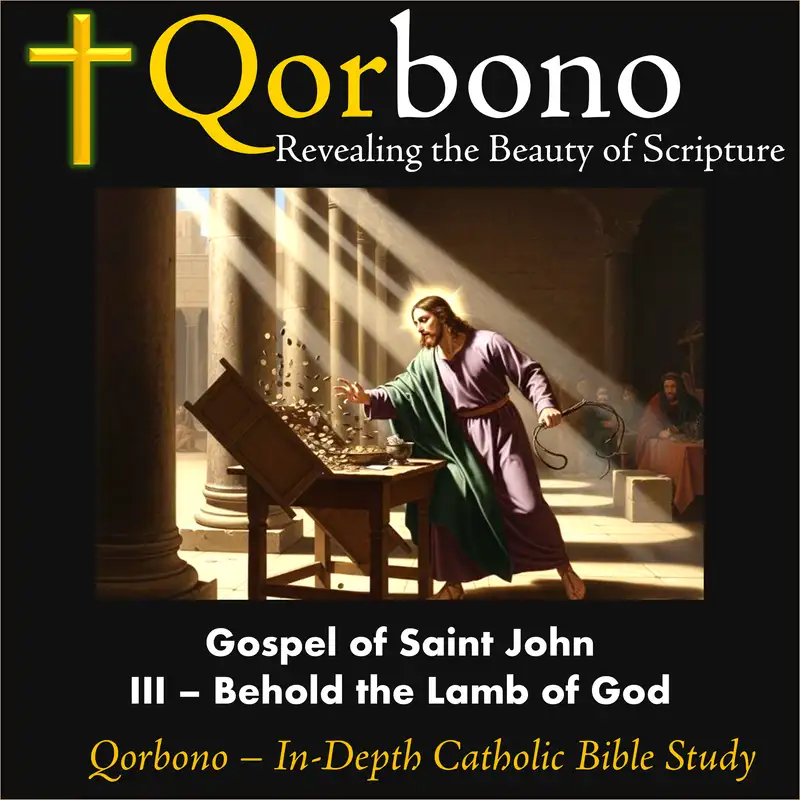
who
were
selling
oxen
and
sheep
and
pigeons
and
the
money
changes.
You
know
the
text.
You
know
exactly
here.
Here's
a
map of
the
temple.
The
gray area
out here,
the whole
gray area
is the
court of
the
Gentiles.
Then
inside you
have the
court of
women,
court of
Israel,
and the
holy,
which is
the
temple.
And inside
the holy
you have
the holy
of holies.
If you're
a Jewish
woman,
if you're
an
Israelite
in good
standing,
you don't
care about
us going
outside.
You can
go into
the
court of
women or
the
court of
Israel.
That's
where you're
going to
worship.
So this
larger part
is for
the court
of the
Gentile.
Now,
in here,
Amos,
the high
priest,
set up
the royal
stoa,
the house
of trade.
That's
where the
location of
money changers
and animal
sellers was
located.
He set
it up
here.
It used
to be
where?
An
amount
of
olives.
It used
to be
there.
That's
where you
would
go,
buy
whatever
you need
to buy
and bring
it to
the
temple.
He
moved
it
there
because
it's
more
convenient.
He
can
make
a
bigger
buck.
That's
what it
would
look
like
in
normal
days.
Then
you
would
have
the
Passover.
The
Passover,
thousands
of
people
are
there.
So
that
area
will
even
spill
over
further.
You
have
even
more
merchants.
It's
expanded.
If
you
are
Gentile,
there
is
no
way
for
you
to
pray
here
anymore.
You
can't.
The
noise,
the
racket,
the
screaming,
the
yelling,
the
whole
thing.
What
upsets
Jesus?
Remember
what I
told you.
If
he
wants
to
restore
Israel,
there
is
no
way
to
do
it
apart
from
restoring
the
whole
world.
So
now
this
stands
by
essentially
keeping
the
Gentiles
out
of
the
temple.
You're
essentially
blocking
his
mission.
By
the
way,
why
does
he
go
to
the
temple?
Not
just
to
fulfill
his
duty,
but
because
he
has
the
spirit.
And
if
you
want
to
bring
life
back
to
the
temple,
you
have
to
bring
back
the
spirit.
Therefore,
you
need
the
person
of
Jesus
in
the
temple.
You
understand?
Now,
what did
St.
John
say
about
all
of
you?
St.
Paul,
you
are
the
temple,
temple
of the
Holy
Spirit.
How can
you be
the
temple
of the
Holy
Spirit
if you
don't
have
Jesus
in you?
There
you go.
So the
whole discourse
in John
chapter 6
about the
Eucharist,
it's already
here.
It's already
at the
Jordan.
The logic
follows
straight up
from the
fact that
the
spirit
came on
Jesus
as a
person,
not in
the
tabernacle,
everything
else
follows.
We'll get
to that
later.
Anyway,
the priests
turned the
only area
accessible to
the nations
into a
livestock yard
by prioritizing
ritual commerce
over Gentile
worship.
They were
effectively
cursing the
outreach of
the covenant.
The king's
restoration,
Jesus used
the medicinal
whip to
clear the
obstruction.
He isn't
just angry
at business,
he's restoring
the right of
the weak
party,
the nations,
to have
access to
the strong
party,
God.
And then
obviously
we get
here,
sorry,
the Jews
said to
him,
what sign
have you
to show
us for
doing this?
And what
is the
answer?
Destroy
this
temple.
Now it
makes sense
why he
says this
temple,
the temple
of his
body,
because
they're
where the
spirit
lays.
This
is where
the
spirit
is.
It's a
temple.
They
don't get
it because
they don't
understand it.
And I
can sympathize
with them.
It's really
hard.
You're
expecting the
spirit to
come back
into this
building,
not on a
person,
not on a
Galilean.
that's a
huge leap
that I'm
willing to
take.
When
therefore he
was raised
from the
dead,
his
disciples
remembered
that he
had said
this,
and they
believed the
scripture and
the word
which Jesus
had spoken.
Watch.
They believed
the scripture.
What scripture?
It's all the
stuff that I
told you about.
All the way
back to
Exodus,
going through
Isaiah,
Ezekiel,
Daniel is
involved here.
All of
that is now
this beautiful
cathedral,
and the
heart of it
is Jesus.
So this
is a
concerted
attack.
This part
of the
gospel of
St.
John is
a concerted
attack by
Jesus on
the old
order.
First,
geographical
and theological.
By having
the spirit
appear at
the Jordan,
Jesus
disqualifies
the temple
mount as
the exclusive
site of
his presence.
It's
ritualistic.
By
subverting
the purification
jars,
he declares
the water
of the
love
fulfilled
by the
wine of
grace.
He's
now taking
over all
these
rituals,
declaring
them null
and replacing
them by
new ones.
Financial,
he strikes
the wallet
of the
sons of
Annas.
The
temple
has
become
a
den,
safe
house
for
robbers.
The
final
consignment,
the new
temple,
the stone
temple will
be destroyed,
the temple
of his
body will
be raised.
We
enter this
new
temple
to the
sacraments
and become
living
stones.
I hope
that you
are starting
to see
that the
purpose of
this
gospel is
to introduce
you to
this strong
party,
the king
who's come
to establish
his kingdom,
and then we're
going through this
phase where he's
basically destroying
the old
covenant one
step at a
time,
it's going to
continue,
and then he's
going to pivot
and deal with
the harder
part,
explaining to
his disciples
and apostles
the nature
of the new
kingdom.
that's the
gospel of
Saint John.
Let's
stand,
we'll finish
with a
word of
prayer,
then we'll
take a
break,
and then
we'll
come back
for
questions.
In the
name of
the Father,
and the
Son,
and the
Holy Spirit,
Amen.
Lord Jesus,
we want to
thank you,
and praise
you,
and glorify
you for
every inspiration
that you
have given
us through
your spirit.
We ask
you,
Lord,
to strengthen
us,
strengthen
our faith,
because we
are weak,
and we
depend on
you,
and to
ask us
to put
every good
thought and
inspiration
you gave
us tonight,
and put
them into
effect.
Lord,
at the end
of the day,
you know
we love
you,
and we
want to
love you
more,
help us
to do
that,
and we
ask this
through the
intercession
of our
Lady,
Mary,
most holy,
as we
pray.
Hail Mary,
full of
grace,
the Lord
is with
thee,
blessed
art thou
among
women,
blessed
is the
fruit of
thy womb,
Jesus,
Holy Mary,
Mother of
God,
pray for
us,
now and
at the
hour of
heartless.
Amen.
Saint Joseph,
Saint Michael,
all the
angels and
saints,
in the name
of the
Father,
and the
Son,
and the
Holy Spirit,
Amen.