06 - Mercy at Bethesda
[00:00:00:20 - 00:00:09:04]
Come to this sixth lecture in our study, the Gospel of St. John, and happy feast of the Annunciation.
[00:00:12:00 - 00:00:19:26]
So tonight we're going to move into Chapter 5 of the Gospel of St. John.
[00:00:21:10 - 00:01:03:06]
We are still in a book of signs, meaning we are still in this part of the gospel in which our Lord is providing people he encounters with these signs to help them come to believe who he is, and at the same time he is deploying the New Covenant. So the New Covenant doesn't happen just on Holy Thursday. The whole mission of our Lord through the three public years of ministry is precisely that, right? To deploy it, to make people understand its nature, and get them to accept it. And it is an uphill battle, as we're going to see today.
[00:01:04:25 - 00:01:36:07]
So the journey thus far. We've seen in the first chapter how St. John has shown us that the word who was with God from the beginning is now reclaiming the world he created. Geographically, when the Holy Spirit came upon Jesus in a Jordan, Jesus declared Jerusalem is no longer the sole obligatory place of worship. The location of God is now a person, not a temple.
[00:01:37:21 - 00:01:46:06]
It was declared in a implicit way at the Jordan. It will become explicit soon enough.
[00:01:47:21 - 00:02:19:21]
Liturgically, the old rites is being replaced by the new wine of the Spirit and the living temple of his body, and we're going to see that happening again today. At Cana it was implicit. You see, they really, one aspect of Cana that I did not mention is that Cana happened on the Sabbath. Our lady knew it was the Sabbath, and she asked her son to violate the Sabbath.
[00:02:20:22 - 00:03:31:00]
They have no wine. She knew what she was doing. I hope this sort of gives you a little bit more of an insight into who Mary is, right? Because unfortunately, because of the way we typically represent her, she seems very passive, but she wasn't at Cana. She asked him precisely to go against the old covenant, and he did. Financially, the cleansing of the temple signals that his church is not a commercial enterprise, but a house of prayer. Cathematically, Jesus overtakes the office of teaching, speaking with the divine authority that eclipses the Pharisees. That's when he talked to Nicodemus. And finally, from a mission standpoint, missionally, in Samaria, Jesus exploded the limited Jewish missionary office into universal harvest, proving the covenant is for all who thirst. So you see this very systematic approach that St. John follows in his gospel
[00:03:32:06 - 00:05:18:28]
as he deploys the work of our Lord. My conviction is that every scene that we're studying did take place. It was a historical situation. St. John is not sitting there and rewiring or retelling a story just to fit his conviction. He observed, learned, distilled, and through the Holy Spirit told us what Jesus did. The one bit that I would agree with the literal historical approach is that the order of the scenes may be shifted. That is possible. But every single one of those situations is presented to us with a very explicit intention, because at the end of the gospel, St. John tells us, "Our Lord did many, many other things that are not written in this book, but these were written so that you may come to believe." But "may come to believe" is not a Protestant thing. It's not me and Jesus and I believe. It is covenantal belief. The whole covenantal system is what you need to believe in. All right. Today we're going to deal with the gospel of St. John chapter 5 verse 1 through 47. I hope you guys had a minute to actually go over that chapter so you're a little bit more prepared for what we're going to be dealing with. We're going to look at the big picture first, then talk about the healing, then what are the, what's the direct consequence of that healing and how Jesus deals with it with ternatory and discourse.
[00:05:20:06 - 00:06:00:27]
Now, by now you should be accustomed to this notion that every time we read one of these chapters, it feels, it sounds incongruous, it's weird, because again, we don't have the context, we don't understand the intent and that's what makes it weird. Or we sort of shut it off and we've heard it so many times and we don't think about it. I am not going to do what I did last time, showing you how incongruous it is. I think you get that and we're going to dive straight up into it, because otherwise we can't finish in an hour and I really, I'm mindful of your time and I want to get you out of here in an hour. So here are a few thoughts to take with you.
[00:06:03:11 - 00:06:17:06]
Where in your life are you sitting by the pool for years waiting for someone else to change the circumstances instead of responding to Jesus's command to rise? How often do we just sit and do
[00:06:18:13 - 00:07:03:01]
nothing? Legalism versus life. Do we ever prioritize the rules of the faith over the restoration of the person as the authorities did in Jerusalem? We can be sometimes sticklers for rules and then forget the people. Now I'm not saying that you let go of truth in favor of the people, I'm saying some of the rules need to be contextualized and applied appropriately when you're dealing with people. And a good little exercise would be to start to read the Old Testament, specifically the Pentateuch, more covenantally to see the face of Jesus on every page.
[00:07:05:00 - 00:07:35:24]
Right. So again, if you are interested in asking questions or sending your questions during the talk, you can grab the secure code and then we'll take questions after the talk. You don't have to, you can ask them live, but just in case you'd like to do that. All right, please stand and start with the word of prayer as we always do. In the name of the father of the son of the Holy Spirit. Amen.
[00:07:36:25 - 00:08:11:18]
Come Holy Spirit, fill the hearts of your faithful and kindle in them the fire of your love. Send forth your spirit and they shall be created and you shall renew the face of the earth. O God, who by the light of the Holy Spirit did instruct the hearts of the faithful, grant that by the same Holy Spirit we may be truly wise and ever enjoy his constellations through Christ our Lord. Amen. Our Lady, seed of wisdom, Saint Joseph, Saint John,
[00:08:12:22 - 00:08:18:00]
all the angels and saints, in the name of the Father, the son of the Holy Spirit. Amen. Please be seated.
[00:08:20:14 - 00:09:14:28]
So we're going to dive straight through into chapter five, verse one through 47. However, what I'm not going to do is read them all once and come back to them. I'm assuming you had a chance to read them. So I'm skipping this section. It is here because later on for those who would like to be able to read them in totality, it'll be present in case you're listening to the talk, you'll have them there. So I'm going to just go in and give you the big picture. Every time, every scene that we see, Jesus is always at the center. You're going to notice that this is a pattern we've seen consistently. Jesus is always as a center. He's the king. He's in control. So in this case, we have the situation, we situate this by the pool of Bethesda and I'll tell you more about that pool later. It's an important element. That's where the action takes place. There is a paralytic on his mat
[00:09:16:08 - 00:10:14:07]
and in this instance, the mat is almost more important than the paralytic and we're going to deal with that. We have the Jews. Now, I'm going to reiterate what I said to you before. When you see this expression in the Gospel of Saint John, especially in the case where there's a confrontation and you hear the word "the Jews," think Democrat. Think Republican. If you hear me say, "Oh, the Democrat," do you take it to mean I'm talking about every single person in the whole world that believes in democracy? Is that what you're hearing? No. You know precisely what I'm saying. Two thousand years from now, somebody for whatever reason decided to listen to this and they heard me say the word "the Democrat," they might think, "Oh, he was talking about everybody who believed in democracy." They lost the context. Same thing if I said Republican.
[00:10:15:21 - 00:10:48:12]
Am I talking about everybody who believes in the Republic? That includes the Greeks and Plato and the rest of them? No. I'm talking about a specific group of people. That's what we're dealing with here. This is talking about in a covenantal confrontation, the leaders of Judea, the keepers of the old covenant. Always associate that word with this. Generally speaking in the scripture, the words Hebrew, Israelites, and Jew do not mean what they mean today.
[00:10:49:21 - 00:11:07:25]
A Hebrew is a son of Eber. Now Eber is six generations up from Jacob. So in particular, all Arabs are Hebrews because they descend from Ishmael. Biblically, that's how it works.
[00:11:09:00 - 00:12:54:03]
Israel, an Israelite, is one who is a descendant from Jacob, Israel. And a Jew is someone who's a descendant from Judah, the third son of Jacob. That's how you have to think when you read these words in the scripture. Do not superimpose modern meaning to them because then the whole thing is lost. Okay, we have the leaders basically there and then we have the crowd. And in the middle of all of this, we have our Lord. And what you're going to notice every single time is that Jesus does not allow them to pull him into their conversation. When he spoke to Nicodemus, he did not allow Nicodemus to pull him into his conversation. He pulled Nicodemus into what he wanted to say. When he spoke to the woman at the well, he did the same thing. He's going to do the same thing here. Why? Because he is the king and he has come to illuminate the minds of the people to offer them a chance for salvation. So he's the one who deals with them on his own terms, not the other way around. And that should be always the pattern for all of us. As sons and daughters of God, you ought to exercise this freedom of the intellect that when you are talking to someone, you reorient the conversation towards what is good for them. You do not simply follow what they're saying if they're talking nonsense or if what they're saying makes takes away from the truth. You orient the conversation. You are a child of God. The Holy Spirit will inspire you to say what you need to say. Just be present.
[00:12:57:03 - 00:13:29:27]
Jesus commands attention always. He shapes the event, not the other way around. He controls the flow, not the other way around. He's never the victim. He guides his listeners. He gives them the gift of life. He gives them the gift of truth. He requires them to choose.
[00:13:32:17 - 00:15:05:23]
And he is always the sole judge. The kingship of Jesus Christ is something that can never be underestimated. And if you want to sort of really dive into a relationship in which Jesus is seen as the king, I highly recommend you read the autobiography of Saint Teresa of Avila. She's a doctor of the church. And in her autobiography, as in all her writings, every time she speaks to Jesus, the way she addresses him is, "Thine majesty." Now in this, in today's chapter, Jesus breaks the Sabbath rest publicly and intentionally. And I'll show you how intentional he was. In Cana, he did it privately, like I told you. He turned the water into wine, but never revealed himself in doing so. Only his immediate disciples knew and believed in him. But everybody else were not aware. Here it is public. He insists requiring the man to carry his mat. That's what is in Congress. And we'll come to it in a minute. The old liturgy of the temple prepares and anticipates grace. The new liturgy bestows grace through Christ. There is a vast difference between the two.
[00:15:07:12 - 00:15:11:10]
And he elevates the conversation to Trinitarian theology. He chooses to do so.
[00:15:14:04 - 00:16:08:10]
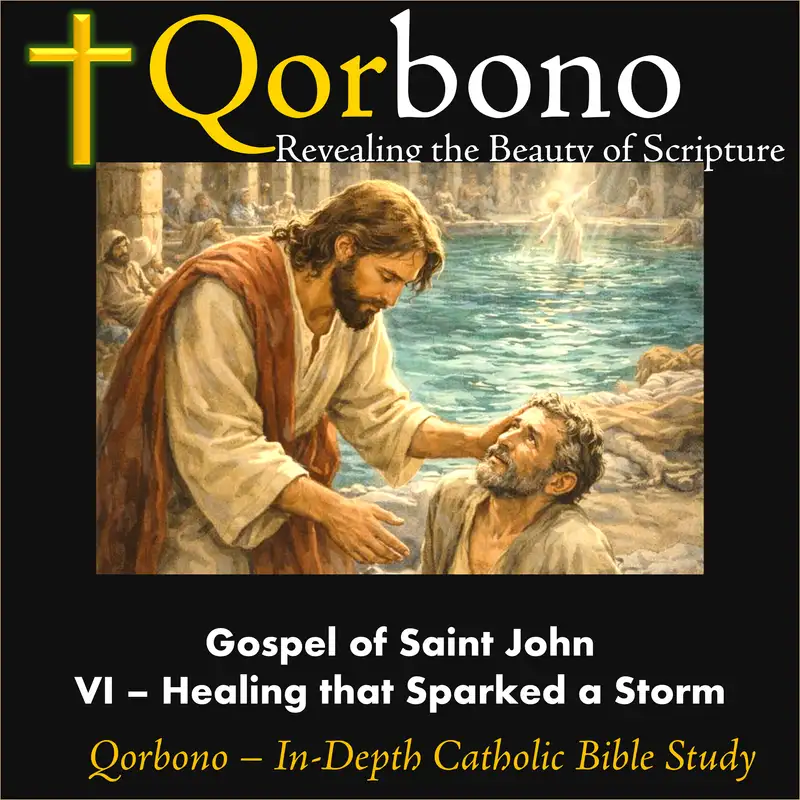
So let's go through it now. Public healing, the Gospel of Saint John chapter 5 verse 9 through 4th 1 through 9. After this, which is mean after talking to the Samaritan woman, there was a feast of the Jews and Jesus went up to Jerusalem. Now there is in Jerusalem by the sheep gate, a pool in Hebrew called Bethesda or Bethzatha, which has five porticoes. In these lay a multitude of invalids, blind, lame, paralyzed. One man was there who had been ill for 38 years. When Jesus saw him and knew that he had been lying there a long time, he said to him, "Do you want to be healed?" The sick man answered him, "Sir, I have no man to put me into the pool when the water is troubled, and when I'm going another steps down before me." Jesus said to him, "Rise, take up your palette and walk." And at once the man was healed and he took up his palette and walked.
[00:16:09:12 - 00:16:45:10]
Okay, let's unbundle this. There's so much going on here. Every detail mentioned here is necessary. The readers of St. John, the time he wrote this, would have caught in all of those. We don't have the context anymore and so we just gloss over it. That we ignore it. And the way we read it typically is after this there was a bleep and Jesus went up to Jerusalem. Now there isn't Jerusalem by the "n" a pool in Hebrew called "n" which has "n".
[00:16:47:02 - 00:16:50:20]
We just look at all these details and they don't mean nothing to us.
[00:16:51:26 - 00:16:55:04]
So we have to unbundle all that. Let's begin.
[00:17:02:09 - 00:17:37:07]
Let's look at Jesus at the time of Jerusalem, the time of Jesus. The gates. Right up here, and this is approximate, all right? Don't use that as a Google map, all right? This is just approximate. Right here is the sheep gate which leads into the temple. Here's the pool. And then the sheep gate continues right here. Here's the amount of volumes. Guess through which gate they brought Jesus in when they captured him.
[00:17:40:05 - 00:17:46:29]
The sheep gate. So that would have immediately triggered an aha moment for his readers.
[00:17:49:29 - 00:17:53:12]
Because it will echo back what St. John said, "Behold the Lamb of God." Right?
[00:17:55:03 - 00:18:05:19]
Okay, there's these echoes that St. John has and he uses a lot of irony to sort of provoke it. But you have to sort of have the layout, the topology to understand, "Oh, okay, it's that gate."
[00:18:06:24 - 00:18:52:17]
All right. Before I dive too much into it, this right here, the Feast of the Jews. Notice, St. John is deliberately vague. He doesn't tell us which feast. The Jews had a similar feast as the Catholic Church does. In fact, a lot of our feasts are calced on top of theirs. Pentecost, Pentecost, right? Hanukkah becomes Christmas. So a lot of similarities between the feasts. And there are liturgies, there are prayers and songs that they read for these feasts. Just the way we do. But in this instance, he doesn't mention which feast.
[00:18:54:22 - 00:19:01:27]
If you look at their liturgical cycle, they had a liturgical cycle that we have, ABC in the Latin, right? Right? They have also liturgical cycle.
[00:19:03:11 - 00:20:08:18]
We didn't invent those things. We just took what they had and moved on with it. Most scholars and Father of the Church, like St. Erenaeus, suggest this is likely either Passover, Pentecost or Purim, a minor feast. But given that he's working on the Sabbath and giving life, many see the connection to the giving of the law, Pentecost, or the memory of deliverance, which is Passover. But St. John is mentioning deliberately being vague about it because he's already starting to turn our attention away from the old covenant and towards the new. Everything is deliberate in what he does. Everything is deliberate. Jesus went up, this little word here. If you go from San Diego to LA, do you say I'm going up to LA or do you say I'm going to LA?
[00:20:13:00 - 00:20:14:00]
You're going to LA, right?
[00:20:18:00 - 00:20:37:07]
But the down has, you see, this is exactly it. When you say going down, you're implying a specific meaning that's not related to geography. It's not a GPS detail. Going up is because well, in one sense, Jerusalem is up on a hill and no matter which gate you follow, you have to climb.
[00:20:38:14 - 00:21:18:11]
But there is something else implied, which is Mount Zion, which is the mountain of God. So it's the ascent. Now there was in Jerusalem by the sheep gate a pool in Hebrew called Bethzatha or Bethesda, the way we say it. All right. I told you about the fact that he's not interested in the feast, but he's mostly pointing back to. So he's not interested in which feast it is, but he's interested in the person. Feast of the Jews is vague, Jesus, the person, you see, he's starting to redirect, right? He's starting to redirect towards Jesus.
[00:21:24:26 - 00:21:32:24]
And so the fact that Jesus goes for the first time up to the temple marks the arrival of the reality that the temple foreshadows.
[00:21:42:22 - 00:22:34:06]
The interesting thing about Jerusalem is that in theology, Jerusalem is the Halleah. The Halleah means, well, it can mean the one up on high, but it also is the navel of the earth, the dwelling place of the Shekinah, the presence, the glory of God. To go to Jerusalem is to ascend to the presence of God. This is the ascent. And so when he uses the up, it's also, I told you about the sort of echoing that he uses. The up here is going to be, it's echoing what Jesus told Nicodemus, and when the Son of Man will be lifted up, and it is him being lifted up on the cross and going up to heaven, right? So he's basically saying, this has started, right? This whole mission has started.
[00:22:40:04 - 00:23:05:12]
Very good. Now, the gates of Jerusalem, that's in the second temple period. I mean, it's his third temple, actually, not the second. Jerusalem had walls with several gates. And I am not going to go through all of them right now. I have them listed in the notes. You're free to look at them. But
[00:23:09:07 - 00:23:26:26]
what is important is that Bethesda is really close to the sheep gate. There's a really reason for it. And then typically, when the pilgrims would come to Jerusalem, none of them would use this sheep gate. This is really reserved for animals. They mostly use the Eastern gate, the Essen gate,
[00:23:28:18 - 00:24:18:28]
the Ephraim gate. And there are a few other ones that are not shown here. This is for garbage that was thrown in the Kidron Valley. And these are some of the most important gates that would use to come into the temple. So Jesus walked in and went around the temple area. So he was close to the temple. And that's when he saw the paralytic by the Pula Bethesda. What is the purpose of the Pula Bethesda? Its official function is the washing, washing the sacrificial animals before they're brought to the outer, to be sacrificed. So it's a pool for washing the animals.
[00:24:22:00 - 00:25:30:24]
And it also acts as a temple water supply. This pool was actually, because Jerusalem had no source of water, it's a city with cisterns. And they had a pretty sophisticated mechanism with their cisterns. In particular, this pool acted as a dual reservoir system. It was sourced in two ways, rainwater collection, and then the upper and lower pools. They would collect all the water. And they would be the northern pool, which acted as a primary storage, which was not necessarily accessible. It was mostly underground. And the southern pool, the basin, this is what they call the Pula Bethesda, where the people gathered. And there's a sluice gate, a conduit between the two pools. And what they would typically do to replenish the water in the southern pools, they would open the sluice gate, and then pressurized water would flow in, causing this troubling. These people were superstitious. They didn't know about this whole mechanical
[00:25:32:02 - 00:25:55:09]
process that was hidden from them. And they suppose that every time the water was troubled, an angel descended into the water. And so they jumped into the pool, used to wash animals, which made them unclean. So that was not a thing condoned by the authorities.
[00:25:57:25 - 00:26:24:22]
But it's an expression of desperation. People want to be healed, and there is no one to heal them. So they resort to superstition. And superstition is still very much alive among us today. So for instance, it's popular for people to read their horoscope. Now that is superstitious.
[00:26:26:14 - 00:26:29:00]
If you're doing it, stop, because it's sinful.
[00:26:31:29 - 00:27:39:01]
You're ascribing to stars and authority over your life that only God has. So don't do that. In the Middle Eastern community, superstition is also very much alive. And I'll only mention two things that people should not be doing. One is, especially with babies, they put a blue stone as a jewelry toward the evil eye. Now the evil eye is something that happens. It's rare, but it happens. An expression, it's essentially a demonic force that magnifies someone's envy. So it does happen, but the response is superstitious. Instead of relying on the Lord and the cross and grace, they're relying on a piece of stone. If you're doing this, stop doing it. It's sinful. The other thing they tend to do is drink Turkish coffee, which is like an espresso, flip it upside down, which makes marks, and then start looking into it to read the future.
[00:27:40:22 - 00:28:12:18]
So they see horses and orangutans and other stuff, and they interpret it, and that is completely superstitious. There's a lot of superstition around us. Ignore them. Now, I'll tell you about one superstition that has really penetrated deeply into Western culture, Friday the 13th. And it is really interesting because it's an inversion. It's an inversion of two of the most important moments and symbols of Catholicism. Friday
[00:28:15:03 - 00:28:34:16]
is the day the Lord were arrested, and 13 is a sign of the Pentecost, Our Lady and the Twelve Apostles. So they took those two together and inverted them and turned them into something evil. Don't participate in that. Okay, so superstition is an answer that comes from despair and
[00:28:35:24 - 00:28:43:05]
mistrust of God. So that's the pool.
[00:28:46:02 - 00:29:04:26]
The unofficial function, a shrine of mercy, the name Beth B'Testa or Beth Zatha means house of mercy. Could you imagine a pool reserved for the Washington animals now considered a house of mercy? I mean, how much more can the devil do to really trick us and then mark God?
[00:29:06:06 - 00:29:09:00]
It's no longer the temple that is house of mercy, it's the pool.
[00:29:11:07 - 00:29:21:13]
You see that? People believe that the first person into the water after a steering, the first person, talk about mercy. Ready, set, go.
[00:29:23:29 - 00:29:40:12]
After a steering likely caused by an intermittent spring or an opening of the sluice, like I said, would be healed. Now watch, Jesus doesn't come and I start lecturing them about their superstition.
[00:29:43:06 - 00:29:52:25]
Doesn't do that. Now, in the gospel, we mentioned the five portecos. Let me go back a bit.
[00:29:54:23 - 00:30:06:14]
Right here. He said by the sheep gate, a pool in Hebrew called Beth Zatha, which is house of mercy, this is irony to an extreme, which has five portecos.
[00:30:08:18 - 00:30:16:06]
But was he giving you this architectural little detail that has five portecos? Why? I mean, he's not asking you to buy it.
[00:30:18:16 - 00:30:24:08]
So you know there is a reason why he's saying that. All right.
[00:30:31:10 - 00:31:00:00]
So the gate and the pool of water is literally the backdrop for the new order. The pool. Okay. The pool, the pool has what? Still water. Yeah. It's not a river. The water is still. Now I want you for a second to imagine that you can take the pool, dig it down by about 20 feet,
[00:31:01:05 - 00:31:18:01]
drop the water, but keep the volume of the water the same. So you're basically dumping that water down by 20 feet. What do you get? What would you call that? If you have a hole, say that again.
[00:31:19:12 - 00:31:22:18]
When was the last time we were at the well?
[00:31:26:01 - 00:31:59:15]
Samaritan woman. What did he tell her about the well? Well, everybody who's thirsty will drink from this water. I'll drink again. I can give you water. Here we go. We're back into a situation where the water is static. And who's there the source of living water? Now, if somebody's reading the gospel and connecting the dots, that is in their back of the mind. This just happened with this Samaritan woman. And now it's going to happen again in Jerusalem by a body of still water because the source of living water is there.
[00:32:03:01 - 00:32:18:15]
The paralytic is surrounded by the five porticoes and has no man to help him into the pool that cannot heal him. Before him is the source of flowing water, the only man who can actually heal him.
[00:32:20:17 - 00:32:25:01]
Okay. There's something else going on here. Let me go back to the text.
[00:32:30:22 - 00:32:37:06]
One man was there who had been ill for 38 years. Five porticoes, 38 years.
[00:32:38:26 - 00:32:42:27]
What does he mention? 38 years. What does he round it up?
[00:32:46:09 - 00:33:03:01]
Okay. Five porticoes, five, the number five represents what? I can't hear. No, five, no, no, no, Old Testament, Old Testament. Thank you. There are five levels of red. No, there's something in the Old Testament where five is important. It's the,
[00:33:05:03 - 00:33:10:26]
that's it. The Torah, the law. Five is the law surrounded by the law.
[00:33:13:05 - 00:33:25:09]
The paralytic is surrounded by the law and he's been paralyzed for 38 years. Let me ask this question. How many years of wandering did Israel spend in the desert?
[00:33:27:25 - 00:33:34:00]
40. 40 is rounding up if you actually compute the numbers 38.
[00:33:38:00 - 00:33:43:23]
Israel paralyzed, wandering in the desert surrounded by the law.
[00:33:45:12 - 00:34:57:23]
Now you understand how the text comes alive because the people he's writing to knew all that stuff. He didn't have to explain. That's why he doesn't explain it because he knows, they know. And if you start to explain, they'll stop reading because it becomes boring. So let's reread that. Feast of the Jews, Jesus went up. So Jesus as in his person is overtaking the feast. He went up as an echo to the going up to heaven. By the sheep gates, the keep they're going to lead him through and it's the gate of sacrifice. There is this pool of mercy, which is completely ironical because it cannot provide any mercy surrounded by the law where all the people who are lame, blind, paralyzed. So what are when Jesus heals these people, we call them signs. What is he indicating? Who's lame? Who's blind? Who's paralyzed? Israel, who had been ill for 38 years. The wandering in the desert. That's what they are. When Jesus saw him and knew that he had been lying there a long time, he said to him, here we go back again, an athenial moment. Do you want to be healed?
[00:34:59:12 - 00:35:15:27]
Now I want, I want you to put yourself in shoes. We didn't have shoes, but anyway, of the paralytic. You've been lying there for 38 years and you can't get into the pool because no one gets you there.
[00:35:17:00 - 00:35:21:09]
And this guy comes and says, do you want to be healed? How would you feel about that question?
[00:35:22:16 - 00:35:37:01]
Because I don't have the temperament of that paralytic because I would say, no, thank you very much. I really enjoy eating the dust from the shoes of people walking by for 38 years. Like, what do you think? So why is Jesus asking this question? To torture the guy?
[00:35:40:06 - 00:35:43:16]
Fundamentally, when Jesus asked this question, do you want to be healed?
[00:35:47:12 - 00:36:02:00]
He's asking the paralytic, do you know what you want? Do you know what you want? Do you know what you want? That question he's asking all of us, do you know what you want?
[00:36:05:07 - 00:36:14:12]
Now, the reason why this question is hard to answer is because
[00:36:15:29 - 00:36:21:00]
of our systematic and consistent ignorance of original sin.
[00:36:24:27 - 00:36:51:25]
In the third century, a monk from England named Pelagius went to Rome and saw the state of the clergy, which was horrible. I mean, the clergy that we have today are saints compared to what they had in the third century in Rome. It was horrible, deplorable. And then he concluded that if you want to be saved, you have to try hard. Or like a modern company said it, just do it.
[00:36:55:01 - 00:36:57:18]
He effectively denied original sin.
[00:37:00:09 - 00:37:08:05]
And that denial of original sin took about 600 years to kill, but it's very much alive today.
[00:37:10:18 - 00:37:31:29]
Very much alive. Original sin is a sin that we don't commit, we inherit. We call it concupiscence. We call it, the church calls it concupiscence. That word talks about the senses. Here's the key thing I want you to understand about the nature of original sin. It is not rational.
[00:37:33:27 - 00:39:25:12]
It is not something you can reason with or talk to. It is irrational. And it's inside of each one of us. So because we tend to be Pelagians, we think, I am sick. I'm going to pray. God is good. He will heal me. Linear, simple, sensible. I mean, it makes sense. And we're Pelagians. We're ignoring original sin. We ignore how that affects us. We don't even understand how that affects us because we don't spend time thinking about how it affects us. Half of my day, what I'm thinking about the spiritual things is spending time thinking about original sin. Because if I don't understand original sin in my life, how am I supposed to answer this question? When Jesus comes to me, what do you want? People think that if I have a child and I speak to the child kindly and I teach the child good manners, I'm going to end up with a good person. They're Pelagian. They ignore original sin. Here's the deal. Nothing can penetrate original sin. Nothing you do or I do can penetrate original sin. Nothing. Only grace. So if you meditate on original sin, you're meditating on the need you have for grace. And then you start to ask for what you really need. Grace.
[00:39:28:23 - 00:39:33:13]
Now, do you want to be healed? The man doesn't answer the question. He simply explains
[00:39:34:18 - 00:40:17:18]
what happens. Again, Jesus ignores all that. Doesn't get into it. Doesn't victimize the guy. Doesn't say, "Oh, poor you. I'm so sorry." And he says to him, "Nasto, there is a sort of a reasonable part and there is an unreasonable part in what Jesus says. Rise. Completely reasonable. We would expect that. Rise. That would be enough, right? He healed him. Rise. Done. The incongruous thing is this. Take up your palette. Jesus is going to have said, "Rise and walk." Miracle done. Check. Move on.
[00:40:20:16 - 00:40:24:22]
Take up your palette. Jesus is concerned about the environment.
[00:40:26:11 - 00:41:08:05]
He doesn't want the guy to leave the palette behind. No, you're not allowed to carry a palette on the Sabbath. And I'm going to get in that in a minute. So it almost, so you understand now, this sign, not miracle. We don't call them miracles in the gospel because they're all signs of Jesus' divinity. They're there so you believe. Because really think about miracle. Think about Lazarus. If I were Lazarus, I would be miffed. I died once. And you know what? It's not fun.
[00:41:09:27 - 00:41:18:19]
Now he brought me back. Guess what I'm gonna have to do again? I'm gonna have to die again. How many of you would like to go through this twice? Raise your hand.
[00:41:21:23 - 00:41:41:14]
You understand? He didn't do it for that purpose. It's a sign. This one place where you have still water, where no one can actually be truly healed. It's unclean, filled with superstitious people. He finds this man who's been laying down for 38 years and he heals them for the purpose of witness.
[00:41:44:09 - 00:43:15:20]
So now what did he do? He just lit up a liturgical fuse by telling him, "Let's understand that. A man is healed, the Sabbath is broken, confrontation begins, and the conflict will escalate. Now that day was the Sabbath. So the Jews said to the man who was cured, "It is the Sabbath. It is not lawful for you to carry your pallet." But he answered them, "The man who healed me said to me, "Take your pallet and walk." They asked him, "Who is the man who said to you, take up your pallet and walk." Now the man who had been healed did not know who it was, for Jesus had withdrawn, as there was a crowd in the place. Afterward, Jesus found him in the temple and said to him, "See you are well. Sin no more, then nothing worse befall you." The man went away and told the Jews that it was Jesus who had healed him. And this was why the Jews persecuted Jesus, because he did this on the Sabbath. But Jesus answered them, "My father is working still and I'm working." This was why the Jews sought all the more to kill him, because he not only broke the Sabbath, but also called God his father, making himself equal with God. All right, that's the confrontation right there. The Jews do not ask, "How are you walking, but why are you carrying your mat?" The rule is from Jeremiah 1721, which forbade carrying a burden out of one's house on the Sabbath. The rabbis had expanded this to 39 categories of work.
[00:43:18:24 - 00:43:27:26]
Jesus's intent by telling the man to carry the mat, Jesus is demonstrating that the restoration of the man is the true meaning of the Sabbath. The Sabbath was made for man to bring him back to God.
[00:43:29:18 - 00:43:51:12]
But they begin to accuse him, to persecute him, because he did these things on the Sabbath. Now, we're going to walk into something that is very important, maybe the most important thing in this lecture. Why were the Jews alarmed? I'm going to talk about this in two ways. The first one, there is, we're living in a time with the rise of anti-Semitism.
[00:43:54:02 - 00:44:07:25]
Hatred of any group, because they're a group, is contrary to God's will. Let me put it this way, if you hate a group, whatever the group is, you won't make it to heaven.
[00:44:09:06 - 00:44:19:21]
Okay? But hatred of the Jews is particularly pernicious. The reason is because
[00:44:21:10 - 00:44:37:25]
when you read this text that we just read here, and you see this, so the Jews, if you have hatred of the Jews in your heart, you're not going to put yourself in their shoes.
[00:44:38:27 - 00:44:44:07]
To you, these people are evil, Jesus is good, we're done. And when you do that,
[00:44:47:20 - 00:45:39:02]
by not understanding what the reason and why they arrived at that conclusion, but not really understanding the struggles of what they were dealing with, you don't understand what Jesus is up to. And if you don't understand what Jesus is up to in that case, you will not understand what Jesus is up to in your own life. So effectively, the hatred of the Jews closes off your understanding of how Jesus is operating in your life. Because you can't get into this. My point is this, I want to show you that we would side with the Jews, not with Jesus. They're not just a bunch of evil people doing evil thing. There's something profoundly at stake there
[00:45:41:08 - 00:46:23:05]
that Jesus is completely destroying. And it's a really hard thing. I want you to appreciate that because then you will start to appreciate what Jesus is doing in your life. First, who are the Jews? Who are the leaders, the Sadducees, the Scribes, the Pharisees? They're the protectors of the Covenant. There is a burden of history. So let's go to this in some detail. These people aren't evil for the sake of just being evil. They are covenantal protectors for nearly 1500 years
[00:46:24:14 - 00:47:22:20]
since Moses. So 1500 years have come and gone since Moses. The Sabbath was the sign of the Covenant. When Israel broke the Sabbath in the past, God allowed the Babylonians to destroy the temple and exile the people. There are dire consequences to breaking the Covenant. They've seen it over and over. David broke the Covenant with Bathsheba. What was the verdict from God? The child will die. He broke the Covenant again when he was going to decide there was no levy taxes. Nathan came with him with three choices. He picked what's considered to be the least terrible of the three and 70 000 people died. Breaking the Covenant has dire consequences. They know that. Here's this man breaking the Covenant. How would they react?
[00:47:24:05 - 00:47:37:22]
The law said do not work. Okay, do not work on the Sabbath. But what does that mean? Practically speaking, what does that mean? Where do you draw the line? You can't go to the bathroom?
[00:47:40:03 - 00:48:30:07]
Well obviously not because you explode. So okay, but what is it? How can you tell that you're actually not breaking the Covenant? So what did they do? They went back to the construction of the Tabernacle and looked at all the activities that were done to build the Tabernacle. They codified them and they're standing here for you and they said these things you shall not do on the Sabbath. You know what? It's reasonable. They helped people gain clarity about what they're supposed to do so they don't break the Covenant because they took the blessings and the curses of the Covenant very seriously. So I'm not going to read all of them to you. They're all here. The only one I'm really going to mention is this one, the 39. Carrying from one domain to another.
[00:48:32:11 - 00:48:48:03]
Carrying from one domain to another. That was considered work on the Sabbath. So if you put yourself in their shoes and you start to think about I am here, God said don't work on the Sabbath. What does that mean? You're going to codify. You're going to do exactly what they did.
[00:48:51:03 - 00:48:53:03]
Because there is no other choice. Otherwise you're not taking God seriously.
[00:48:56:24 - 00:49:30:11]
So they see this man breaking the Covenant. He's breaking the Covenant. They know if he breaks the Covenant the curses will be triggered and the entire people will be in danger. And they can't have that because they care about their people. Now do they care about other things? Do they care about their positions? Are they full of themselves? Absolutely. But it's not just that. There is a fundamental element that is respectable.
[00:49:33:08 - 00:49:37:07]
All right. Let me paint it to you in a different way so you can feel it better.
[00:49:40:03 - 00:50:46:25]
Today a similar sin, because obviously it's a sin, because they're not recognizing God. Simple as that. That's the real problem. It's not all this is a problem. The problem is they're not recognizing God. We're going to get to that in a minute. A very respectable sin today is contraception. If you're going to accept, you're being reasonable. You want control of the number of kids you're going to have. So you can actually have a family and have good lives and save for their education. Everything you're doing is respectable. It's just a respectable thing. And here, Pope Paul 6 comes in and tells you it's a great matter. And if you do it knowingly, you're committing a mortal sin. Now the people who are contraceptives aren't evil people. They're not doing it to destroy the world. They're doing it because they think they're doing the best they can. They have good intent.
[00:50:51:03 - 00:51:11:06]
They're like the Jews here. So Jesus comes across and says, "Stop, contraceptives." A lot of people are going to open their doors to Him. They're going to welcome Him. They're going to say, "You're not reasonable." And here's the bottom line. God is not reasonable.
[00:51:14:12 - 00:51:34:22]
If you can grasp onto this and accept it and combine it with original sin, you'll have a lot less pain in your heart when things don't go the way you expect them to. God is not reasonable. You have a kid, three years old, falls in the pool, drowns. How is God reasonable?
[00:51:38:23 - 00:52:10:19]
The war is going on. How is God reasonable? God is not reasonable. Why? Because original sin is not reasonable. And we ignore it. So we reduce God to our linear beautiful equation, but He knows what we need and He doesn't play because He's in control. We get upset with Him. There's a domino effect therefore of disobedience for them. The precedent, if a man can carry a mat, then carrying a mat is no longer a violation. If that's not a violation,
[00:52:11:20 - 00:52:32:12]
why not the other melekot, the other categories? Why can't you sow, plow, or reap, or sheaf make, or thresh, or winnow, or the rest of it? And by the way, do you think the people back then were a lot better than the Catholics today? If you told most Catholics today, you don't have to come to this mess on Sunday. How many do you think will show up on Sunday?
[00:52:33:19 - 00:52:42:25]
The people are looking for every single way to sort of, you know, finagle their way through it. You're forcing me not to work one day. I'm losing money.
[00:52:44:28 - 00:52:58:06]
You understand? The pressure was just as high for them as it is for us. Nothing different. So if you allow that, why can't you allow the other thing? Somebody else will say, "Oh, well, if you did this, I can do that." You see how the domino effect, everything breaks?
[00:53:01:06 - 00:53:07:18]
There's an erosion of identity. If the Sabbath is no longer distinct, Israel loses its set-apart status, they become a distinguishable from the Greeks and the Romans.
[00:53:10:15 - 00:53:17:29]
And finally, the covenantal curses. Without the Sabbath, the covenant is void. History taught them that a void covenant leads to the edge of a sword and the smoke of a burning Jerusalem.
[00:53:19:06 - 00:53:45:09]
That's what they're dealing with. They're also dealing with their own ego, their envy, and the rest of it. So it's a combo. Jesus' problem with them isn't all that. The main problem is I healed him. Isaiah prophesied about me healing. I just did it. They can't let go.
[00:53:47:14 - 00:53:49:15]
They cannot let go. Well, there's a hardness of heart.
[00:53:51:04 - 00:55:46:02]
I can explain to somebody until I'm blue in the face why contraception is sinful, not enough. They're not gonna let go. They don't let go. There's hardness of heart. It sets. Why? Because of concupiscence. You're not dealing with just a reasonable person. You're dealing with what is inside of them that they themselves don't know about. So caring from one domain to another. This is a technical thing, but just so you can understand it. In the rabbinic law, in the halakha, the term domain refers to the legal status of a specific physical space in the context of the Sabbath. To prevent work, the rabbis identified four types of domain. So the private domain, the public domain, and basically the 39th category forbade work specifically, forbidding work specifically, prohibits carrying an object from a private domain to a public domain. If you carry an object within the private domain within your house, it's not considered work. If you cross that threshold, it's considered work. And likewise, if you carry an object from a public domain to a private domain, it's considered work. Then carrying an object for more than four cubits, six feet, within a public domain is considered work. Now, we can laugh about those rules, but at least we can appreciate that they try to provide clarity for people so people would know what they're supposed to do and not do. So now, in the case of the paralenic, why did it matter at Bethesda? Because the pool with its five particles was distinct enclosure and therefore considered as a semi-private domain. So this man carried an object from a private domain to the public domain. He broke the 39th interdict and therefore he's breaking the 7th. That's what's going on.
[00:55:50:21 - 00:55:54:14]
So they were worried that he carried an object from one physical domain to another
[00:55:56:13 - 00:56:34:13]
while our Lord was carrying the man from the domain of death and paralysis into the domain of life and grace. And they just can't. And if you can think and say, "Well, that doesn't make any sense. It's logical. Why can't I see it?" He raised the man. Why can't I see it? Because, like I said, concupiscence is not rational. You tell people who are contraception, "God," so why is contraception really a sin? You see, not all sins are equal, right? So for instance, and you know what I mean, if I steal five bucks from a millionaire,
[00:56:35:29 - 00:57:10:20]
you immediately know that's not the same gravity that if I steal five bucks from a little girl who spent a month saving the five bucks. You know right away something is not the same. Why? Because sin is proportional to the innocence of the victim. That's how it is. So abortion is a graver sin than murder. It's proportional to the innocence of the victim. Well, okay, in that case with contraception, who's the victim? I'm not hurting anyone, right? Actually, you are.
[00:57:12:19 - 00:58:33:20]
And the one you're sinning against is God. It's a direct sin against the authority of God. And his innocence is infinite. That is why it's such a big deal. Now you can explain that. You can tell people if you are a Catholic, you should trust God. A child is always a blessing. If he's going to give you a child, it's a blessing. And no, it doesn't mean you have to have 12 children. It simply means that before the man and the woman come together, they need to pray and ask the Lord, "Is this the right time?" And if the woman is fertile and they have a sense it's not the right time, they abstain. So it teaches responsibility. It teaches respect, trust in God, and that's the grace flows into their house. You can explain all that. And it doesn't mean people are going to go, "Oh, okay, got it. Let me sign up." Because of concupiscence. That's what you're dealing with. But Jesus did the transfer that is so much more radical, they can't see it. He moved the man from the domain of the old order to the domain of the new order. The Pharisee saw a man breaking a boundary. Jesus saw a man crossing the threshold into the kingdom of God because of the sign. That's the difference. And they just can't see it. It's a tragic irony. And so often we're in the same place. So often we ourselves are in the same exact situation. We don't see it.
[00:58:37:25 - 00:58:48:06]
How does thinking of the mass as healing and transformation change the way you prepare for Sunday? Because this is all done in the context of the liturgy, you understand? Sabbath is liturgy.
[00:58:49:06 - 00:59:16:06]
What is the purpose of mass? It's to heal you. I mean, the fruit of mass is to heal you. The purpose of mass is for us to give God the glory. Like when people tell me, "Well, I don't get anything going to mass." My typical answer is, "Well, that's because you're not supposed to get anything. You're supposed to go give God the glory. It's your duty for it did for you." Now, God in return as a fruit heals you. That's what He's showing us with the sign.
[00:59:18:06 - 00:59:45:21]
But if you knew that, if you knew that's what you're supposed to do, will that change your approach to mass? You know, I'm sure there are people who have good reasons for showing up late. It happens all the time. Things happen. Life is complicated. Nevertheless, if tomorrow, Father Soroki was to say, "Next Sunday, right at the altar, there's going to be $5 million in cash. First come, first serve." How many people will show up late?
[00:59:50:00 - 01:00:04:22]
There you go. And yet, behind the altar, there's something so much more worth than $5 million. But why can't we? Because it concupuses. It blocks us. It doesn't want to. It rebels. It refuses.
[01:00:11:06 - 01:00:41:15]
Jesus moved the man from the domain of death to the domain of grace. In what area of your life is Jesus asking you to cross the threshold today? He's coming to you. He's going to cause you to be uncomfortable. I would say this to you, be very attentive when somebody you're talking to makes you uncomfortable. Most likely, Jesus is talking to you. You have a choice. You can shun them away, reject, or do what the man said, pick up your mat, and walk.
[01:00:44:18 - 01:01:26:07]
Moses' accusation to read the Bible to find evidence for our own opinions or to find the person of Jesus. Who are we looking for? "Lord Jesus, son of the living God, you are the Lord of the Sabbath. Transform us by your word that being healed of our paralysis, we may reflect the image of your father to a world in need of your rest." Amen. Now, I'm going to stop here because it's, I told you, it's an hour. I'm not going to be able to go through the rest of the lecture, but I will tell you very briefly that when they confront him, Jesus doesn't even respond and start talking about Trinitarian theology. That shows you how much he has them in high regards
[01:01:27:10 - 01:01:43:24]
because Jesus illuminates the minds of the people he's talking to. He brings them always to the truth. Faith is the illumination of the intellect. He brings them to the truth. To the Samaritan woman, to Nicodemus, and to Nathaniel, he did not talk Trinitarian theology, but to the Jews he does.
[01:01:44:28 - 01:01:50:27]
So he holds them in the highest respect and he gives them the best gift. Unfortunately,
[01:01:52:00 - 01:02:14:16]
because of their envy, they refuse to listen. The sign is clear, he healed him, but they can't listen and they reject it. And because they reject it, and in a text is very clear, he gives them a choice. You either come on board and you'll be blessed. If you don't, you won't be blessed, you'll be cursed.
[01:02:15:25 - 01:02:18:28]
And that's the choice that is in front of every one of us every single day.
[01:02:21:01 - 01:02:27:23]
So as we enter into Holy Week and we go through the Passion of the Lord,
[01:02:29:12 - 01:02:54:20]
it might be a good idea to really reflect and take time to sit down and think about all these areas in my life that I can't control, that maybe I don't like or people around me don't like. And maybe sit down and try to write them down. I'm impatient, I'm going to sit too quickly.
[01:02:56:21 - 01:03:16:23]
I don't listen, I talk too much, whatever the case may be, just write them down. Because if you write them down, you're now starting to poke at the effect of concupiscence in you. Then you can take this knowing that you need the grace of God to mass.
[01:03:19:07 - 01:03:35:12]
And I say to the Lord, here I am, that's me. I can't do anything because I'm the paralytic, I'm the lame, I'm the blind, I'm the deaf, I can't fix myself, I can't take care of this. You need to do that for me and see the transformation it brings into your life.
[01:03:36:21 - 01:03:39:20]
Because at the end of the day, he is the God of life and God of mercy.